The last truck in line was a dusty silver sedan with Jefferson County plates, and I knew it before the door opened.
My daughter Carol stepped out in jeans and work boots, her hair tied back, with a toolbox in one hand and a look on her face I’d seen on her mother a hundred times, the look of a woman who had made up her mind.
“Daddy,” she said.
“Carol.” My voice came out rough. “I thought you were in Louisville.”
“Dennis called me at midnight. I drove down in the dark.” She dropped the toolbox on the porch and wrapped her arms around me, and I held onto her like I was the one who needed holding. “I’m so sorry. I came at you like you were a problem to solve. I never stopped to ask what you were really protecting.”
“You were scared for me, honey.”
“I was. But I should have been scared with you instead of at you.”
That was the whole apology, and it was enough.
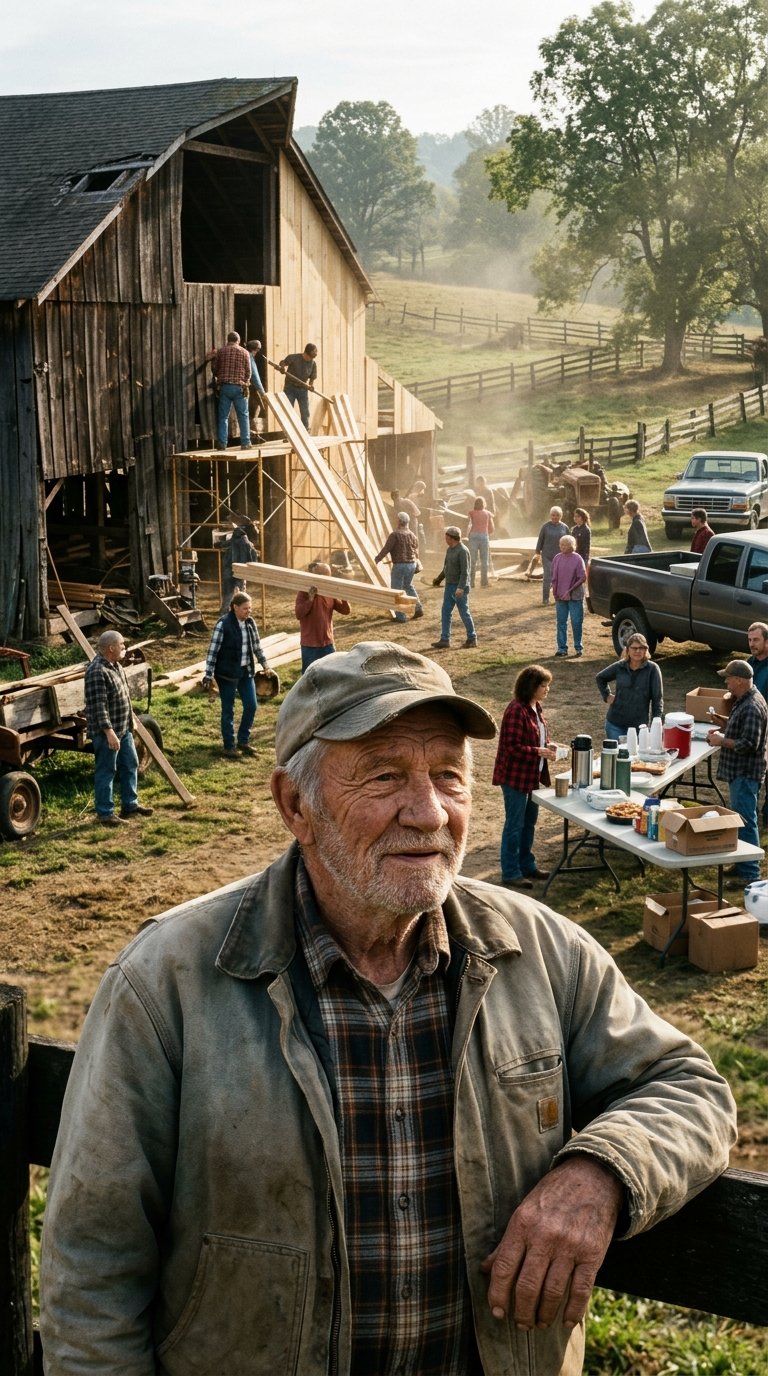
By eight o’clock, the place looked like a county fair with a purpose. Eli had divided the crew into teams. One group cleared the debris with chainsaws and tractors borrowed from three different farms. Another sorted salvageable lumber from splintered. The women set up long folding tables under the oak and covered them with fried chicken, biscuits, ham, green beans, and pies enough to feed an army. Teenagers hauled hay bales back into neat stacks. Someone found my daddy’s old hand plane in the wreckage, miraculously unbroken, and handed it to me without a word.
I carried it in my pocket all day.
Around noon, the man with the white envelope came to find me again. He was Gerald Pruitt, the widow’s grandson, now president of the Farmers & Merchants Bank in Russellville.
“Mr. Whitaker,” he said, “could I have a word?”
We sat on the tailgate of a truck, and he opened the envelope. Inside was a cashier’s check for $14,300, and a folder of papers.
“The collection came to about nine thousand,” he said. “The rest is from folks who couldn’t be here but wanted to help. Mr. Whitaker, I also took the liberty of looking into your medical debt.”
I stiffened. “That’s private.”
“Yes, sir. But the hospital has a charity care program for seniors, and you qualify. Most of those bills can be forgiven or cut to a fraction. Nobody ever told you.” He slid the folder toward me. “My grandmother taught me that you never let a man like you go without. My office has already filed the paperwork.”
“I don’t take charity,” I said, out of habit.
Gerald smiled. “Mr. Whitaker, with respect, you’ve handed out more charity in this county than the church has. Let somebody hand you a little.”
I looked at Carol, who was standing nearby. She gave me a small nod.
I took the check.
By the end of the first week, the new barn was framed. Eli’s crew worked from sunup to sundown, and every day more people showed up. Some drove two hours. A retired carpenter named Lyle Burnside brought his own scaffolding. A group of high school kids from the FFA chapter spent their whole Saturday painting the siding red, the same shade my daddy chose in 1951.
I sat in a lawn chair near the work, supervising nothing, grinning like a fool.
On the tenth day, Dennis came by with a surprise. He’d tracked down the transmission for the tractor, a used one, and arranged for a mechanic friend to install it at cost. “Uncle Tom,” he said, kicking at the dirt, “I told you to sell. I’m glad you didn’t.”
“Why’s that?”
He looked around at the half-finished barn and the people laughing and hammering and passing water jugs. “Because I think I finally get it. It’s not just land. It’s the thing that holds everybody together.”
I put my hand on his shoulder. “That’s the smartest thing anybody in this family has said in a long while.”
The barn was finished on a Saturday in late June. At sundown, the whole crew gathered in front of it, covered in sawdust and paint, and Eli carried a long board up to the front door. On it, burned into the wood with a hot iron, were the words:
WHITAKER BARN — 1951 — REBUILT BY THE COMMUNITY, 2024
Beneath it, someone had added a line in smaller letters: “A good deed whispered is worth ten shouted.”
I read it twice and had to turn away.
Ruth had said it. Nobody else ever heard it from her but me.
“How did you know that?” I asked Carol, my voice breaking.
She smiled through her tears. “Mama told me when I was little, Daddy. She said it was your motto. I told Eli.”
That night, after everyone had gone, I walked up to the oak on the hill with Biscuit and sat beside Ruth’s stone.
“Well, honey,” I said. “We kept it.”
The wind moved through the leaves, and the dogwood by the porch, which had somehow survived the storm without losing a single branch, shook its blossoms in the dusk.
I stayed on that land for eleven more years.
Carol began driving down every weekend. She helped me manage the books, set up a payment plan for the remaining bills, and eventually moved her own family closer, to a little house in Russellville. My grandchildren spent their summers learning to drive the tractor in the same east field where I’d learned. Eli’s company took over the heavy repairs, and Gerald Pruitt’s bank refinanced everything at a rate I could actually afford. The farm turned a modest profit for the first time in years, and the cattle did better than they had in a decade.
When I finally passed, at eighty-eight, in my own bed with the window open to the pasture, the funeral drew four hundred people. The line of trucks stretched down the lane and out of sight, just like the morning after the storm.
I’d have liked that. I’d have said they were fools for the fuss.
But I’d have been grateful.
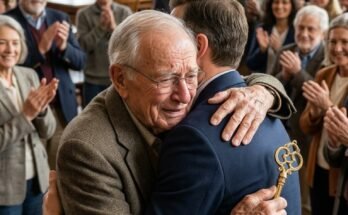
At the back of that crowd stood a young man in a freshly pressed shirt, holding his hat. He was one of the FFA kids who painted my barn red. At the end of the service, he walked up to Carol and told her he’d been accepted to the state agriculture program, and he’d be back to farm in four years.
“Mr. Whitaker taught me more in two weeks than I learned in four years of school,” he said. “He never told me a thing. He just worked, and let me watch.”
That is how a farm survives. Not through money or machines, but through someone willing to stand on the same patch of ground long enough for the whole community to grow up around them.
If you have a neighbor who quietly works hard and never asks for anything, go check on them this week. Bring a pie. Fix a fence. Be the one who whispers the good deed.
You never know whose storm is coming.