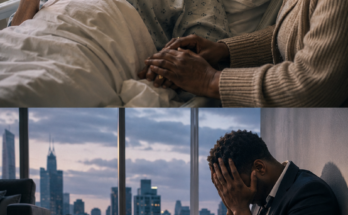
I need you to understand what twelve years of not knowing does to a person.
It doesn’t break you cleanly. A clean break you could work with — you could grieve it, name it, eventually find the edges of it. What losing a child to disappearance does is something different. It keeps you perpetually suspended between two unbearable possibilities: that he is gone, and that he is somewhere, and that the difference between those two things determines whether you are a grieving mother or a searching one. You cannot fully be either. You are both, always, simultaneously, until the not-knowing becomes the texture of your entire existence.
My son Caleb was ten years old on the Tuesday afternoon he walked out the front door of our house in a quiet suburb of Portland and did not come back.
There was no fight that morning. No warning I can identify with certainty, though I have examined that day from every angle for twelve years and will probably examine it until I die. He had seemed quieter than usual at breakfast. He had hugged me before school — which he sometimes did and sometimes didn’t — and I had kissed the top of his head and told him to have a good day.
That was the last time I touched my son for twelve years.
The search was everything you imagine and worse. Police reports filed within hours. Posters printed by morning. My voice going raw from calling his name in parks and alleys and along the creek path he liked to walk. Volunteers. Tip lines. Sleepless weeks that blurred into sleepless months. My ex-husband, Caleb’s father, flew in from Denver and we searched together in the wordless way of two people whose shared love for a child temporarily dissolved everything else between them.
Nothing.
Gary Hutton lived three houses down. He had been a peripheral presence in our neighborhood for two years before Caleb disappeared — the kind of neighbor you wave to, occasionally chat with over the fence, the kind of solid, quiet presence you never examine too closely because he gives you no reason to.
When Caleb vanished, Gary appeared. He brought food the first week. He sat with me when I couldn’t sleep, which was always. He cried with me — genuinely, or what I believed was genuinely — and when I collapsed on the kitchen floor at 2 AM one night six months into the search, it was Gary’s arms that stopped me from hitting the ground. He promised me, more than once, that he would find Caleb. That he would not stop looking.
I believed him. I held onto him. And somewhere in the long wreckage of those years, I stopped being a woman suspended between grief and hope and became, slowly, a woman who had built a life with the man who had promised to find her son.
We married four years after Caleb disappeared. I told myself this was survival, not replacement. I told myself Caleb would understand, if he was somewhere alive to understand anything.
Twelve years, one month, and nine days after Caleb walked out the front door, my doorbell rang at 8:15 on a Sunday morning.
I opened the door.
Standing on my porch was a young man of twenty-two with dark hair and familiar eyes — my eyes, my mother’s eyes, the eyes I had memorized in a school photograph I had carried in my wallet every single day for twelve years.
My knees went. I reached for the doorframe. I said his name — just his name, just Caleb — and the word came out in a sound I didn’t recognize as my own voice.
He was alive. He was standing in front of me. He was real.
I reached for him.
He didn’t hug me.
He looked past me — over my shoulder, into the hallway where Gary had appeared behind me, drawn by the sound of the door. Caleb’s eyes found Gary’s face. And the expression that moved across my son’s features was not the relief of a child coming home.
It was cold. Deliberate. The face of someone who had been waiting a very long time to be exactly here.
He looked at Gary and he said, barely above a whisper:
“I know what you did.”
What followed in the next four hours was the most devastating and most clarifying conversation of my life.
Caleb had not been taken by a stranger. He had not run away in the conventional sense — not from me, not from our home, not from his life.
He had run from Gary.
In the two years Gary had lived in our neighborhood before Caleb disappeared, he had been systematically grooming my son. Caleb, at ten, had not had the language for what was happening or the framework to understand that what Gary had been doing was criminal. What he understood was that it was wrong, that he was frightened, and that Gary had told him — directly and explicitly — that if he told his mother, she would not believe him because Gary was her friend and Caleb was just a child.
So he ran. To a cousin of his father’s in another state, a woman named Ruth who had taken him in without fully understanding the circumstances, believing it was a custody dispute. He had lived with Ruth under a different name, finished school, and spent years building toward the moment he felt strong enough and prepared enough to come back.
He had a file.
This is the part that stopped my breath entirely: Caleb, at twenty-two, working with a victims’ advocacy organization he had connected with at nineteen, had spent three years documenting everything he could remember with the help of a trauma-specialized therapist and a legal advocate. Dates. Incidents. Specific details that investigators would later confirm were verifiable.
He handed me the file on my own kitchen table, in the house I shared with the man he had fled.
I read it while Gary sat in the next room.
I will not detail what I did in the hours that followed with any drama because the truth is there was no drama in me. There was only a terrible, bone-deep stillness — the stillness of a woman who has been lied to at the most profound level possible and who understands, reading page after page, that the man who held her while she screamed her son’s name had known exactly where that son had gone and exactly why.
I called the police from the kitchen. Gary was still in the living room when they arrived. He did not run. He seemed, in those final minutes, almost relieved — the specific relief, I have come to understand, of a person who has spent years maintaining an unbearable deception.
He was arrested that afternoon. Charged with multiple counts. The investigation expanded as investigators cross-referenced Caleb’s documentation with records from that period. Gary did not make bail.
He has not been in my home since that Sunday morning.
Caleb stayed. Not immediately in my house — he needed his own space, his own pace, the ability to approach rebuilding on his own terms. But he stayed in Portland. We had dinner the following week, and the week after that. We talked for hours and then we sat in silence and both of those things were necessary.
There is guilt I carry that I will carry always — for not seeing it, for bringing Gary into the permanence of my life, for the twelve years my son spent away from me because the alternative was staying near someone dangerous and being disbelieved. He never said I should have known. That generosity undoes me regularly.
What I know is that he came back. That the eyes in that school photograph in my wallet are the same eyes that sit across from me at dinner on Thursday evenings. That he is twenty-two and careful and braver than anyone I have ever known.
He walked out that door to survive.
He came back to make sure it was finally safe.
— As told by the mother who opened the door and finally understood everything.