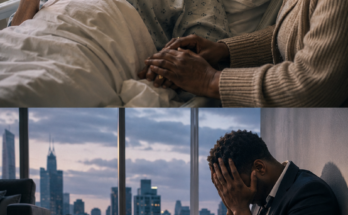
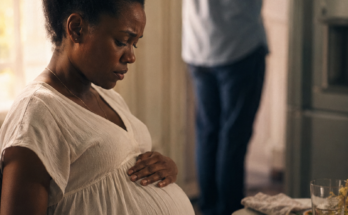
I didn’t understand silence until it became my entire reality.
The administrator had already left. The room door clicked shut softly, like the world itself was trying not to wake me from a nightmare I was already living inside. My hands were still gripping the hospital blanket, knuckles pale, trembling from something deeper than fear—something closer to collapse.
“No involvement,” I repeated under my breath.
The words didn’t feel real. They didn’t feel like language at all. Just noise shaped like betrayal.
A nurse stepped back in slowly, avoiding my eyes. That avoidance told me everything the administrator hadn’t.
“My babies,” I whispered again, more urgently now. “I need to see them.”
This time, she didn’t hesitate.
“Yes,” she said quietly. “We’ll take you.”
They moved me through the corridor in a wheelchair. The hospital lights passed overhead in steady intervals, each one like a countdown I didn’t understand. Every turn brought me closer to something I had dreamed of for nine months… and further away from the life I thought I had.
NICU doors opened with a soft mechanical hiss.
Warm air. Machines. Beeping monitors.
And then I saw them.
Three tiny lives inside separate incubators, each smaller than I had imagined possible, each fighting in their own quiet, determined way. Tubes. Wires. Tiny chests rising and falling like fragile promises.
I pressed my hand to the glass.
“I’m here,” I whispered. “I’m here. I’m here.”
One of them moved slightly, fingers curling instinctively.
And something inside me changed.
Not healed. Not fixed.
Awakened.
Because in that moment, I realized something painfully clear: while I was fighting to survive death… someone else had been signing away my life.
Two days later, I was strong enough to sit up on my own.
That was when the second truth arrived.
A woman entered my room without knocking. Expensive coat. Calm expression. Eyes that didn’t belong in a hospital—they belonged in boardrooms where decisions were made without emotion.
“I’m counsel for the Holloway Holdings trust,” she said.
Even hearing his name made my chest tighten.
She placed a folder on my bedside table.
“He left instructions.”
My stomach sank.
“What instructions?”
She opened it.
Inside were documents. Not medical. Not emotional.
Financial.
Property transfers. Account freezes. Legal separations executed with surgical precision.
And then I saw it.
A clause labeled: “Post-Separation Risk Containment Protocol.”
My breath caught.
“What is this?” I asked.
She didn’t hesitate. “It ensures that in the event of marital dissolution, no claims can be made against company assets, intellectual property, or investor holdings.”
I stared at her.
“You’re saying he planned this.”
Her silence confirmed it.
Not a reaction.
A strategy.
That night, I couldn’t sleep.
Not because of pain.
Because of memory.
Because I suddenly remembered something I had ignored for years.
Late nights when Grant thought I was asleep.
Private phone calls he ended too quickly.
Names I didn’t recognize—until one of them came back to me now like a blade cutting through fog.
Bel Knox.
The woman who had texted him during the divorce.
Is it done?
Yes.
I had thought it was just an affair.
I had been wrong.
It was coordination.
The next morning, I asked for my personal belongings.
My phone was returned. My wallet. A small bag.
Inside my wallet was a folded document I had forgotten I even carried.
A medical consent form I had signed weeks before delivery—when everything was still “normal,” when trust still existed between us.
Grant had insisted on it.
“Just a precaution,” he had said.
But the signature on that form… was the key.
Because buried in its language was something no one had explained to me properly:
Full spousal medical authority transfer in cases of incapacitation.
He hadn’t just signed away our marriage.
He had legally positioned himself as the gatekeeper of my existence.
Until he didn’t need it anymore.
On the fifth day, I received my discharge notice.
No celebration. No reassurance. Just paperwork.
No insurance coverage.
No shared assets.
No emergency contact listed.
Just me.
And three babies in NICU survival pods.
A nurse walked me out quietly.
Before I left, she leaned closer.
“There’s something you should know,” she said.
I looked at her.
Her voice dropped even lower.
“The CEO never came once. Not for updates. Not for authorization. Not even for the babies.”
I already knew.
But hearing it confirmed something final inside me.
He hadn’t left in anger.
He hadn’t left in panic.
He had erased.
That night, I made my first real decision since waking up.
I called a number I found in the back of an old medical file.
A name I barely remembered agreeing to.
A corporate investigator.
When he answered, I said only one thing:
“I need everything you can find on Grant Holloway. Not as my husband. As a system.”
A pause.
Then: “You sure?”
I looked at the incubator photos on my phone.
My children.
My reason.
“Yes,” I said. “Because I think he didn’t just leave me.”
I swallowed.
“I think he built his empire on people who were never supposed to wake up afterward.”
Three weeks later, the first breach appeared.
Hidden subsidiaries.
Unreported investor channels.
A secondary trust registered under a shell entity tied directly to Bel Knox.
And then the real discovery:
My name had been removed not just from our marriage—
but from internal corporate records months before I ever went into labor.
Meaning one thing:
The divorce wasn’t the ending.
It was the cover.
The investigator called me late at night.
“You need to see this,” he said.
A pause.
Then he added:
“He didn’t just erase you.”
“He replaced you.”
I looked out the hospital window at the city lights.
Somewhere in that skyline, Grant Holloway was still a name people respected.
Still a man people feared.
Still a CEO people called visionary.
But now I understood something he never expected:
You can sign papers to erase a wife.
You can freeze accounts, rewrite records, and bury truth in legal language.
But you cannot erase the consequences of a woman who survives what was meant to destroy her.
Especially when she now knows where to look.
And who helped him do it.
Because my story didn’t end with divorce papers.
It started there.
And this time…
I was the one holding the pen.