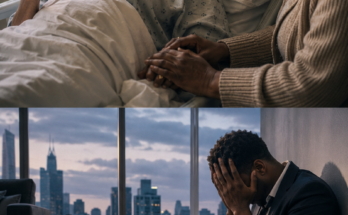
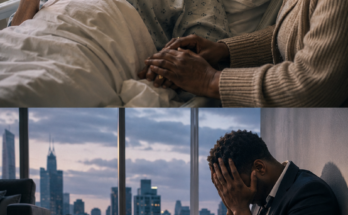
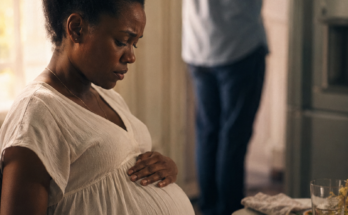
I built a million-dollar company in twelve months on the assumption that I understood betrayal.
I had told myself the story so many times it had calcified into fact: Nora left because she couldn’t handle poverty. Nora left because she wanted security I couldn’t provide. Nora chose money over love, and that was the cleanest, most bearable version of events, so I kept it. I built my empire partly in spite of her — or the version of her I had constructed to make her absence survivable.
I was wrong about everything.
The woman sitting on that cold stone bench in the October park, shivering inside a jacket too thin for the weather, holding two four-month-old infants against her chest — she had not left me. She had been removed. Purchased out of my life with a $200,000 check written by my mother the same week Nora told her she was pregnant with twins.
My mother looked at Nora’s pregnancy and saw a complication. Those were her exact words, delivered without flinching, her elegant composure only cracking when I pushed hard enough that the facade couldn’t hold.
“She and the pregnancy were just a complication. I only wanted to protect your future.”
I looked at my children — blue eyes, my eyes, four months of a life I had missed entirely — and felt something restructure permanently inside me. Not rage. Not yet. Something colder and more precise than rage.
I drove them to the lake cabin that night. It was the only property my mother didn’t know about — purchased quietly, in cash, through an LLC my attorney had set up early in the company’s formation. I had bought it as an investment. It became a sanctuary.
It was there, with the babies finally warm and sleeping, that Nora told me the rest.
After the $200,000 — which she had refused, twice, before my mother’s intermediaries made clear that refusal had consequences — Nora had been systematically dismantled. Her apartment lease was terminated through pressure on her landlord. Her job offer, the communications position she had worked toward for two years, was quietly rescinded after a phone call she only pieced together later. She moved through three homeless shelters in four months, pregnant and then postpartum, keeping the twins alive on determination and the kindness of strangers.
And through all of it, a black SUV followed her.
At the hospital where the twins were born, a woman she didn’t recognize visited twice — calm, professional, clipboard in hand — presenting paperwork she described as “private adoption arrangements for mothers in difficult circumstances.” She pressured. She returned. She implied that Nora’s situation — homeless, unsupported, the father apparently unaware and unreachable — made her an unlikely candidate to retain custody in any formal proceeding.
Nora refused to sign. Each time. She told me this quietly, not as heroism, just as fact. She had refused because they were mine. Ours. Regardless of everything else, she had refused.
Then my phone buzzed.
The photo showed my mother standing outside a hospital nursery, smiling, beside the same woman Nora had described. The second image was a contract — Full Surrender of Parental Rights, Biological Father — and at the bottom, in my handwriting so precise it stopped my breath, was my signature.
I had never signed that document. I had never seen that document.
I was still processing this when the headlights swept across the window.
The black SUV in the driveway. Two men in dark coats. My mother standing between them in the porch light, folder in hand, phone message reading:
“Open the door, Mason. They’ve come to collect the merchandise.”
Merchandise. She used that word about her own grandchildren.
I did not open the door.
What happened in the following seventy-two hours was the most important thing I have ever done and the most illegal-adjacent sequence of events I hope to never repeat.
I called my attorney first — not my corporate attorney, but the criminal defense lawyer I had retained two years earlier during a contract dispute that briefly involved fraud allegations. He answered at midnight without complaint, which is what you pay for. I described the forged signature, the SUV, the adoption paperwork, the woman at the hospital.
He told me to photograph everything Nora could document. Every shelter intake form. Every date. Every interaction with the woman — whose name, we would discover within 24 hours, was Dr. Patricia Hale, a private adoption broker with a fourteen-year history of operating in legal grey zones and a specific, documented relationship with three families in our city’s upper financial tier.
One of those families was my mother’s oldest friend.
The man standing beside my mother in the parking lot photograph — partially visible, partially obscured, which is why I hadn’t immediately identified him — was Richard Calloway. My mother’s attorney. My late father’s former business partner. The man who had administered my father’s estate and, I now began to understand, had made certain financial decisions during that administration that had never been fully explained to me.
My attorney made a call. Then another. By morning we had a forensic document examiner reviewing the forged signature and a private investigator pulling the thread on Richard Calloway’s relationship with Patricia Hale’s adoption network.
What unraveled was not a single act of cruelty. It was a system.
My mother had not improvised. She had used an existing infrastructure — one that Calloway had connected her to, one that Hale operated with practiced smoothness — designed to move children from inconvenient situations into wealthy homes through paperwork that looked legal until someone with resources looked closely enough to see the seams.
She had paid $200,000 to remove Nora. She had then arranged, through Hale, to place the twins with a couple she had pre-selected — people she approved of, people who fit the vision she had for my life and my legacy. She had a forged signature prepared. She had a timeline.
What she had not prepared for was me finding Nora in that park.
That was chance. A mutual friend, a passing mention, a Sunday afternoon when I had chosen to walk rather than drive. The entire architecture of her plan rested on my never knowing, and it nearly held.
The legal proceedings took eleven months. Calloway’s financial irregularities in my father’s estate — exposed during discovery — extended the case significantly and resulted in a separate criminal referral. Patricia Hale surrendered her operating licenses and faced civil charges from four families her network had affected. My mother’s attorneys negotiated aggressively and she avoided criminal prosecution through a combination of expensive legal maneuvering and the fact that the forged signature, while clearly produced in her orbit, could not be directly tied to her hand.
I chose not to pursue her beyond what the law required. Not for her sake. For mine, and for the question of what I wanted my children to understand about how their father moved through the world — not with vendetta, but with precision and without apology.
My company did not survive intact. The distraction, the legal costs, the restructuring required when Calloway’s involvement in early financing arrangements came to light — it cost me roughly sixty percent of what I had built. I dissolved what remained and rebuilt smaller, cleaner, with partners I had vetted personally and contracts reviewed by attorneys who worked for me alone.
Nora and I did not immediately return to what we had been. That would have been its own kind of dishonesty. What we did was slower and more deliberate — two people who had been separated by violence, not choice, finding out whether what remained was real.
It was.
Our twins are three now. The boy has Nora’s stubbornness. The girl has my tendency to observe a room before entering it. They are healthy and loud and completely unaware of the machinery that tried to redirect their lives before they were old enough to hold their own heads up.
My mother exists at the edge of our lives — not inside them. I send a photograph at the holidays. I do not explain this to people who ask. It is simply the boundary that allows me to sleep.
The cabin by the lake is still ours. We go in October, when the trees turn, when the light comes through the windows at an angle that makes everything look like it was built specifically for this moment.
I think about that park bench sometimes. The paper-thin jacket. The blue eyes.
I think about how close it came.
And then I stop thinking about it, because my daughter is calling from the other room and my son has apparently decided that breakfast requires my immediate supervision, and the life that almost didn’t happen is happening — fully, loudly, and without anyone’s permission but ours.
— As told by the father who burned the empire and kept what mattered.