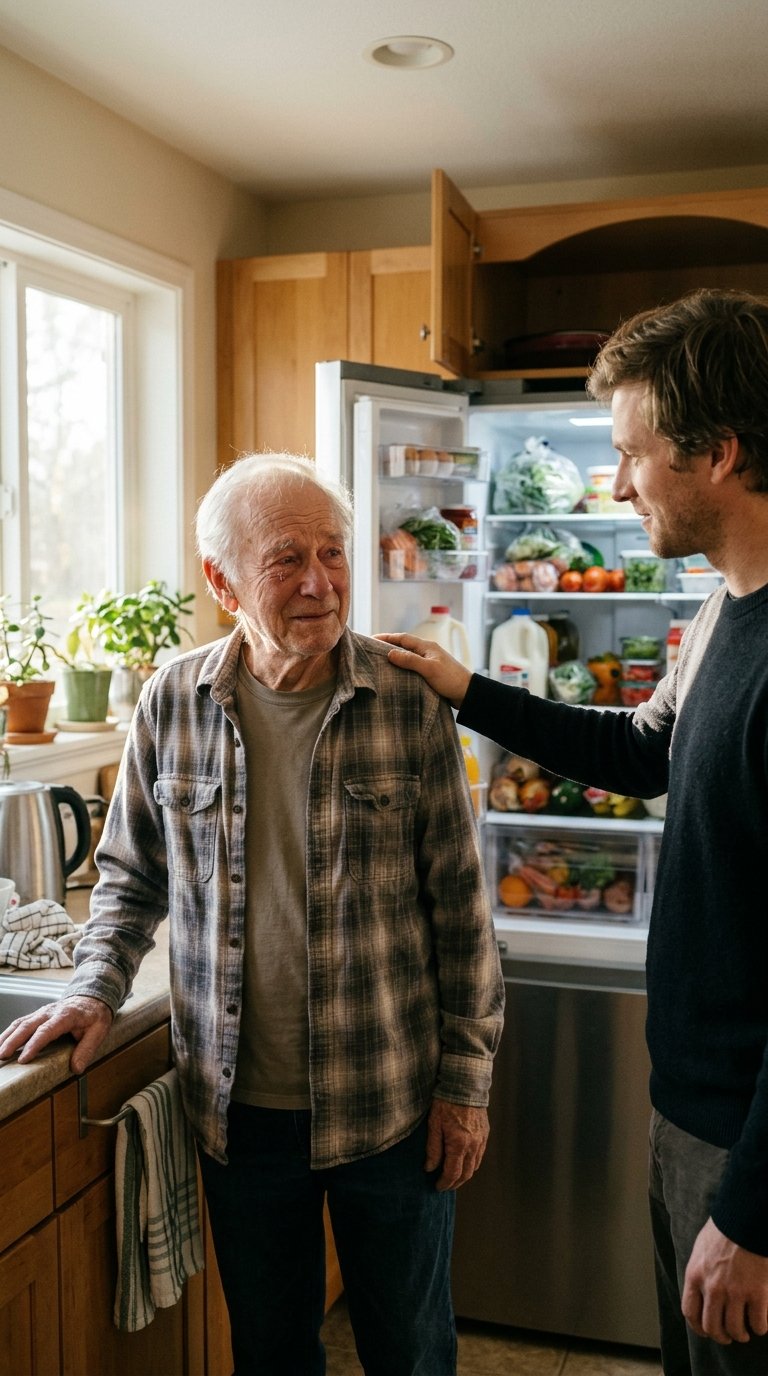
It took three hours at the kitchen table, and by the end, George’s envelope-budget was covered in notes in four different handwritings.
Tasha laid it out plainly. George had been paying for things he didn’t have to pay for, and missing benefits he had never applied for. He qualified for a state utility assistance program that cut his winter electric bill nearly in half. The county ran a senior property-tax and rent relief program that he’d missed three years in a row, and the application window was still open. His income was low enough for the Medicare Savings Program, which would cover his Part B premium and put almost a hundred and seventy dollars a month back into his check. A local food pantry delivered boxes to seniors who couldn’t travel. And the Area Agency on Aging ran a home-repair program that would fix the aging porch rail, the drafty window by the bed, and the water heater that had been dying for a year.
“Dad,” Tasha said. “Added up, you’re probably leaving four to five hundred dollars a month on the table.”
George stared at her. “Four hundred dollars? Every month?”
“Maybe more.”
He sat back. He looked at the envelope, at forty years of penciled math. “I could’ve been eating real dinners,” he said, almost to himself.
“You could’ve been,” Carol said gently, and she squeezed his shoulder. “But you’re going to now.”
They filled out the forms together. It was slow, and it was humbling. George signed his name eleven times, each time with a small hitch in his hand, as though he were signing a confession.
When they finished, Tasha gathered the papers and said, “Dad, I want to say something. Needing help isn’t a character flaw. It’s a stage of life. You helped plenty of people when you could. Now people want to help you. Let them.”
George was quiet. He turned the pencil over in his fingers.
“Dorothy used to say that,” he said finally. “She said giving is easy. Receiving is the hard part, because it asks you to trust somebody.”
“She was right,” Carol said.
“She usually was.” He smiled, small and crooked. “Don’t tell her I said so.”
Word traveled fast on a street like his.
The following Monday, a neighbor named Mrs. Delgado from across the road knocked on his door with a foil-covered casserole. George opened it, mortified, expecting pity.
“I made too much,” she said. “I always do. Would you do me a favor and take half?”
He took it. He didn’t say thank you right away; he was too busy realizing she meant exactly what she said. It tasted like green chile and kindness.
On Tuesday, a young man from the Agency on Aging arrived with a truck and a toolbox. By Friday, the water heater was replaced, the porch rail was solid, and the bedroom window no longer whistled. Across the street, Mr. Pham, a retired plumber, wandered over to check the work and stayed an hour talking about old tools.
By the weekend, the story had made its way down the block, softly, the way these things do. A box of groceries appeared on the porch, with a note: From the folks at Maple Street Church. No obligation. Just neighbors. George stood over it for a long time. He didn’t carry it inside right away.
Then he did.
Christmas came, and the whole family returned. Eli brought the tree he’d forgotten the first time. Carol brought a ham. Ray brought his terrible eggnog. Tasha brought a printed list titled George’s Benefits, Updated, which she taped inside a kitchen cabinet and made him promise to review every year.
The refrigerator hummed in the corner, stocked top to bottom. On the shelf, right at eye level, sat a pan of Dorothy’s recipe for stuffed peppers that Carol had made from memory, nearly right.
They crowded around the little table, extra chairs borrowed from Mrs. Delgado, and George sat at the head. He looked around the room: his daughter, his son, his granddaughter, his grandson, all of them pressed shoulder to shoulder, passing dishes.
When Eli lifted his glass, the room went quiet.
“I just want to say something to Grandpa,” Eli said. “Two months ago, I found you eating crackers off a saucer. I’ve thought about that every day since. Not because I was angry. Because I realized how long you’d been doing this alone, and how much it cost you.”
George’s eyes were wet.
“You taught me that asking for help isn’t weakness,” Eli continued. “And then you forgot it. So thank you for letting us remind you.”
George stood, slowly, one hand on the table. For a moment he didn’t speak. The old machinist, the man who had never missed a day, who had never borrowed a cup of sugar, looked at the faces around him.
“I spent my whole life believing a man’s worth was what he could do on his own,” he said. His voice shook. “I was wrong. A man’s worth is who shows up when he can’t.”
He raised his glass.
“To the ones who knocked on the door.”
In January, George did something he hadn’t done in years.
He picked up the phone and called an old friend from the machine shop, a man named Walt, whom he hadn’t spoken to since Dorothy’s funeral. Walt answered on the second ring.
“George?” he said. “George Whitaker? I thought you were dead!”
“Not yet,” George said, laughing. “Listen, I need a ride to the pharmacy on Thursday. My knee’s been bad. Could you help me out?”
There was a stunned silence. Then Walt said, “Of course I can. George, I’ve been waiting twenty years for you to ask me for something.”
They both laughed until they coughed.
That evening, George sat at his kitchen table with a plate of real food: chicken, rice, green beans, a slice of bread with butter. The refrigerator hummed behind him. The old envelope, the one with forty years of penciled math, sat in the drawer. On the table in front of him was a new notebook, a gift from Tasha, and on the first page, in his careful handwriting, he’d written a single line.
People who love you want to be needed.
He read it twice. Then he picked up his fork.
For the first time in a very long time, George Whitaker ate dinner without doing the math.