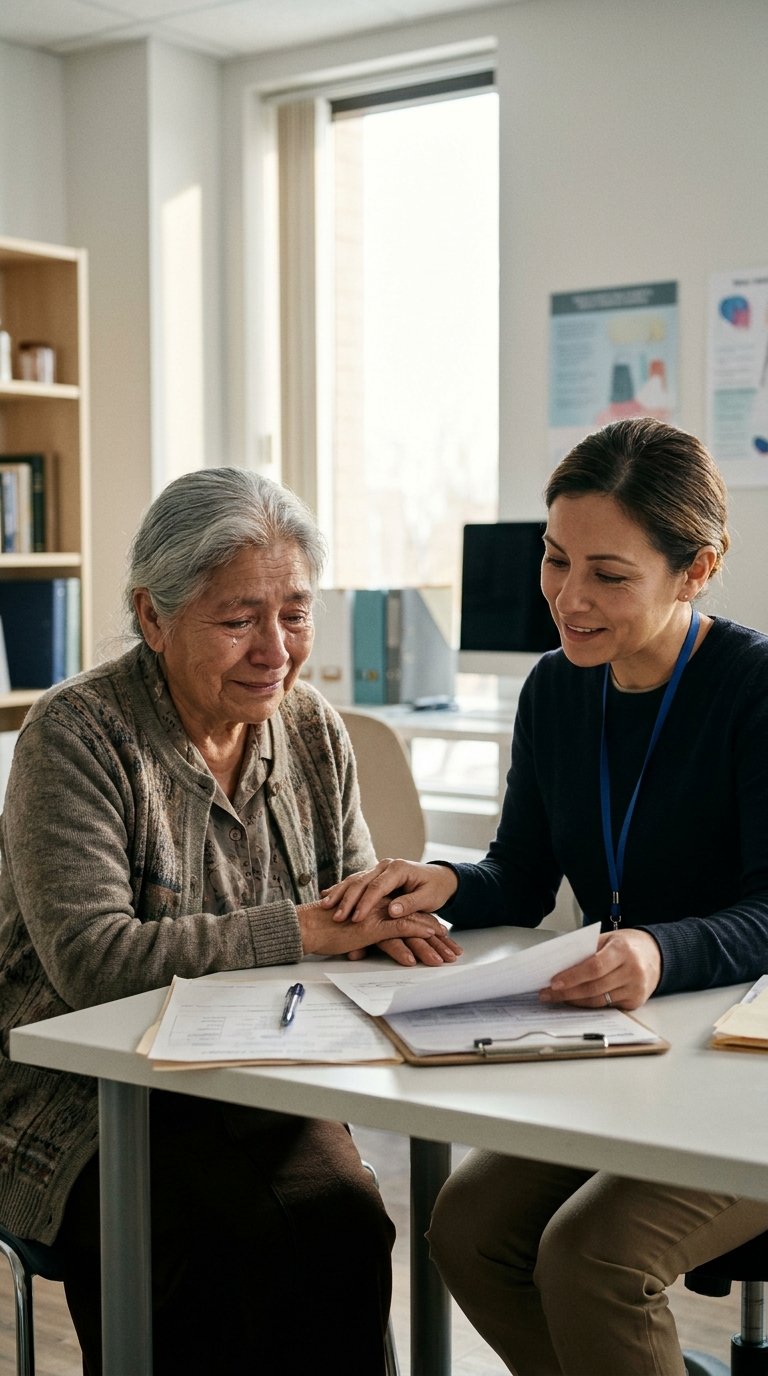
Ana read the letter slowly, once in English and once, in a low voice, in Spanish.
“This is from your doctor’s office,” she said. “It says you’ve missed several appointments, and that your thyroid medication needs to be refilled. It says your doctor is worried and wants to see you soon.” She looked up. “It’s not a punishment, Rosa. It’s an invitation.”
Rosa laughed, a small, wet, astonished laugh. “All this time, I thought they were angry.”
“They were worried,” Ana said. “There’s a difference.”
Ana stayed with her for three hours that afternoon.
She sat beside Rosa while the doctor examined the ankle, which was sprained but not broken. She translated every question, and she translated Rosa’s answers back, sentence by sentence, never summarizing, never rushing. When the doctor asked about the missed appointments, Rosa explained, through Ana, in her own words, that she had been afraid.
The doctor, a young man named Dr. Okafor, put down his clipboard.
“Mrs. Delgado,” he said, “I am so sorry. We should have had an interpreter scheduled for every one of your visits. That was our failure, not yours.”
Rosa blinked. Nobody had ever apologized to her for something like that.
Then the doctor ran the tests she’d avoided. Her blood pressure was dangerously high. Her thyroid levels were off, and her blood sugar was borderline. None of it was a catastrophe, but all of it needed attention, and all of it had been quietly worsening for months.
“If you’d waited much longer,” Dr. Okafor said gently, “we might have been having a very different conversation. But you’re here now. We can fix this.”
Before Rosa left, Ana asked if she could visit her apartment the next day.
“I’d like to help you with the mail,” she said. “If you’d let me.”
Rosa hesitated, then nodded.
The next afternoon, Ana arrived with a folder, a pack of sticky notes, and a box of pan dulce from the corner bakery. Rosa led her to the kitchen and opened the drawer under the dish towels.
Ana looked at the stack of envelopes, thirty-one of them, some from over a year ago, and her expression softened.
“Okay,” she said. “Let’s open them together.”
It took two hours. They sorted the mail into three piles: Urgent, Important, and Throw Away. Ana explained each letter in Spanish, in plain words, and wrote the key points on sticky notes in large print. A pharmacy refill. An insurance renewal. A notice about a free senior transportation program that Rosa had qualified for, and had never known about. A reminder about a vaccine. A letter that said she was eligible for a Medicare savings program.
“Rosa,” Ana said, holding up the last letter, “you’ve been entitled to these things for years.”
“Nobody told me.”
“No,” Ana said, quietly. “Somebody should have.”
That evening, Rosa did something she hadn’t done in forty years.
She called her children, all three, on a group video call that Ana helped her set up. Marisol answered from her kitchen, with a laptop and a half-chopped onion. Daniel appeared from a hotel room. Teresa was at her desk, grading papers.
“Mami?” Marisol said. “What’s wrong? Why are you calling so late?”
Rosa looked at the three faces on the screen. She took a breath.
“I need to tell you something,” she said. “And I need you to listen without interrupting.”
They went silent.
“I cannot read English,” she said. “I have never been able to read it. Not the letters, not the medicine, not the forms. For forty-four years, I have pretended. I was afraid you’d be ashamed of me.”
Nobody spoke. On the screen, Marisol’s hand went to her mouth.
“I missed four doctor’s appointments because I was too afraid to ask for help. A kind woman at the clinic found me today. She helped me. I’m okay. But I wanted you to know the truth, because I’m tired of hiding it.”
Teresa was the first to speak. Her voice was shaking.
“Mami,” she said. “Oh, Mami. All those times I told you to just read the label…”
“You didn’t know.”
“I should have known.” She was openly crying now. “You signed my report cards. You went to every parent night. I never once wondered how…”
“I didn’t want you to wonder,” Rosa said. “That was my job.”
Daniel had covered his eyes with his hand. When he lowered it, his face was wet.
“Mami, we are so sorry,” he said. “We were so busy being proud of what you gave us that we never asked what it cost.”
“I’m not angry,” Rosa said. “I only want to be seen.”
“We see you,” Marisol whispered. “We see you now. We’re coming tomorrow.”
They all came, even Daniel, who flew back early from his trip. They arrived at her apartment on Saturday with grocery bags, a pillbox with the days of the week, and a large-print calendar. Marisol set up automatic refills and a bilingual line for the pharmacy. Daniel installed grab bars in the bathroom. Teresa sat down at the kitchen table with a notebook.
“Mami,” she said, “I want to teach you something. If you want to learn.”
Rosa raised her eyebrows. “At seventy-nine?”
“At any age.”
So, that afternoon, at a kitchen table that had held forty years of silence, Rosa’s youngest daughter handed her a pencil and wrote four letters on a sheet of paper.
ROSA.
“Now you,” Teresa said.
Rosa’s hand shook as she copied them. The R came out crooked. The S looked like a snake. But when she finished, she stared at the page for a long time, at her own name in the language that had kept her at the edge of every room.
“I wrote it,” she whispered.
“You did,” Teresa said, her voice breaking. “You did, Mami.”
Over the next months, Rosa joined a free adult literacy class at the library, in a room with eleven other students, most of them grandmothers. Ana still visited every other week, and she introduced Rosa to a senior center where there were Spanish-speaking volunteers, a lunch program, and a woman named Elena who also loved pan dulce and bad telenovelas.
Rosa’s blood pressure came down. Her thyroid levels settled. She took her pills every morning from the pillbox, checking the little day-of-the-week windows, one tiny victory at a time.
On a bright morning in spring, she sat at the clinic’s front desk with a clipboard of forms. A young receptionist offered to help. Rosa smiled, shook her head, and with slow, careful letters, filled in her name.
Rosa Delgado.
She handed back the clipboard. In the margin, in her own handwriting, she had added three words in English.
I need interpreter.
The receptionist smiled. “Of course, Mrs. Delgado. Ana’s already on her way.”
Rosa sat down in the waiting room, back straight, hands folded, feeling something she hadn’t felt in decades. It wasn’t pride exactly. It was lighter than pride.
It was the feeling of being visible.
She looked at the faces around her: a young father with a baby, an elderly man in a cap, a teenager translating for her mother in a low voice. Rosa caught the teenager’s eye, smiled, and gave her a small nod that said I see you, too.
Because Rosa had learned something at seventy-nine that she wished she’d known at twenty-nine. Growing old in a new country should never mean growing invisible. And needing help was not a failure of the one who asks. It was a test of the world that answers.