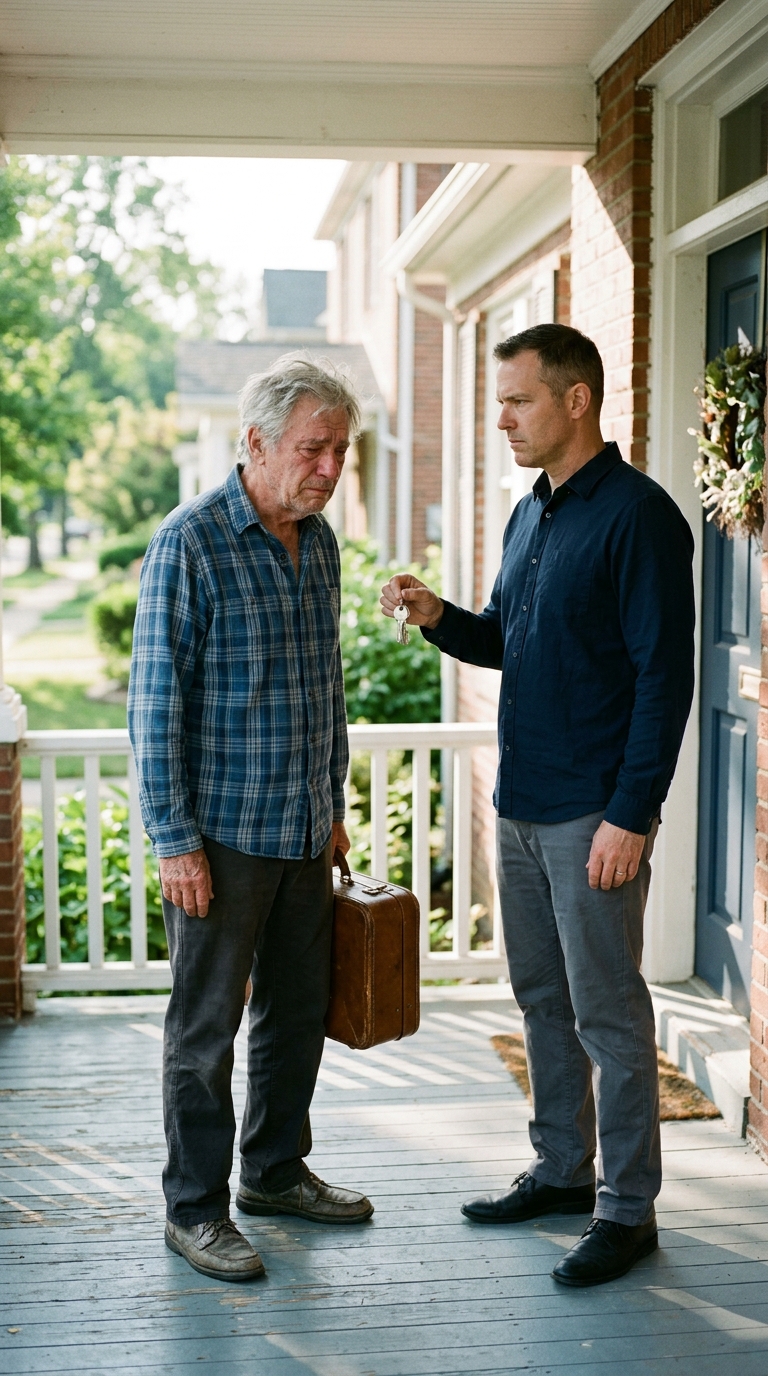
Harold spent that first night in a motel off the interstate, sitting on a stiff bedspread staring at a suitcase full of clothes he didn’t remember approving. His hands wouldn’t stop shaking — not from cold, but from a kind of disbelief that hadn’t fully landed yet.
It took a phone call to his old friend Walter, a retired paralegal, to start putting the pieces together. Walter drove down the next morning with a legal pad and a look on his face Harold hadn’t seen since they’d served together decades earlier — the look of a man bracing for bad news he already suspected.
The house, it turned out, had been transferred out of Harold’s name four months earlier. A quitclaim deed, filed quietly at the county recorder’s office, moved ownership to Peter and his sister, Denise, jointly. The signature on the deed was Harold’s.
Harold had no memory of signing any such document.
What Walter eventually uncovered — through records requests, a notary’s log, and an increasingly uncomfortable conversation with Denise, who cracked under pressure faster than Peter did — was this: during the worst weeks of Margaret’s decline, when Harold was sedated with exhaustion and grief and barely leaving her bedside, his children had brought him a stack of papers to sign. They’d told him it was related to Margaret’s care directives, insurance forms, hospice paperwork — the kind of documents a dying spouse’s family signs constantly, numbly, without reading every line. Buried in that stack was the deed transfer.
Harold had signed it without reading a word, because he trusted his children completely, and because his entire attention that week had been on holding his wife’s hand while she slipped further away.
Peter and Denise, it emerged, had been anticipating the inheritance for years — arguing privately about what would happen to the house, resentful of a father they saw as sitting on an asset instead of a home. They’d decided, apparently, that waiting for a natural transfer of ownership was an unnecessary risk. Better to secure it while Harold was too consumed by grief to notice.
What none of them expected was Margaret.
Three weeks after the funeral, Harold received a call from Margaret’s estate attorney — a woman she had quietly retained eighteen months earlier, unbeknownst to her children, and even mostly unbeknownst to Harold himself. Margaret, sensing her own decline and knowing her children better than they realized, had left a sealed letter to be opened only after her death, along with an updated will that placed a legal life estate on the house in Harold’s name — a protection she’d arranged specifically because, in her words, written in her own hand, “I know our children, and I know grief makes people believe they deserve things early.”
The life estate superseded the quitclaim deed entirely. Harold’s ownership rights were restored within weeks, backed by an attorney Margaret had hired specifically to protect him.
Harold moved back into the house on Willow Creek Road a month after being locked out of it. Peter and Denise did not contest the ruling — perhaps out of shame, perhaps because they knew exactly how badly the truth would look in a courtroom.
Harold framed Margaret’s letter. He keeps it on the nightstand, on her side of the bed, where he still, out of forty-seven years of habit, says goodnight.