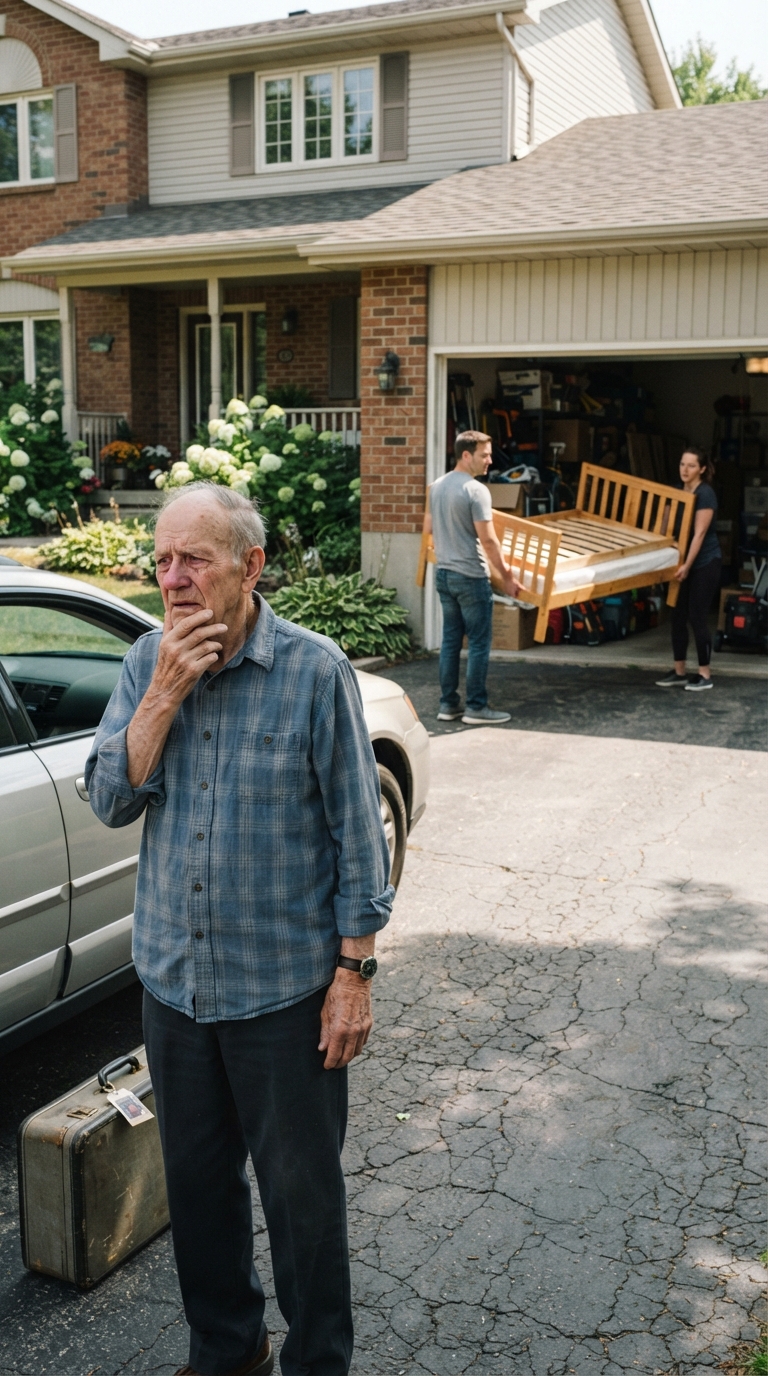
I arrived to find my father eating breakfast alone in the garage on a folding chair at a card table, wearing his winter coat indoors because the space heater was insufficient for the February temperature.
The garage had been my father’s workshop — the place where he kept his tools and where he had taught each of us, at various ages, the basic principles of building and fixing things. His workbench was still along one wall. His tools were still on their hooks. He had been moved into the space he had built things in, surrounded by the evidence of everything he had made, and given a space heater and a folding partition and told this was care.
I stood in the doorway and looked at him for a moment before he heard me come in.
He was eighty-two years old and he was eating cereal alone in a garage in February in his winter coat and he looked smaller than I had ever seen him look in my life.
Then he looked up and saw me and his face changed in the specific way of someone who has been trying not to need anything and has just been given permission to need something, and it is the expression I will carry for the rest of my life as the clearest possible definition of what it means to arrive when someone needs you.
“Catherine,” he said. “You didn’t have to come all this way.”
“Yes I did,” I said.
I did not speak to Raymond that first evening. I took my father inside — past Cheryl’s visible displeasure in the kitchen, past Raymond’s carefully calibrated explanation about space and family needs and temporary arrangements — and I put him in the actual bedroom of the house he had built and I sat with him until he fell asleep.
Then I called an attorney.
Her name was Judith Marsh and she had been recommended by a colleague and she answered my call at 9 PM with the alertness of someone who had taken calls like this before and understood their urgency.
I described the situation. The transfer. The timeline. The garage. The space heater. My father’s age and physical condition.
She was quiet for a moment.
“When was the transfer signed?” she asked.
“Nine days ago,” I said.
“Did your father have independent legal counsel?”
“No,” I said. “Raymond said it wasn’t necessary.”
“Of course he did,” she said. Not unkindly. With the specific weariness of someone who has heard this particular sentence many times. “I need you to bring me the documents tomorrow. All of them. And I need you to document the current living situation — photographs of the garage, the space heater, the sleeping arrangements. Tonight if possible.”
I documented everything that night. The folding partition. The card table. The space heater with its inadequate radius. The winter coat hanging on the workbench hook because my father had been wearing it to eat breakfast.
What Judith found when she reviewed the transfer documents was not immediately obvious but was, once identified, significant.
My father had signed the transfer without independent counsel — Raymond had prepared the documents through an online service and presented them as routine family paperwork. In our state, property transfers of this nature involving elderly individuals without independent legal representation carried specific procedural requirements that the online document service had not flagged and Raymond had not disclosed.
Additionally, the transfer had been accompanied by a verbal promise of care — and while verbal promises are notoriously difficult to enforce, Judith identified a text message exchange between my father and Raymond, on my father’s phone, in which Raymond had explicitly confirmed the care arrangement in writing three days before the signing.
“This will be your home for the rest of your life. You’ll be in the house. We’ll handle everything. That’s the deal, Dad.”
That text message was sent by Raymond from his own phone. It was timestamped. It was explicit. And it established a promissory framework that Judith believed gave us grounds to challenge the transfer on the basis of undue influence and failure of promised consideration.
“He made a promise to get the signature,” Judith said. “He broke it within forty-eight hours. That matters.”
We filed within two weeks.
Raymond’s response was initially aggressive — his attorney sent a letter characterizing my involvement as interference by a sibling with no legal standing and describing the garage arrangement as a comfortable private space thoughtfully prepared for an elderly parent.
Judith responded with the documentation. The photographs. The temperature records — I had noted the garage temperature each morning for ten days, which was between 47 and 54 degrees Fahrenheit depending on the weather. My father’s medical records indicating that sustained cold exposure was contraindicated for his cardiovascular condition. The text message.
Raymond’s attorney requested a meeting.
At the meeting — which I attended with Judith and which Raymond attended with his attorney and without Cheryl, which I noticed — the posture changed considerably. The comfortable private space language disappeared. The temperature documentation had clearly created discomfort. The text message had created more.
A negotiated resolution was reached without proceeding to full litigation. The transfer was unwound. The property returned to my father’s name, with a formal trust established — by a proper estate attorney, reviewed by all parties, with independent counsel for my father — that protected the property, established legitimate care provisions with enforceable conditions, and named me as successor trustee.
Raymond did not contest the trust structure. His attorney had advised him, apparently at some length, that contesting it would expose the garage arrangement to the level of scrutiny that the word elder abuse attracts in a courtroom.
My father moved back into his bedroom.
The first morning, he made coffee in his own kitchen and sat at his own table — the table he had bought in 1978 and refinished in 1994 and which was as much a part of the house as anything he had nailed or poured or framed — and he looked out his own window at his own yard.
He didn’t say much that morning. We sat with our coffee and the particular silence of people who have been through something and are on the other side of it and don’t need to fill the space.
Eventually he said: “I should have called you before I signed.”
“Yes,” I said.
“I didn’t want to bother you,” he said. “You have your own life.”
I looked at my father — eighty-two years old, winter coat no longer necessary indoors, sitting at his own table in the house he had built board by board in 1974 and 1975 while my mother sat with him and he told her the story of every piece of wood.
“Dad,” I said. “You are my life. You are part of my life. Please bother me.”
He looked at his coffee cup.
“All right,” he said. “I will.”
Raymond and I have a relationship that is functional and bounded and honest in the way that things become honest when pretense has been formally removed by legal proceedings. He and Cheryl did not attend Christmas this year. This was their choice and I did not pursue it because some distances, once established, serve everyone better than forced proximity.
Linda came for Christmas. She and my father sat in the living room after dinner and he showed her the floors — the ones he had laid in October 1975, still the original wood, refinished twice but structurally his — and told her the story of them the way he had once told my mother.
Linda listened with the attention of someone hearing something for the first time that she realizes she should have heard long ago.
The house is still standing. My father is still in it.
The ink is dry now. And the right name is on the paper.
— As told by the daughter who booked the flight and took the photographs and sat with her father while the coffee was still hot.