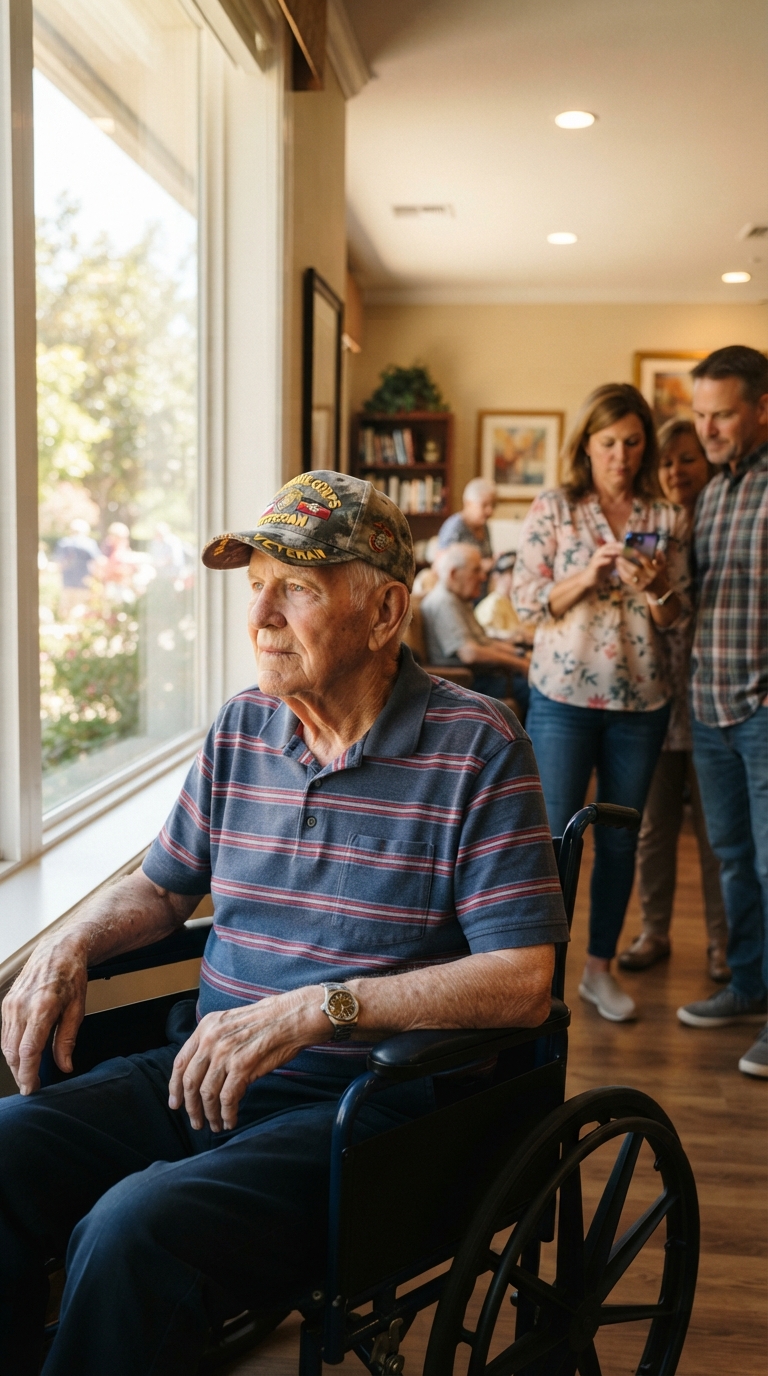
Keisha had worked at Meadowbrook for six years.
She had learned, in those six years, to see the difference between residents who were lonely and residents who were grieving — because loneliness and grief look similar from a distance but require different responses up close. Loneliness responds to company. Grief responds to witness.
William Carter was grieving. He was grieving his children — not their deaths but their absence, which is a specific kind of grief that has no ceremony and no community because the loss is not acknowledged by the people who caused it and therefore cannot be fully named by the person experiencing it.
Keisha had watched him sit by the front window for three consecutive Christmases. She had helped move the chair each time. She had brought him coffee at four o’clock and a sandwich at seven and had sat with him for twenty minutes at eight-thirty while the other residents watched a holiday film in the common room.
She had watched him watch the parking lot.
After the third Christmas she went home and sat at her kitchen table for a long time.
Then she started making calls.
What Keisha did was not part of her job description. It was not sanctioned by administration, though when the director of Meadowbrook — a woman named Sandra Okafor who had a practical view of extraordinary measures — learned about it six weeks later, she chose not to unsanction it.
Keisha had found the Marine Corps veterans’ community network in their region. She had called the local VFW chapter. She had explained the situation to a man named Commander Dale Hutchins — retired, sixty-seven, the kind of man who responds to information about a fellow Marine being abandoned by his family by going very quiet and then asking what the address was.
She had also, through a combination of Meadowbrook’s records and public information, located contact details for several of William’s former military colleagues. Three were still living. Two were in reasonable health. One — a man named Albert Reyes, eighty-one, living forty minutes away — had served with William in Korea and had lost touch over the decades in the ordinary way of lives that diverge without intention.
Albert had not known William was at Meadowbrook.
Albert had not known, because no one had told him, that William was alone.
When Keisha called him he was quiet for a moment and then he said: “I’ll be there Saturday.”
He was there Saturday.
William was in the common room when Albert arrived. Keisha had not told him — she had been uncertain how to prepare someone for the return of a person from fifty years ago and had decided that some things were better experienced than anticipated.
Albert walked in and William looked up and there was a moment — five seconds, perhaps, ten — in which the two men simply looked at each other across fifty years of separately lived life.
Then William said: “Reyes. You got old.”
Albert said: “Look who’s talking, Carter.”
They sat together for four hours. Keisha brought coffee. Then lunch. Then more coffee. The other residents drifted in and out with the comfortable curiosity of people who have learned to find interest in each other’s visitors. Margaret in the room beside William’s — ninety-one, former librarian, still reading — sat near them for an hour and listened to stories about Korea with the attention of someone who understands that testimony requires witnesses.
William laughed that afternoon in a way Keisha had not heard in three years.
Commander Dale Hutchins arrived the following Saturday with four members of his VFW chapter. They came in their organization jackets — not uniforms, just jackets, the casual dress of men who want to communicate affiliation without making the visit feel like a ceremony. They brought coffee from the good place down the road and a cake that said Semper Fi in red frosting that William regarded with the expression of a man simultaneously amused and moved and unwilling to display either too openly.
They stayed three hours.
They came back the following Saturday.
And the Saturday after that.
What happened with William’s children happened slowly and without dramatic resolution, which is the way most things happen when the problem is not a single decision but a pattern of choices made over years.
Keisha had documented her concerns about William’s isolation in his care record — as she was required to do, and as she had been doing with increasing specificity for eighteen months. The documentation now included a formal note that the family had been unreachable through standard channels and that alternative community support had been arranged in response to resident welfare concerns.
Sandra Okafor, the director, forwarded this documentation to the family’s last known contact addresses with a letter that described the situation clearly and without sentimentality. The letter noted that William’s emotional and social wellbeing had been significantly impacted by prolonged family absence and that the facility had taken measures to address this through community connections given the family’s unavailability.
The letter also noted, in the final paragraph, that facilities which document family neglect of residents are required in their state to report patterns of concern to the relevant elder welfare oversight office, and that they intended to fulfill this requirement if the situation did not change.
Patricia called within a week. Her call to Sandra was careful and concerned in the way of someone who has just been made aware that their behavior has been documented and may have consequences. Sandra was warm and direct and expressed hope for increased family involvement going forward.
Patricia visited the following Sunday. She sat with William for two hours. She did not take any phone calls.
William was gracious. He was always gracious — it was, Keisha had decided, one of his most defining characteristics and probably one of his most costly ones, this capacity for grace toward people who had not earned it.
James called three weeks after Patricia’s visit. His call was brief and slightly defensive in the way of someone who expects to be attacked and is surprised when they aren’t. William talked to him about Korea. About Albert Reyes. About the VFW chapter and the cake with the red frosting. He talked as though James had simply been away for a while and was now back, which was either profound generosity or a survival mechanism so deeply embedded it had become indistinguishable from character.
Probably both.
Robert came in the spring. Denise came in June — the distance and finances having resolved themselves in the way that distances and finances sometimes resolve when they become the only barrier left.
William had four children visiting by summer. Irregularly, imperfectly, with the slightly effortful quality of people rebuilding something they should never have let fall.
He did not pretend it was sufficient.
He did not refuse it either.
The following Christmas Keisha moved the wingback chair to the front window again. She did it on the twenty-third, as she always did, because some traditions exist for the person they serve regardless of whether the circumstances have changed.
William sat in it on Christmas Eve.
At four-fifteen, a car pulled into the parking lot.
James.
At five, another car. Patricia with her husband and two grandchildren William had not seen in two years, who were taller than he remembered and who called him Great-Grandpa with the unconscious ease of children who have been told a person matters before they were old enough to understand why.
At six, Robert.
Denise called on video. Her face on the screen of the tablet Keisha held for her was tearful in the unguarded way of someone who has flown past the point of managing appearances.
Albert Reyes arrived at seven with a bottle of something he described as medicinal and Commander Hutchins at seven-thirty with members of the chapter who had decided that William Carter’s Christmas was a community event.
The front sitting room had not contained that many people in Keisha’s six years at Meadowbrook.
William sat in the wingback chair by the window and looked at the room — at the family who had come back, however imperfectly, and the friends who had appeared when the family hadn’t, and the staff who had moved a chair every December for three years because a man believed someone might come — and was quiet for a moment.
Then he said, to no one specifically and everyone present:
“Margaret would have loved this.”
He meant his wife. He said it the way you say someone’s name when they are so present in a moment that not saying it would be a kind of dishonesty.
Nobody spoke for a moment.
Then the grandchildren discovered the cake Keisha had ordered — Semper Fi in red frosting again, because she had learned from the first one — and the moment resolved into the comfortable noise of people eating and talking and being, collectively, in the same place at the same time.
Which is all a window is really for.
— For every resident by a front window. And for the people who move the chair.