Patricia arrived on a Saturday.
She did not announce she was coming — she called me Friday evening and said I’ll be there tomorrow in the voice she uses when she has made a decision and is informing rather than discussing, which is a quality she inherited from Rosemary and which I have always found both formidable and deeply reassuring.
She arrived at ten in the morning. Brian opened the door with the expression of a man who had not expected this and was rapidly calculating what it meant. Tara appeared behind him with the particular composure of someone who has already decided on her framing.
Patricia walked past both of them and asked where I was.
They showed her the garage.
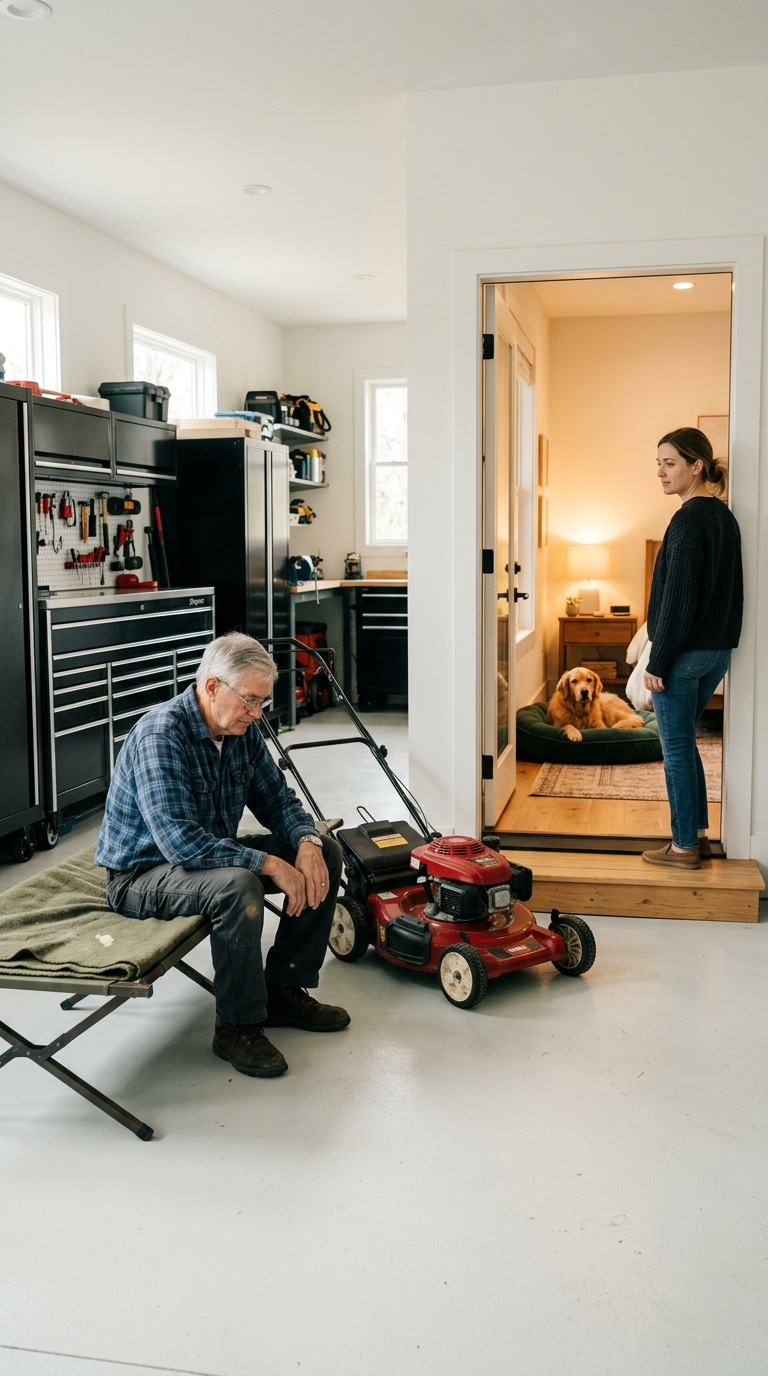
She stood in the doorway of the garage where I had been sleeping for six weeks — the folding cot, the lawn mower, the space heater that struggled against the November temperature, the plastic shelving unit holding my clothes in the space where a car should have been — and was quiet for what felt like a long time.
Then she turned to Brian.
“How long?” she said.
Brian began explaining about Biscuit’s sleep disruption and the guest room’s suitability for the dog’s needs and the temporary nature of the arrangement while they figured out a longer-term solution.
Patricia listened to all of it without expression.
Then she said: “Pack your things, Dad. You’re coming with me.”
I want to tell you what happened next in the full detail it deserves because the complete picture matters and I have spent seventy-eight years believing that the complete picture always matters more than the comfortable version.
Patricia drove me to her home in Pasadena — a three-bedroom house she shared with her husband Daniel and their teenage son — and put me in the actual guest room, with an actual bed and actual curtains and a window that faced the garden she had been growing for fifteen years and that in November still held enough color to be worth looking at in the morning.
She made me coffee.
We sat at her kitchen table and I told her everything. The $280,000. The house sale. The garage. The six weeks. The space heater. The folding cot beside the lawn mower.
She listened without interrupting. When I finished she sat for a moment.
“Did you sign anything?” she asked.
“The loan paperwork,” I said. “Sandra helped me draft it.”
Sandra Park was the attorney who had handled my estate planning since 2015. I had called her the previous week — not yet knowing that Patricia was coming, simply operating from the instinct of a man who has learned that documentation matters regardless of family.
“I called Sandra last week,” I told Patricia. “She has copies of everything.”
Patricia closed her eyes briefly in the way of someone receiving information that is both too late and exactly in time.
“Okay,” she said. “Then we have something to work with.”
What Sandra and Patricia and I worked with over the following weeks was thorough and deliberate and designed with the care that I had always applied to the structures I built professionally — because a structure is only as good as the foundation it rests on and the foundation here needed significant attention.
The loan documentation I had signed with Brian established a legal debt of $280,000. Sandra had drafted it carefully — she always drafted things carefully, which is why I had retained her for nine years — with standard terms including a repayment schedule and a default provision.
Brian had made no payments.
The repayment schedule showed six months of zero payments against a documented loan of $280,000 from a seventy-eight-year-old man who had subsequently sold his home and moved into his debtor’s garage.
Sandra’s assessment was direct: the documentation, combined with the living arrangement and the circumstances of my relocation, created a strong basis for a legal claim. Additionally, the nature of the arrangement — an elderly person transferring significant assets and property to a family member who then failed to provide the promised care and housed him in a garage — raised flags that Sandra noted, carefully, could attract the attention of adult protective services if we chose to involve them.
We did not immediately choose to involve them.
We chose to involve Brian directly first.
Brian came to Sandra’s office on a Tuesday. He came alone — Tara had apparently decided her attendance was inadvisable, which was perhaps the most strategically sound decision she had made in the entire situation.
Sandra presented the documentation. Brian’s attorney — whom he had retained between Patricia’s Saturday arrival and Tuesday’s meeting, which told me something about how seriously he was taking the situation — reviewed it carefully.
The conversation that followed was not comfortable. Brian made several attempts to characterize the loan as a gift, the living arrangement as temporary, and my relocation to Patricia’s as voluntary rather than necessitated. Sandra had anticipated each of these characterizations and had documentation that addressed them with the patient thoroughness of someone who has been doing this long enough to know what to prepare for.
Brian’s attorney advised him quietly. Brian listened. His expression moved through several stages that I watched from across the table — the expression of a man who had made a series of decisions that had felt manageable in isolation and was now seeing them assembled into a complete picture that was considerably less manageable.
At the end of the meeting Brian looked at me directly for the first time.
“Dad,” he said. “I’m sorry.”
I looked at my son — fifty-one years old, three children of his own, the man I had held in a hospital in 1973 and made promises to that I had kept across five decades — and I felt the specific complexity of loving someone who has done something that required this room and this table and this documentation to address.
“I know you are,” I said. “That matters. It’s not sufficient, but it matters.”
The repayment arrangement was formalized through Sandra’s office — a structured schedule with specific terms and consequences for non-compliance that Brian’s attorney had negotiated in good faith and that Sandra had agreed to with the appropriate modifications.
The landscaping business had grown in the intervening months. Brian’s company was generating the stability he had projected eighteen months earlier. The $280,000 was not an impossible debt — it was a significant one that required discipline and time, and the legal structure now ensured that the discipline and time would be applied.
I live with Patricia and Daniel in Pasadena. The guest room faces the garden. The coffee is made before I wake up. My grandson — sixteen, interested in engineering, which gives us a great deal to talk about — comes to the doorway of the guest room sometimes in the evenings to ask questions about load-bearing calculations and material choices, because he has decided to pursue what I spent thirty-four years doing, and this gives me more pleasure than I have adequate words for.
Brian’s family comes for dinner on the last Sunday of every month. The children — my grandchildren — are loud and present and completely unaware of the garage and the folding cot and the space heater, which is exactly as it should be. They climb on me with the unconscious trust of children who have decided a person is safe, which is the only credential that has ever mattered to me.
Biscuit the golden retriever is at these dinners. He is a good dog — genuinely, without reservation, the kind of animal who is incapable of anything other than enthusiasm and affection. I have never blamed him for any of it.
He got the room. I got Patricia.
I consider this an acceptable outcome.
— As told by the grandfather who slept beside the lawn mower and was found on a Saturday morning by the person who didn’t wait to be called.