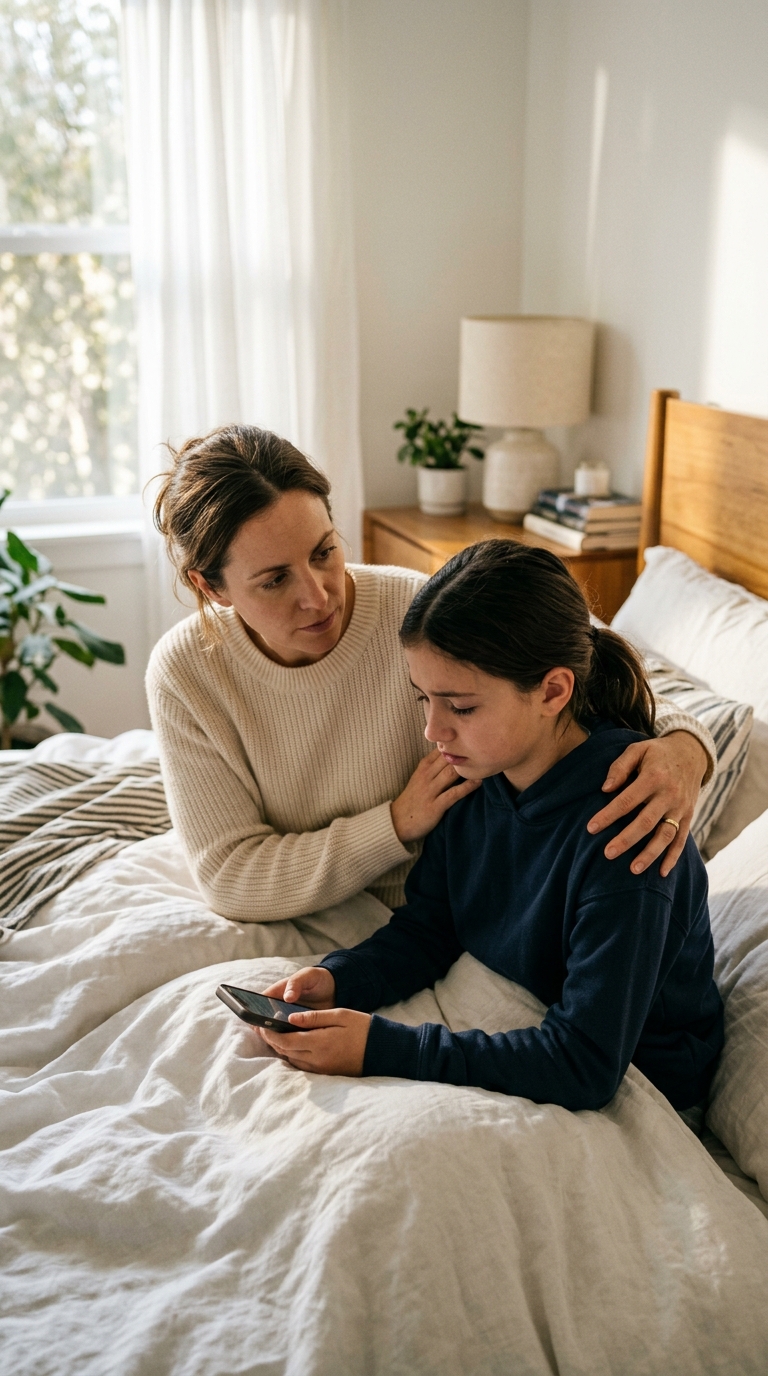
The screen showed a private group chat.
Not my daughter’s messages — a different conversation entirely, one that Principal Morrison had discovered two days earlier through a report from another student who had become uncomfortable with what the group had become.
The group had forty-three members. Students, yes — but the chat had been created and was being administered by an adult account. The profile picture was generic. The username was meaningless. But the messages from the administrator told a story that the student messages had only been following.
The adult account had started the campaign. Had suggested the language. Had encouraged escalation when the messages seemed to be having an effect. Had created several of the anonymous accounts that had messaged my daughter directly.
Morrison had been working with the district’s IT department for two days trying to identify the account. They had traced it to an IP address. She had the report open on her desk beside her computer.
The IP address resolved to a residential location.
I looked at the address.
I knew that house.
It belonged to the mother of my daughter’s former best friend — a girl named Brianna whose friendship with my daughter had ended eight months earlier over something small and twelve-year-old and apparently, for Brianna’s mother, not small at all.
Her name was Diane Collier. I had been in her house. I had had coffee at her kitchen table. She had held my daughter’s birthday cake at a party two years ago and smiled in the photographs.
She had spent eight months coordinating an anonymous harassment campaign against a twelve-year-old child from her kitchen.
I sat down in the chair across from Principal Morrison without being invited to and looked at the report for a long time.
“How certain is the IT identification?” I asked.
“Certain enough that I’ve already contacted the district’s legal team,” she said. “And the police resource officer.”
“When were you going to tell me?”
She had the decency to look uncomfortable. “I wanted to be sure before I brought it to a parent. We confirmed the IP this morning.”
This morning. While I was already in her office with four hundred pages because I had stopped waiting for the school to tell me my daughter was fine.
I picked up my phone and called my attorney before I left the building.
What followed moved faster than I expected and slower than I needed it to — the particular pace of institutional processes operating alongside a mother’s urgency.
The police report was filed that afternoon. The IP identification, combined with Morrison’s documentation and my four hundred pages of screenshots, gave investigators a foundation that Diane Collier’s attorney would spend considerable effort attempting to undermine and insufficient success doing so.
The anonymous accounts were traced. Three were registered from the same IP. Four others from a mobile device that cell records placed consistently at the Collier residence.
Diane Collier was charged with cyberstalking of a minor and criminal harassment. The charges carried real weight in our state — weight that her attorney had apparently not calculated for when advising her initial posture of complete denial.
She denied everything for six weeks. Then the cell records arrived in discovery. Then the denial became a different conversation.
She pleaded to a reduced charge. The terms included mandatory counseling, a no-contact order covering my daughter permanently, and a formal record that would follow Diane Collier in any subsequent background check for the remainder of her professional life.
Brianna — her daughter, twelve years old, who had not been the architect of any of this and who had, evidence suggested, been aware of some of it and deeply uncomfortable — was handled separately by the school with the appropriate care for a child who was also, in her own way, a victim of her mother’s choices.
My daughter and Brianna have not resumed their friendship. I don’t think they will. Some things, once examined clearly, cannot be reconstructed into what they were — not because of malice but because the ground beneath them turned out to be something other than what either of them had been standing on.
My daughter is thirteen now.
She does not eat lunch alone anymore. This is not because the school resolved everything perfectly — it is because I transferred her to a different school in January, three months after the police report, because I had decided that her continued presence in a building where this had happened required more daily management of her own history than any thirteen-year-old should be required to perform.
The new school has a different lunch table. Different hallways. Different people who did not receive instructions about her from an adult in a kitchen.
She came home last week and told me about a girl in her English class who makes her laugh.
Just that. A girl who makes her laugh.
I said that’s wonderful.
She said yeah and went to her room and I sat at the kitchen table and let myself feel, for a moment, what it had cost us to get to a girl who makes her laugh being the news of the day.
I kept the four hundred pages. They’re in a folder in the filing cabinet where I keep things that matter.
Some things you keep not because you need them anymore but because they represent a version of yourself you want to remember — the version who sat on a bathroom floor for twenty minutes and then got up and screenshotted everything and walked into a principal’s office with a stack of paper and did not leave until someone showed her what she needed to see.
That version of myself.
I want to remember her.
— As told by the mother who printed four hundred pages and set them on the desk and waited.