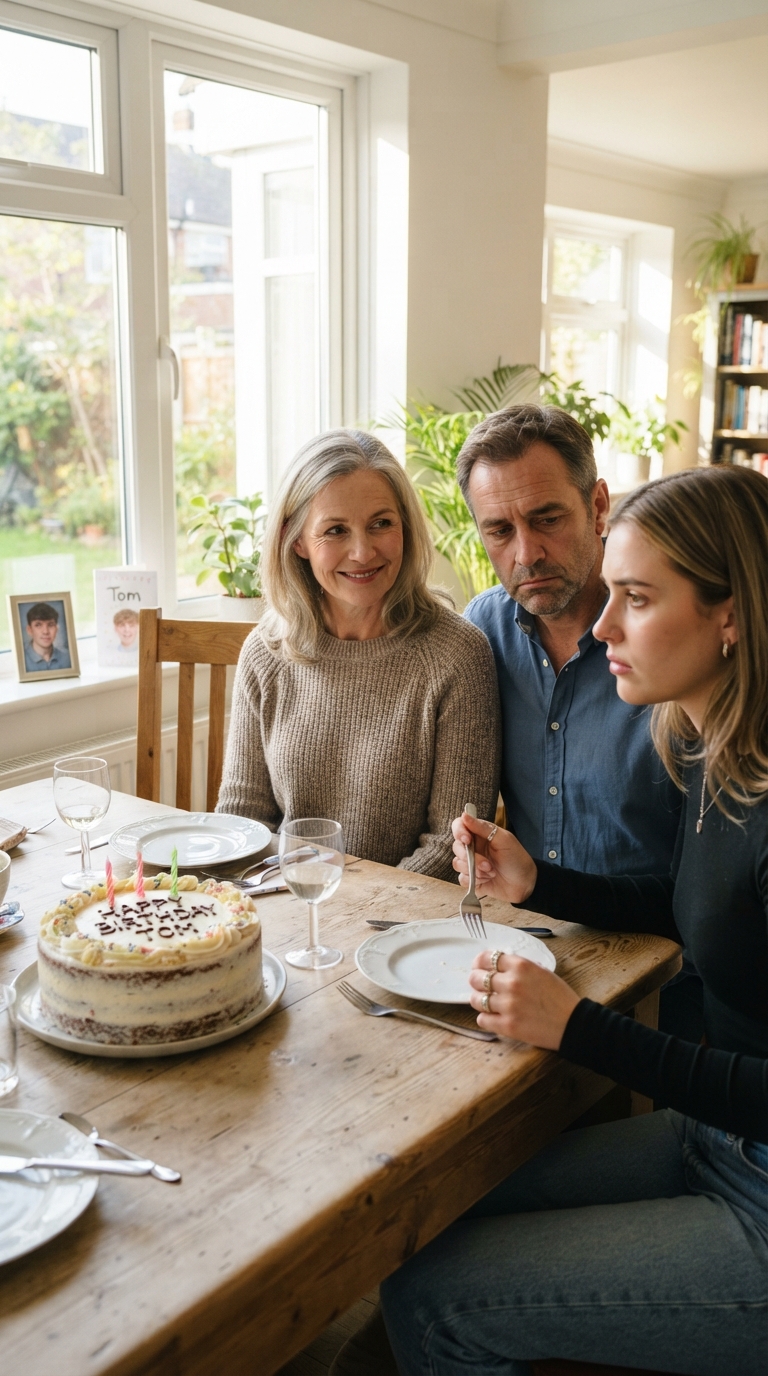
At the top of those stairs was not the daughter I remembered — and what she told me next revealed a truth so much bigger than cancer, so much bigger than silence, that it changed everything I thought I knew about the last six years of my life.
The staircase felt longer than it had any right to be. Every step creaked the way it always had — I remembered that from a hundred nights of carrying a sleeping toddler up to bed — but tonight each creak sounded like a countdown. My ex-husband stayed a few steps behind me, silent, letting me lead for the first time in this entire conversation.
The door at the end of the hall was cracked open, lamp light spilling into the hallway in a warm, uneven line. I pushed it open.
Karen was sitting up in bed, a book open on her lap, a soft cap covering hair that was still growing back in patchy, determined tufts. She was thinner than I remembered, her face sharper at the cheekbones, but her eyes — God, her eyes were exactly the same. The same eyes that used to look up at me from a bassinet. The same eyes that had glared at me across a courtroom hallway during the divorce, blazing with a fury I never fully understood until tonight.
When she saw me, the book slid off her lap. Neither of us moved for a full three seconds. Then she said my name — just my name, nothing else — and something in my chest cracked open like a dam giving way after years of holding back a flood.
I crossed the room and sat on the edge of the bed, and we held each other the way you hold someone you thought you’d lost, careful and desperate at the same time, both of us crying without any pretense of trying to stop. It took a long time before either of us could speak in full sentences.
When we finally pulled back, Karen wiped her face with the sleeve of her sweater and looked at me with an expression I hadn’t seen from her in years — not anger, not grief, but something that looked almost like relief.
“Dad told you,” she said. It wasn’t a question.
“He told me about the cancer,” I said. “About the surgery, the infection, the treatments. I know why you didn’t want me to see you sick.” I took her hand. “But Karen, I need you to know — I would have come. Every single day. I don’t care what version of you I would have seen. You didn’t need to protect me from that. I would have chosen you every time.”
She was quiet for a moment, and then she shook her head slowly, and what she said next reframed everything — not just the last six months, but the entire six years.
“Mom, it wasn’t really about the cancer keeping me away. The cancer is why I finally stopped being angry enough to keep staying away. But it’s not why I left in the first place.”
I frowned, confused. “What do you mean?”
She took a breath, the kind of breath you take before you say something you’ve rehearsed a thousand times in your head and never once out loud.
“When you and Dad divorced, I blamed you. You know that. I told everyone it was you — that you’d given up on the marriage, that you’d walked away from our family for no reason anyone could understand. That’s the story Dad told me, over and over, for months after you two split. He was hurting, and I think in his hurt he needed someone to blame, and it was easier to make that someone you instead of himself.”
My stomach turned over. I glanced back at him standing in the doorway, his face pale, his eyes fixed on the floor.
“But last year,” Karen continued, “when I was in the hospital — really sick, mom, sicker than Dad probably told you — I found old emails. Yours. Emails you sent me for years after the divorce that I never saw. Birthday messages. Apologies. An entire message explaining your side of what happened between you and Dad — the reason you actually left.” Her voice cracked. “He’d been filtering them. Blocking your number from my phone when I was a teenager still living under his roof, forwarding your emails to a folder I never knew existed, telling me you’d stopped trying to reach out so I wouldn’t go looking. He built the story that you abandoned me. And I believed it, because why would I doubt my own father?”
The room went very still. I felt the old anger I’d buried for six years rise up new and sharp, but underneath it was something else — a terrible, aching sadness for the years Karen and I had both lost to someone else’s decision, made without either of us in the room.
“I found out the truth almost a year ago,” she said. “I confronted him about it right there in my hospital bed, hooked up to an IV, half out of my mind from chemo, and do you know what he did? He broke down. Just like tonight. He told me the truth — that his own pride and grief over the divorce had turned into something uglier than he ever meant it to be. That somewhere along the way, keeping us apart became less about protecting me and more about punishing you. He’s spent this whole year trying to make it right. Slowly. Carefully. He didn’t want to just throw it at you and disappear — he wanted to actually fix what he broke, one honest conversation at a time, starting with taking care of me the way he should have all along.”
I looked at him again. He hadn’t moved from the doorway. His hands were shaking.
“Is that true?” I asked him, my voice barely above a whisper.
“Yes,” he said. “All of it. I am so sorry. I don’t expect you to forgive me tonight, or ever, honestly. But I couldn’t let one more year go by with Karen calling you her mother in secret while I let you believe she hated you. That wasn’t fair to either of you, and it was never really about her. It was about me.”
Karen squeezed my hand. “The cancer didn’t create the silence between us, Mom. It just finally broke it. Being that sick makes you realize how much time you’ve wasted being angry at the wrong things, believing the wrong stories. I spent this whole year getting stronger so I could have this exact conversation with you — not through an email, not through a phone call, but sitting up, in person, telling you the truth myself.”
I don’t remember exactly what I said after that. I remember crying in a way I hadn’t cried since she was born — a mixture of grief for six stolen years and a fierce, overwhelming relief that the daughter I thought had chosen to erase me had actually spent that entire time fighting two battles at once: one against a disease trying to take her life, and one against a lie trying to take her mother.
We talked until almost two in the morning. Karen told me about the treatments in detail this time, no filtering, no protecting me from the hard parts. I told her about the six birthdays, the empty chair, the candles I blew out alone every year while hoping she’d walk through the door. She cried when I described the chair. She said she never knew, and that if she had, she would have found a way to reach me sooner, sickness or no sickness, lie or no lie.
Before I left that night, long after midnight, my ex-husband walked me to the door. He looked older than he had when I first arrived, but something in his face had loosened, like a man finally setting down a weight he’d been carrying so long he’d forgotten what it felt like to stand up straight.
“I know sorry doesn’t undo six years,” he said. “But I’m going to spend as long as it takes trying to earn something better than sorry.”
I didn’t answer him that night. Some wounds don’t close on a single conversation, no matter how honest it is. But three weeks later, on a Sunday afternoon that felt more like spring than the calendar had any right to promise, Karen came to my house for dinner. She sat in the chair that had stayed empty for six years, and for the first time since her twenty-first birthday, I set the table for three people who all actually showed up.
I don’t know yet what my relationship with my ex-husband will look like going forward. Trust, once broken that deeply, doesn’t rebuild itself in a season. But I know what my relationship with my daughter looks like now, because she told me herself, sitting in that chair, finally able to eat a full plate of food without getting tired halfway through.
She looked at me, raised her glass of water like it was champagne, and said the only thing that mattered:
“Happy late birthday, Mom. I’m not going anywhere again.”
And for the first time in six years, I believed every word of it.