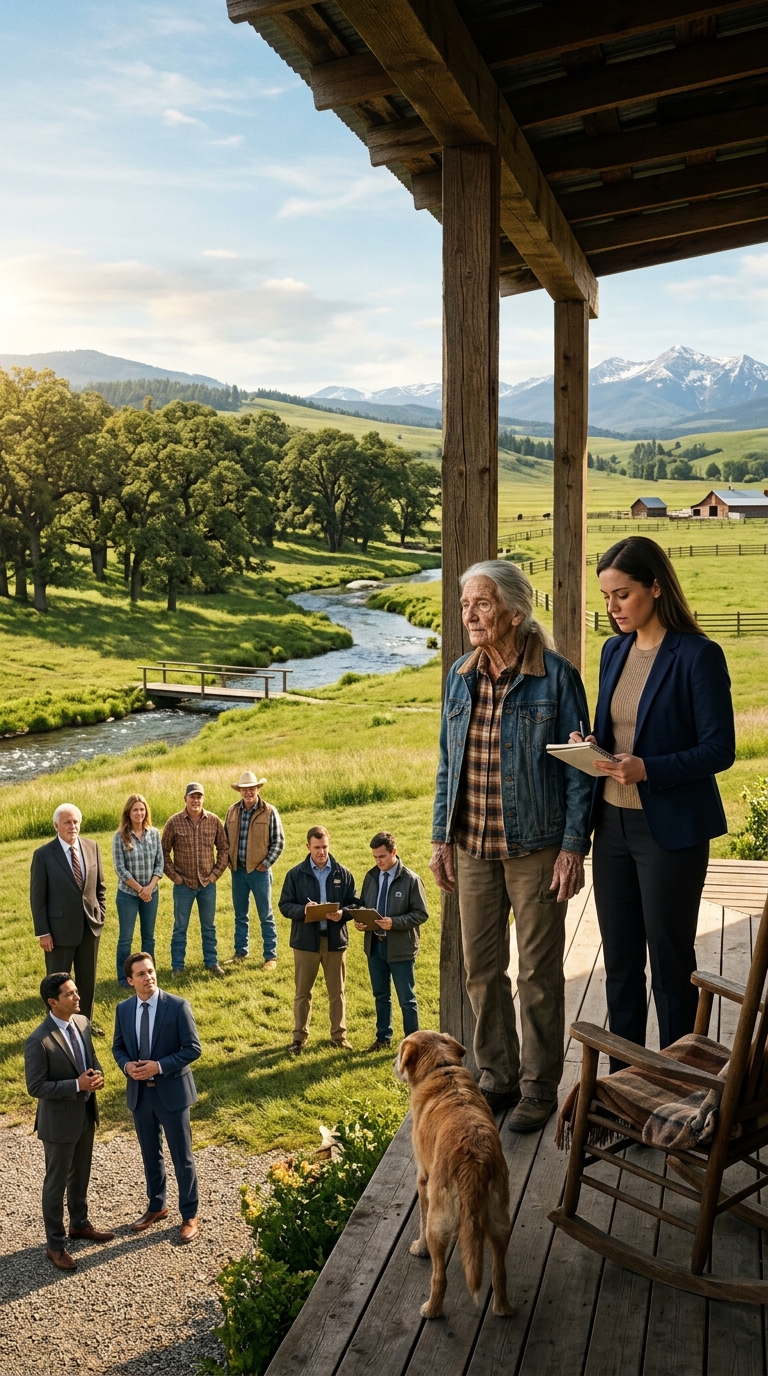
The courtroom in the county seat was not built for a case like this. It sat forty people on good, splintery wooden benches, had one ceiling fan that only worked on the left side of the room, and had, until three weeks ago, never seen a single reporter from outside a hundred-mile radius. On the day of closing arguments, it held two hundred and eleven people standing in the aisles, on the steps outside, and in the parking lot listening through the propped-open double doors, because word had traveled — the way it does in places where everybody still knows everybody — that Miss Nell Voss was fixing to take on the government and a billion-dollar corporation with nothing but a legal-aid lawyer and forty-one years of stubbornness, and that today, they’d find out if it had been enough.
Judge Samuel Okafor took the bench at nine in the morning, and before he let either side say a word, he did something no one in that courtroom had ever seen him do in three decades of presiding. He set aside his prepared remarks, folded his hands, and spoke without notes.
“I want to say something before we begin,” he said, “and I want it on the record, because I think it matters for what comes next, and because I am seventy-nine years old and I have decided I am done pretending that judges don’t carry their own history into a courtroom with them.
“In 1961, my grandmother, Adaeze Okafor, owned forty acres of good farmland in Terrell County, Georgia. A local development board decided that land was needed for a ‘county improvement project.’ She was offered a fraction of its worth. When she refused, they condemned it anyway, under a process that was, on paper, entirely legal — and in practice, entirely a lie, because the land was sold eighteen months later to a private cotton gin operation that had wanted it all along and hadn’t wanted to pay full price. My grandmother spent the last eleven years of her life trying, and failing, to get that land back, or get justice for how it was taken. She died in 1972 still filing appeals nobody read.
“I tell you this not because it should decide this case. It will not, and it has not. But I want everyone in this courtroom, and everyone in Harrow-Kestrel’s very expensive legal department, to understand exactly who is reading this file, and exactly why I read every page of it twice.”
The room was dead silent except for the one working half of the ceiling fan.
What followed was, by the county’s standards, the most thorough discovery process anyone could remember. Priya Ashworth, working nights with two law students who’d volunteered after reading about the case in a wire story that had, against Harrow-Kestrel’s clear preference, finally gone national, laid out the full timeline for the court.
The full disclosure was this:
The so-called “Rural Growth Corridor Initiative” had never existed as an infrastructure project. It had been created eighteen months earlier inside a little-known federal grant office, staffed at the time by a regional administrator named Carl Denning, who — records obtained through a Freedom of Information Act request Priya’s students filed on a hunch — had, four months before the initiative was announced, accepted a paid “advisory consultancy” position with a firm called Praxis Strategic Partners. Praxis Strategic Partners’ single largest client, disclosed in a separate SEC filing that took three paralegals two full days to locate, was Harrow-Kestrel Agricultural Solutions.
In plain terms: the man who designed the federal program that justified taking Eleanor Voss’s land was, at the time he designed it, being quietly paid by the company that stood to profit from taking it. He had never disclosed the conflict. The “public good” cited in Eleanor’s eviction notice had a private paycheck sitting underneath it the whole time.
Once the land was condemned and acquired at government-set “fair market value,” the plan — laid out in internal Harrow-Kestrel emails that Priya’s team subpoenaed and that the company fought for six weeks to keep sealed, unsuccessfully — was for the government to transfer the parcels to Meridian Ag Partners, the shell company, at a modest markup that would still leave Harrow-Kestrel with six hundred hectares of prime bottomland for a fraction of its actual value, on which they intended to build not a road or bridge or anything resembling public infrastructure, but a industrial waste-processing and containment facility that no county government had been willing to permit through ordinary zoning review, because it sat directly above the watershed feeding three counties’ drinking water.
The eminent domain claim had been, in the court’s final written words, “not a legitimate exercise of the public trust, but a laundering mechanism — using the machinery of government to disguise a private corporate land grab as a matter of public necessity, and to strip a private citizen of both her property and her ability to negotiate its fair value in the process.”
Desmond Praxton, for his part, argued for six full days that Harrow-Kestrel’s relationship with Meridian was a standard subsidiary structure, that Carl Denning’s consultancy was unrelated to his federal role, and that the timing of every single document Priya’s team had uncovered was, in each individual instance, coincidental. Judge Okafor listened to every argument. He asked, at one point, whether Harrow-Kestrel’s legal team could explain why Meridian Ag Partners had been incorporated in the same state, in the same month, by the same registered agent, as four other shell entities used in prior Harrow-Kestrel land acquisitions across two other states — a pattern Priya’s students had found by cross-referencing public incorporation records, something none of Harrow-Kestrel’s own expensive lawyers had apparently thought an eighty-nine-year-old woman’s legal-aid team would bother to do.
Praxton did not have an answer for that one.
On the fourteenth day of trial, Judge Samuel Okafor issued his ruling from the bench, reading it slowly, so that everyone standing in the parking lot listening through the open doors could hear it too.
He ruled that the taking of Eleanor Voss’s one hundred fifty hectares had been conducted in bad faith, under a federal program whose stated public purpose was a pretext for private corporate benefit, in violation of both the takings clause and the state’s own eminent domain statutes governing legitimate public use. He voided the condemnation entirely. He ordered the land returned to Eleanor Voss’s name, title clean, effective immediately. He referred Carl Denning’s conduct to the federal Inspector General’s office for a criminal fraud investigation, and did the same for two Harrow-Kestrel executives whose names appeared repeatedly in the subpoenaed correspondence. And, in a move that made front-page news in four states, he ordered Harrow-Kestrel to pay not only Eleanor’s legal fees, but a punitive damages award of four million dollars — an amount he explained, on the record, he had calculated specifically to exceed whatever profit margin the company’s own internal projections had estimated for the waste facility, “so that this court can say, without ambiguity, that this scheme cost the company more than it ever would have gained.”
Eleanor Voss sat in the front row through the entire reading, her rope-worn hands folded in her lap, and did not cry until the very end, when Judge Okafor set down his papers, looked directly at her — not at the lawyers, not at the gallery, at her — and said, quietly, off any script:
“Ms. Voss, your grandmother was right. Land doesn’t belong to us. We belong to it, for as long as it lets us stay. I hope you get a very long while yet.”
The courtroom, against every rule of decorum the bailiff tried to enforce, broke into applause that lasted almost two full minutes.
What happened after:
Carl Denning was indicted eight months later on federal fraud and bribery charges and eventually pleaded guilty to a reduced charge, cooperating in exchange for testimony against two Harrow-Kestrel executives, both of whom were fired within the year, though neither faced criminal charges — the company settled a separate civil suit brought by the state attorney general for an undisclosed sum, widely reported to be in the tens of millions, before that case ever reached trial. Harrow-Kestrel issued a statement expressing “strong disagreement” with the ruling while declining to appeal, a decision most legal observers read as an acknowledgment that an appeal would only surface more of the discovery record.
The Rural Growth Corridor Initiative was quietly dissolved by the federal grant office eleven months after the ruling, following a congressional inquiry that cited Eleanor’s case, among four others uncovered in its wake, as evidence of “systemic vulnerability to private capture in eminent domain proceedings nationwide.” Three of those four other cases resulted in landowners getting their property back as well; a fifth family, in a neighboring state, had already sold under duress two years earlier and was never made whole, a fact Eleanor thought about often and never stopped being angry about.
Priya Ashworth left legal aid work eighteen months later to found a small nonprofit dedicated entirely to representing rural landowners against eminent domain overreach, funded in part — over her repeated, embarrassed objections — by Eleanor Voss’s portion of the punitive damages award.
Judge Samuel Okafor retired four months after the ruling, exactly as he’d planned, and gave a single interview to a national paper in which he said the Eleanor Voss case was the only ruling of his thirty-year career he would ask to be remembered for. He mentioned his grandmother by name in that interview too.
And Eleanor Voss, eighty-nine years old going on ninety, planted a new stand of walnut trees along the fence line behind the hayfield that spring, not far from where Ruth Ann Calloway was buried, in soil that was, once again and forever, unambiguously her own.
She never did get the eleven months of anxiety back, or the sleep she lost, or the friends who’d sold out around her while she held on alone. Some things a courtroom can hand back to you, and some things it can’t. But she got the dirt back. She got to die, years later — an old, old woman, in her own bed, in her grandmother’s house, on her own hundred and fifty hectares — without ever having to ask anyone else’s permission to stay.
Land doesn’t belong to you. You belong to it, for exactly as long as it lets you stay.
She’d kept that promise. In the end, so had the law — barely, and only because one tired old judge had decided, one more time before he was done, to make it keep its word.