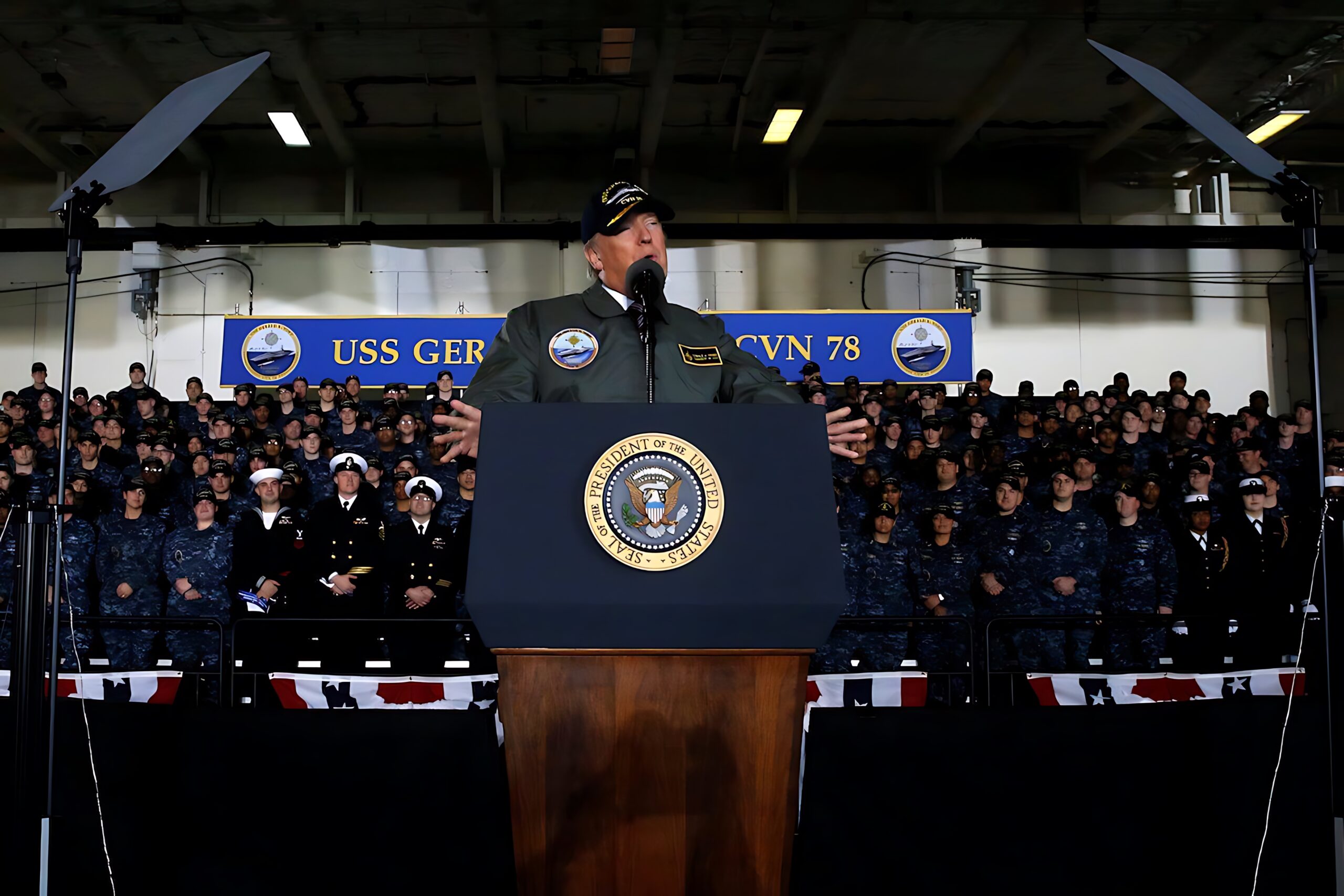
April 2026 — Atlantic Ocean
The USS Gerald R. Ford, the U.S. Navy’s newest and most advanced aircraft carrier, has completed a record-breaking operational deployment that military officials describe as a milestone in modern naval capability. The mission, which stretched longer than any previous maiden deployment of a U.S. carrier, has drawn significant attention due to the ship’s central role in President Donald Trump’s stated military modernization goals.
A Deployment Designed to Test Limits
Navy officials confirmed that the Ford spent months at sea conducting integrated exercises, joint operations with NATO partners, and high-tempo flight operations intended to push the vessel’s next-generation systems to their limits. The carrier’s electromagnetic aircraft launch system (EMALS) and advanced arresting gear—two of its most scrutinized technologies—completed thousands of cycles during the deployment.
Commanders described the mission as “a proving ground” for the $13 billion vessel, the first in its class and the most technologically complex carrier ever built.
Strategic Significance Amid Global Tensions
The extended deployment comes at a time of heightened geopolitical friction, with U.S. naval forces increasingly active in the Mediterranean, the North Atlantic, and the Indo-Pacific. Defense analysts note that the Ford’s presence served both operational and symbolic purposes, demonstrating U.S. naval reach while reinforcing commitments to allies.
The carrier participated in multinational exercises involving the United Kingdom, Italy, Norway, and Canada, integrating advanced air wings and testing interoperability with European naval forces.
A Centerpiece of Trump’s Defense Agenda
President Trump has repeatedly highlighted the Gerald R. Ford as a cornerstone of his administration’s military ambitions, emphasizing fleet expansion, readiness, and modernization. While the administration has not released detailed long-term plans for the Ford-class program, officials have stated that the ship’s performance will shape future procurement and deployment strategies.
Pentagon briefings have framed the deployment as evidence that the Navy is moving toward a more agile, technology-driven force structure. The Ford’s successful operations are expected to influence decisions on carrier air wing composition, unmanned systems integration, and global force posture.
Crew Endurance and Operational Tempo
Sailors aboard the Ford faced an unusually demanding schedule, with extended flight operations and rapid port calls designed to simulate real-world crisis conditions. Navy leadership praised the crew’s performance, noting that the deployment provided valuable data on personnel endurance and shipboard logistics.
Despite the high tempo, officials reported no major system failures, a notable achievement given the ship’s history of developmental challenges.
Looking Ahead
With its record-setting deployment now complete, the USS Gerald R. Ford returns to port for maintenance, data analysis, and preparation for its next operational cycle. Defense observers expect the ship’s performance to play a significant role in shaping U.S. naval strategy over the coming decade.
As the Navy continues to refine the Ford-class program, the vessel’s first major mission stands as a benchmark—both for technological innovation and for the evolving role of American carrier power in a shifting global landscape.