“Margaret,” Robert said, and the polish was gone from his voice, “I think you should come to the house. Alone. Before you speak to Ivan.”
“I’ll come,” I said, “but you’ll tell me now who filled in that form.”
A long breath. “Stella did. She told us you’d signed off months ago. She said you were frail about the house and wanted her to handle everything.”
My hand went still on the folder. “Frail.”
“Catherine and I believed her. Why wouldn’t we?”
Their house sat on a hill outside Millbrook, all columns and clipped hedges. Catherine met me at the door in a cardigan, pale, without a trace of the warm hostess smile from the invitation.
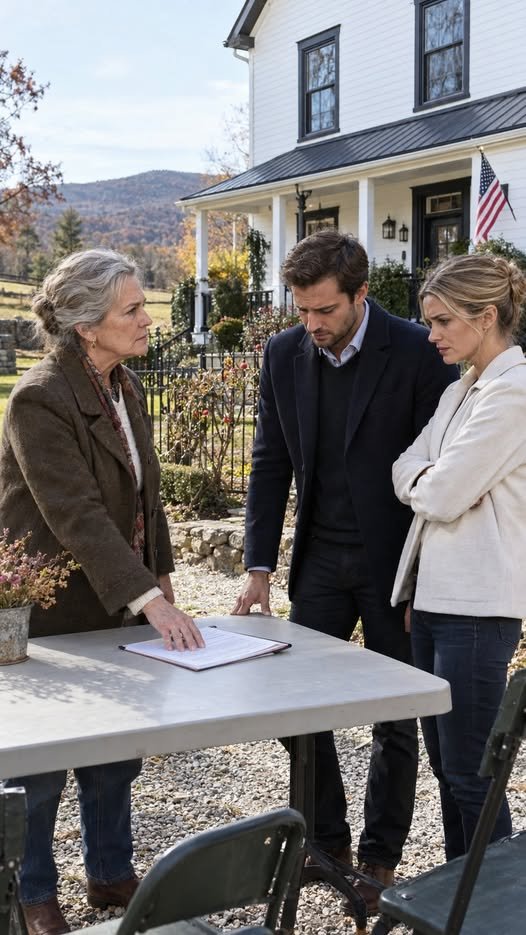
They sat me in the sunroom with tea I didn’t touch. On the table lay a thick folder. Robert opened it with unsteady hands.
“We paid forty-one thousand dollars in deposits,” he said. “Stella handled the planning. She said you’d donated the venue as a wedding gift, that you were too modest to be named, and that you’d asked her to say we were the hosts.”
“I asked for nothing of the kind.”
“I know that now.” Catherine’s voice trembled. “When the coordinator asked for proof of your approval, we had none. Stella said it was in your handwriting, in a letter. She promised to find it.”
“Did she?”
Robert slid a single page across the table. It was a letter on cream stationery, dated four months back.
I, Margaret Callaway, authorize Stella Hartley to coordinate all events at my Millbrook property and to represent my interests to vendors.
It carried my signature. It was a good copy. It was not mine. I’d never dotted my name that way, with the little flourish over the i.
I sat very still. I had taught thirty-four years of children’s handwriting. I could have picked out a forgery from across a classroom.
“Where is Stella?” I asked.
“Upstairs,” Catherine whispered. “She’s been in her room since the coordinator called.”
I stood. “I’d like to speak with her. Alone, if you’ll allow it.”
Robert and Catherine looked at each other with the helplessness of parents who have just realized how little they knew. Catherine nodded.
Stella’s room was a nursery of an adult’s expectations: a white vanity, framed magazine covers, a wedding dress hanging in plastic by the window. She sat on the bed in a sweatshirt, hair unbrushed, looking younger than twenty-eight.
“I knew you’d find out,” she said before I spoke.
“You forged my signature.”
“Yes.”
“Why?”
She laughed, shaky. “Because you’d have said no. And Ivan wanted that house for the wedding. He talked about it constantly. ‘Mom’s farmhouse, the oak tree, my grandmother’s roses.’ I wanted to give him the day he described. And my parents wanted the best for me, and everyone had already been told. So I just… said yes on your behalf.”
“And the roses?”
She flinched. “Mr. Hartley’s landscaper said they were diseased. I believed him. I didn’t know they were your mother’s.”
“And the swing?”
“I didn’t ask.” She looked at her knees. “I should have asked everything.”
I sat in the white chair opposite her. “Stella, why did you tell your parents I was frail?”
Her eyes filled. “Because I couldn’t think of another reason you’d stay quiet. Ivan always said you were so strong. I thought if you were fragile, nobody would question why I was handling it.” She wiped her face. “And I think, honestly, I wanted you to be small. You frightened me. You raised him alone. You’re everything he admires. I was afraid I’d never be enough beside that.”
It wasn’t an excuse. But it was the first true thing she had ever said to me.
“Does Ivan know?” I asked.
“No. He believes you approved it, and that you were just upset about the changes.” She covered her face. “He thinks I’m good, Margaret. I couldn’t stand for him to learn otherwise.”
“He’s going to learn tonight,” I said. “From you.”
She nodded, sobbing.
I called Ivan. He arrived forty minutes later, windblown, anxious, still in his work shirt. He found us in the sunroom, Stella standing by the window, trembling, with her parents on the sofa and the forged letter on the table.
“Mom? What’s happening?”
“Stella has something to tell you,” I said.
It took her twenty minutes. She did not soften it. She told him about the letter, the false authorization, the lie to her parents, and the roses. At the end she said, “I’m so sorry. I’m sorry I made your mother disappear from her own property.”
Ivan stood motionless. When he finally spoke, his voice was very quiet.
“You made me believe she’d agreed. I called her selfish in my head. For weeks.”
“I know.”
He turned to me. His eyes were wet. “Mom. I let her. I should have called you myself. I should have asked.”
“Yes,” I said gently. “You should have.”
We did not cancel the wedding that night. We argued about it for three hours instead, at the Hartleys’ dining room table, all five of us, with a legal pad and a pot of coffee.
I made my terms plain.
The wedding could go forward at the farmhouse, because Ivan wanted it, and because I wanted to be present in my son’s life more than I wanted to win. But the Hartleys would be listed as guests, not hosts, and the program would thank me by name as the property’s owner. Stella would write apologies to the coordinator and to me, and she would restore the roses at her own expense, with a landscaper I chose. The invoice for the damaged fence would be paid by the Hartleys.
“And the letter,” Robert said hoarsely. “It’s forgery. You could press charges.”
I looked at Stella. She stood with her hands knotted, waiting.
“I won’t,” I said. “But the copy goes in my files. If it ever happens again, I will.”
Stella cried openly then, and Catherine, to my surprise, reached across the table and took my hand.
“Thank you,” she whispered.
The wedding took place on a clear Saturday in May.
The roses were still bare stalks, but Stella had planted new ones with her own hands, and the gardener swore they’d bloom by July. My mother’s porch swing hung again from its hooks, a second-hand replacement Ivan had found. The program read: Ivan and Stella are married at the Callaway Farmhouse, with gratitude to Margaret Callaway, who loves this land.
I sat in the front row, in a pale yellow dress that matched my mother’s old paint.
When Ivan saw me, he stopped at the altar and crossed the aisle in front of two hundred guests. He hugged me, hard, the way he had when he was eleven.
“I’m sorry I forgot you,” he whispered.
“You remembered,” I said. “That’s what counts.”
Stella and I were not close at first. For a year, our conversations were careful. But she wrote me a letter every month, honest and short. She learned the recipe for my mother’s biscuits. When she planted the new roses, she sent me a photograph of every bud.
At Christmas, she hung my mother’s tin star on the farmhouse tree, then looked at me anxiously.
“Is that all right?”
“Perfectly,” I said.
The following summer, the roses bloomed, pink and crowded, climbing the porch rail the way they always had. Ivan and Stella hosted Sunday lunch on the lawn, and I sat on my mother’s swing with a glass of lemonade, watching my son laugh.
On the deed in my drawer, my name was still alone.
But the farmhouse, I realized, had never been only mine. It belonged to everyone who had learned to treat it, and each other, with care.