The town of Oakridge was quiet on Christmas morning. Snow blanketed the sidewalks, and frost sparkled on the storefront windows along Main Street.
Samuel walked slowly toward the newly constructed Oakridge Community Library—a grand stone building that had been erected two years prior through an anonymous multi-million-dollar donation.
When Samuel reached the library at five minutes to ten, the main glass doors were locked, and the building appeared dark and quiet. He walked around to the west wing, as the note instructed. Beside a heavy, polished oak door stood a small antique brass lockbox embedded in the stone wall.
Samuel pulled the golden key from his pocket. His hand shook as he inserted it into the keyhole. With a soft, satisfying click, the lock turned, and the heavy oak door unlocked.
Samuel pushed the door open and stepped inside.
Instantly, bright warm lights flooded his eyes, and a thunderous round of applause echoed through the grand central atrium!
Samuel froze in complete shock.
The library was not empty. Standing inside the sunlit atrium were over two hundred people—men and women of all ages, holding flowers, banners, and framed photographs. Standing at the central podium was a tall, distinguished man in his sixties with silver hair and warm, tear-filled eyes, wearing an expensive suit.
It was David Ross.
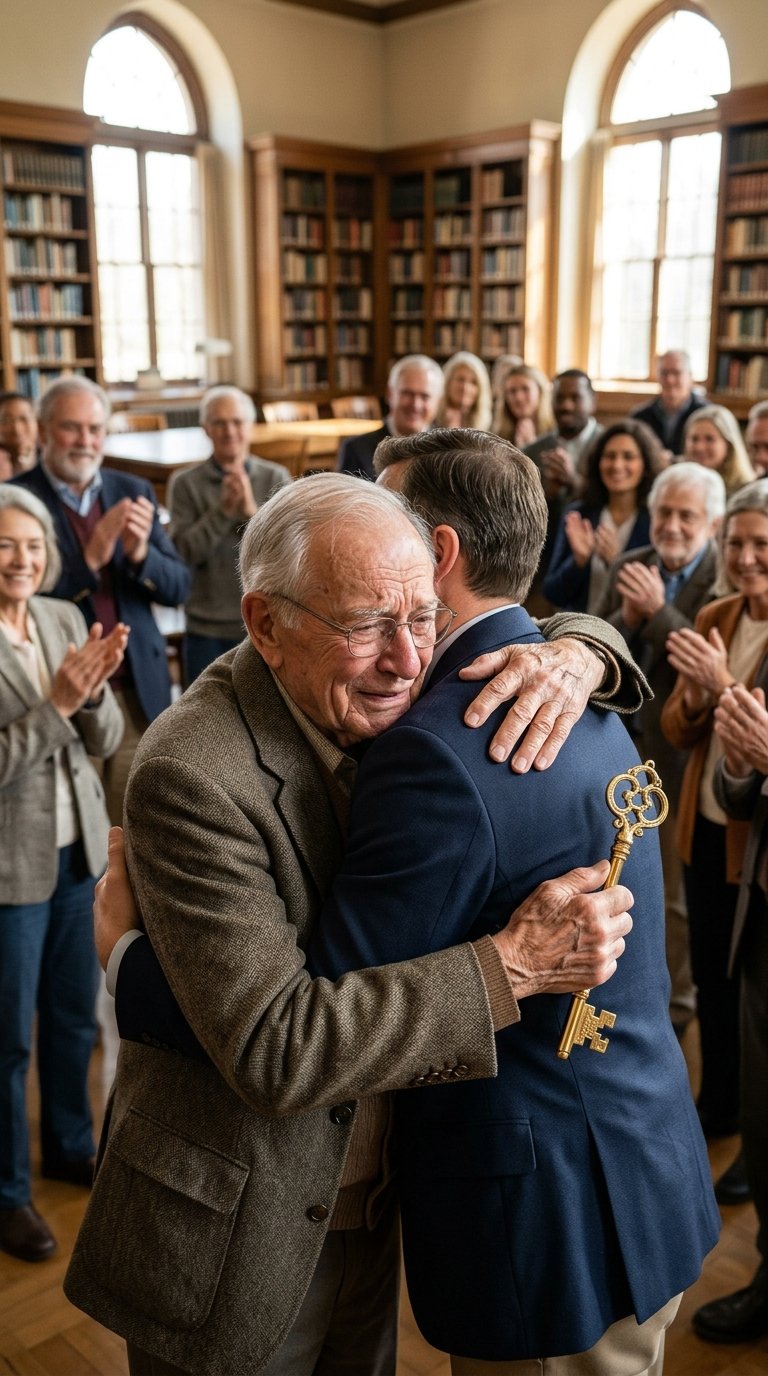
David stepped down from the podium and walked across the marble floor, opening his arms to embrace his eighty-two-year-old former teacher.
“Merry Christmas, Mr. Vance,” David whispered through tears as he held Samuel tight.
When they stepped back, David led Samuel toward the center stage, picking up the microphone.
“Fifty years ago,” David announced to the emotional crowd, “I was an orphan boy who believed I was invisible and worthless. The world had written me off. But one man stayed behind every single afternoon in an empty classroom. He fed me, he taught me to read, and he gave me a key to a drawer where I could write my dreams.”
David turned toward Samuel, holding up an international bestseller novel written under David’s name, along with a foundation plaque.
“That leather journal you gave me, Mr. Vance, became my first published book. I went on to become a writer and a publisher, and I created the Ross Literacy Foundation. Over the past thirty years, our foundation has built forty public libraries across the country and funded ten thousand university scholarships for foster children.”
David pointed to the massive bronze plaque mounted on the library’s marble wall, unveiled before the crowd.
The inscription read: THE SAMUEL VANCE LITERACY CENTER — In Honor of the Teacher Who Believed When No One Else Did.
David looked out at the cheering audience. “Every single person standing in this room today is a former student of yours, Mr. Vance—doctors, engineers, artists, mechanics, and teachers—along with the children who benefited from our literacy foundation. Every book I have ever written, every library I have built, belongs to you.”
Generations of students stepped forward, hugging Samuel, sharing memories of his classroom, and handing him letters of gratitude they had carried for decades.
Standing in the center of the hall, surrounded by hundreds of lives he had touched, Samuel looked up at the warm afternoon sun streaming through the stained-glass windows. He realized that no true act of kindness is ever lost in time—and that a teacher’s love echoes through eternity.