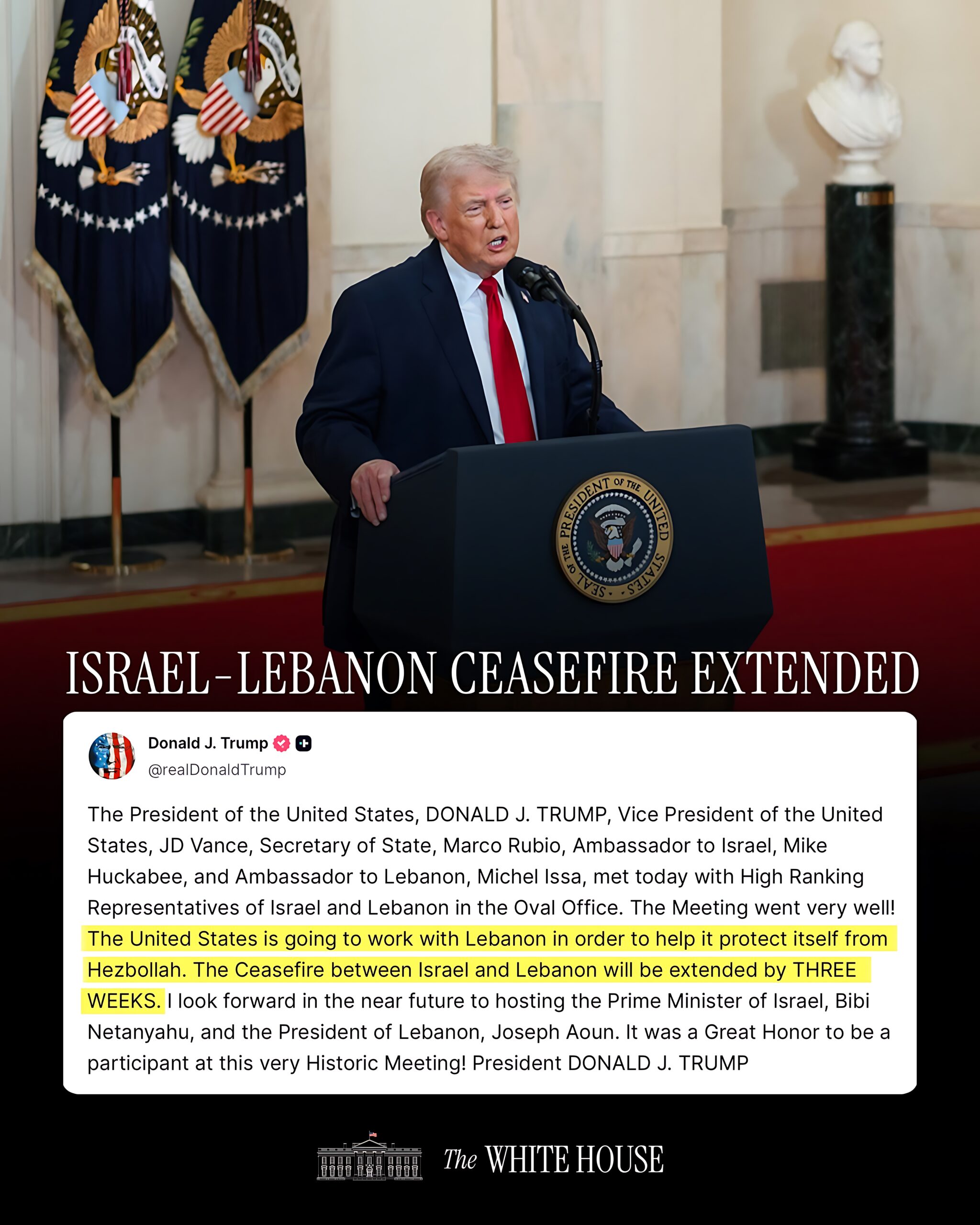
WASHINGTON — President Donald J. Trump said Friday that the United States will begin working directly with Lebanon to help the country “protect itself from Hezbollah,” as part of a new diplomatic framework accompanying the extension of the Israel–Lebanon ceasefire by three weeks.
“The meeting went very well,” Trump said in a statement. “The United States is going to work with Lebanon in order to help it protect itself from Hezbollah. The ceasefire between Israel and Lebanon will be extended by three weeks.”
The announcement follows a series of high‑level talks involving U.S., French, and Qatari mediators, who have sought to stabilize the fragile truce that first took effect earlier this month.
A Broader Security Commitment
Senior administration officials said the new U.S.–Lebanon initiative will focus on border security, intelligence sharing, and counter‑terrorism training, aimed at strengthening Lebanese state institutions and reducing Hezbollah’s influence.
Pentagon sources confirmed that the plan does not involve deploying American troops to Lebanon but will include expanded cooperation through the U.S. Embassy in Beirut and regional partners.
“This is about helping Lebanon stand on its own,” one official said. “The president wants to ensure that Hezbollah cannot dictate the country’s future.”
Ceasefire Extension Negotiated Overnight
The three‑week extension was finalized after overnight negotiations between Israeli and Lebanese representatives, with indirect communication through intermediaries in Doha and Islamabad. Officials said both sides agreed to maintain the existing terms — halting artillery fire, drone activity, and cross‑border raids — while exploring a longer‑term de‑escalation framework.
Israeli officials welcomed the extension but warned that any violations would trigger “immediate defensive action.” Lebanese leaders described the pause as “a vital window for diplomacy and reconstruction.”
Regional and International Reaction
European governments praised the announcement, calling it a “rare moment of sustained calm” in a region long defined by volatility. The United Nations said it would increase monitoring along the Blue Line to prevent accidental clashes, while Gulf states expressed cautious optimism that the truce could evolve into a permanent settlement.
Energy markets responded positively, with oil prices dipping slightly amid expectations of reduced regional risk.
Analysts: A Strategic Win for U.S. Diplomacy
Foreign‑policy analysts say Trump’s move to link the ceasefire extension with direct U.S. support for Lebanon represents a strategic recalibration of American policy in the Middle East.
“It’s a two‑track approach — pressure on Hezbollah, partnership with the Lebanese state,” said one regional expert. “It’s both deterrence and diplomacy.”
What Comes Next
U.S. officials say the next phase will involve drafting a joint security memorandum with Lebanon’s government and coordinating with Israel to ensure compliance with the ceasefire terms. If successful, the administration hopes the three‑week extension will pave the way for a longer‑term peace framework and a regional security dialogue later this year.
For now, Trump’s statement marks a rare moment of optimism in a conflict that has tested the limits of diplomacy — and underscores Washington’s renewed role as a broker of stability in the Middle East.