He found the first letter on a Tuesday. Tucked between the pages of her old recipe book, right where she used to hide the good chocolate. His name was written in her handwriting — that soft, looping script he hadn’t seen in two years, not since the night the world went quiet and she slipped away in her sleep.
He sat down at the kitchen table, the one they bought when they were too young to afford anything better, and opened it with trembling fingers.
“If you’re reading this, it means you’ve finally cleaned the kitchen like I always asked.” He laughed — a broken, startled sound — because it was exactly the kind of joke she would make. But the next line stopped him cold.
“I wrote you a letter for every anniversary after I’m gone. One for each year you’ll have to learn to live without me.”
He pressed the paper to his chest. He wasn’t ready. But she had always known he wouldn’t be.
The second letter came a month later, hidden in the pocket of her old gardening apron. The third was taped inside the coffee tin. The fourth arrived in the mail — she had arranged it years before, the stamp faded, the ink smudged by time.
Each one carried a memory. A lesson. A reminder. A piece of her.
And each one ended the same way: “Go sit on the porch for me. I’ll meet you in the wind.”
He went every time. Even in winter.
By the fifth letter, he began to understand what she was doing. She wasn’t trying to keep him tied to the past. She was teaching him how to walk into the future without collapsing under the weight of it.
The sixth letter was the hardest. It was the one where she admitted she had known her illness was worsening long before she told him. The one where she apologized for the pain she knew he’d carry. The one where she wrote, “Loving you was the easiest thing I ever did. Leaving you will be the hardest thing you ever do.”
He cried until the ink blurred.
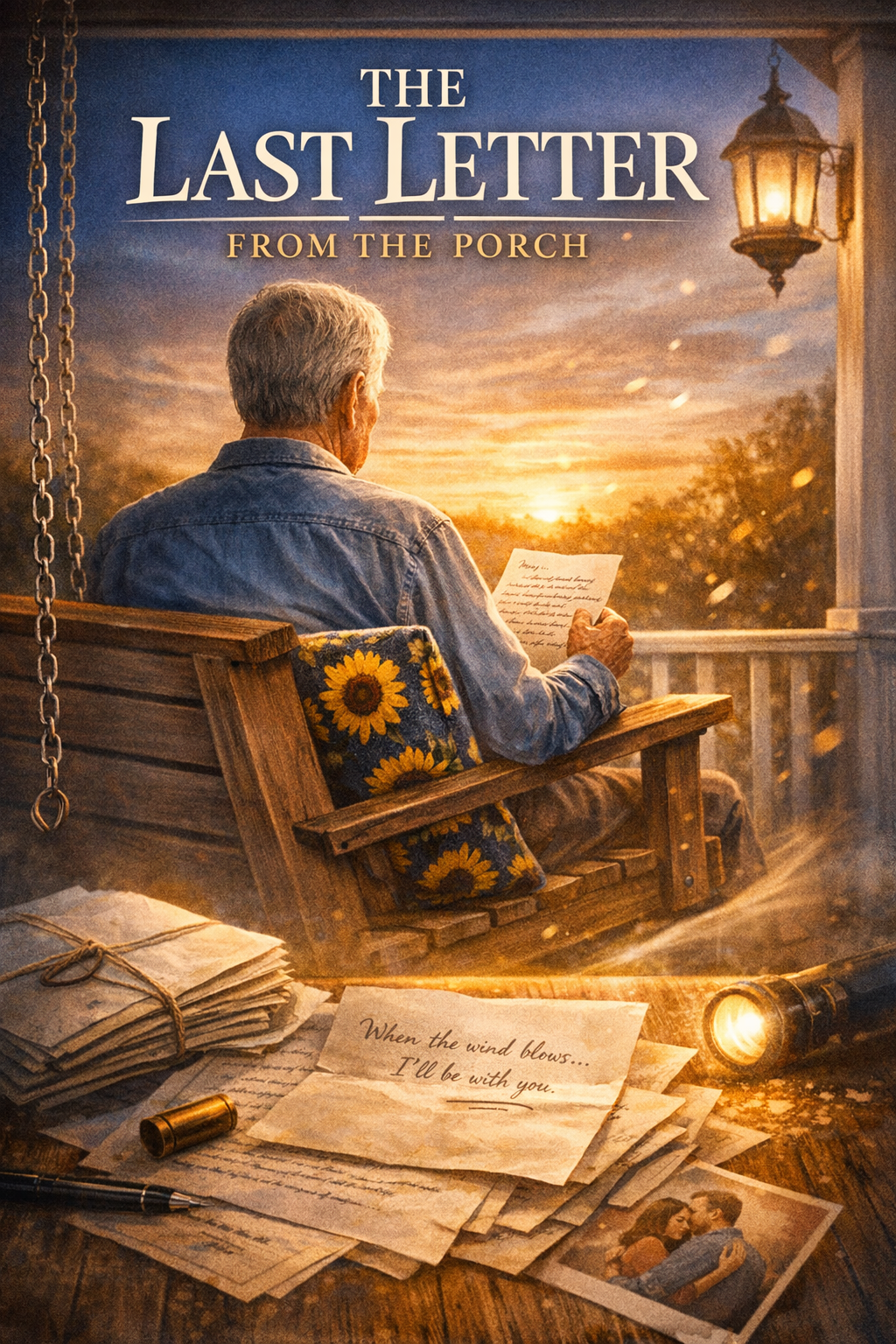
The seventh letter arrived on the morning of what would have been their 40th anniversary. He found it on the porch swing — the swing he hadn’t sat on since the day she died. But something was different.
The wood was new. The chains were polished. The seat cushions were the exact pattern she loved — sunflowers on navy blue.
He opened the letter with a sense of dread and wonder.
“I asked the carpenter to restore our swing after I’m gone. You always said it was where we fell in love the first time… and every time after.”
He looked around the porch, suddenly aware of the breeze brushing his cheek.
“Sit, my love. Let the wind hold you the way I can’t.”
He sat. The swing creaked softly, moving on its own. And for the first time in years, he didn’t feel alone.
The eighth and final letter came at sunset. It was short. Almost too short.
“You’ve made it this far. I’m proud of you. Now live the rest of your life the way we always dreamed — with laughter, with courage, with messy joy. And when the wind blows… that’s me, coming back to you.”
He folded the letter, placed it on his lap, and leaned back on the swing. The breeze picked up, warm and familiar. He closed his eyes.
And for a moment — just a moment — he felt her hand in his.