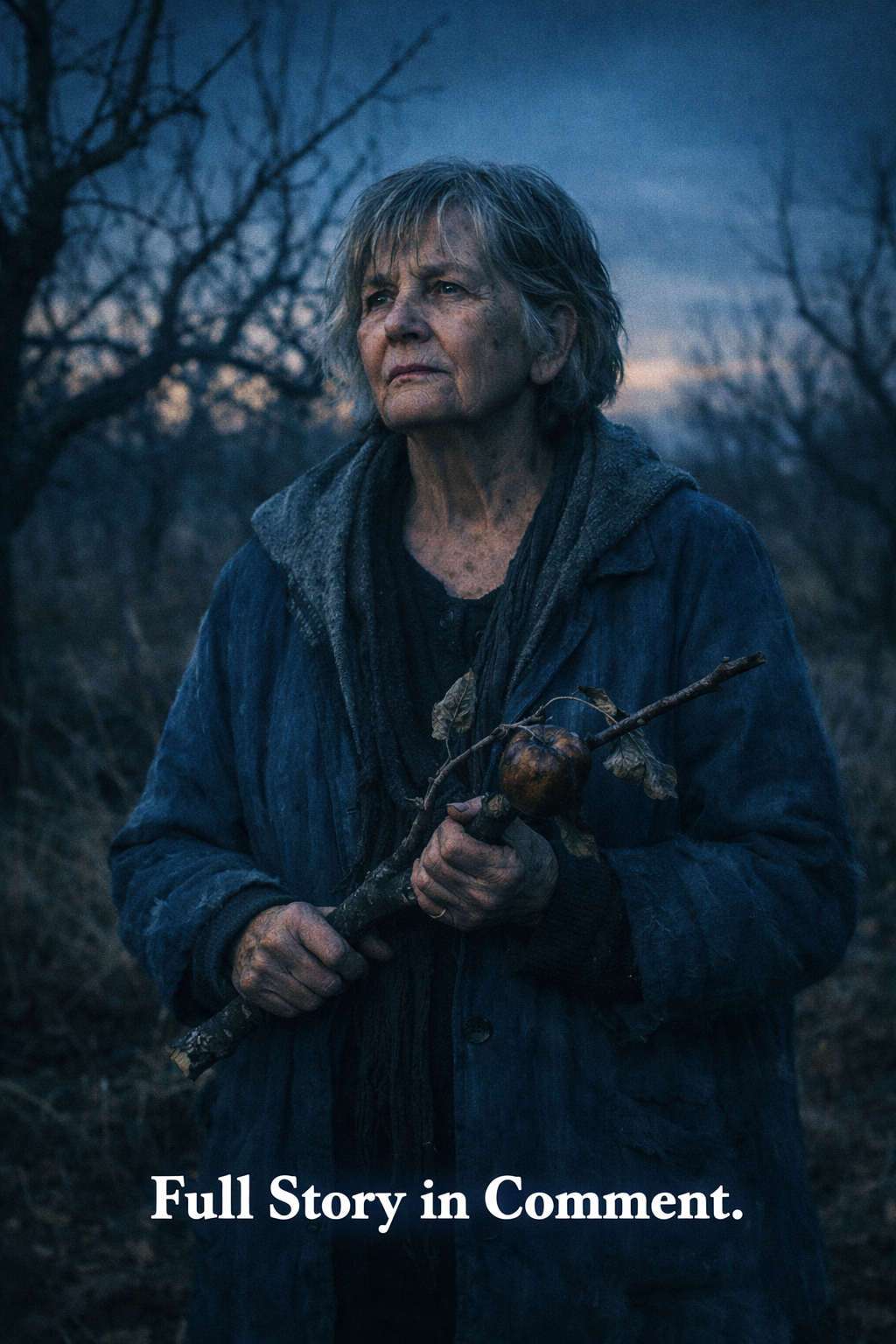
The orchard had once been alive — rows of apple trees glowing under the morning sun, their branches heavy with fruit and laughter. The air used to smell of sweetness and soil, of life and love. But now, the trees stood bare, their bark cracked, their leaves gone. The wind passed through them like a ghost searching for what was lost.
Evelyn stood at the edge of the field, her hands buried in the pockets of her faded coat. The ground beneath her boots was dry, the color of old bones. She looked at the trees and saw not wood and leaves, but memories — her husband’s laughter, her daughter’s small hands reaching for apples, the sound of summer that used to fill the air.
Her husband, Thomas, had built the orchard for their daughter, Lily. “It’ll be her inheritance,” he used to say. “She’ll grow up knowing what hard work feels like, what love tastes like.”
But Lily had grown up and left. Left for the city. Left for a life that didn’t smell of apples or rain or home.
At first, she called. Then she texted. Then she stopped. The last message Evelyn received was short, cold, and final: “I’m not coming back. Please stop calling.”
Thomas never recovered from that message. He stopped tending the trees. He stopped singing while he worked. He stopped believing that love could survive distance.
When he died, Evelyn buried him beneath the oldest apple tree — the one that had always bloomed first. She placed his hat on the branch and whispered, “She’ll come home someday.”
But she never did.
Now, years later, Evelyn stood alone in the orchard, the wind tugging at her hair. The trees were dying, one by one, their roots brittle, their fruit gone. She walked slowly between them, touching each trunk as if saying goodbye.
She stopped at the old tree — Thomas’s tree. The hat was still there, faded and torn, swinging gently in the wind.
Evelyn knelt beside the roots. Her fingers brushed the soil. “I kept it alive for her,” she whispered. “For both of you.”
The wind answered with silence.
She looked up at the horizon, where the city lights shimmered faintly in the distance. Somewhere out there, her daughter lived a life untouched by dirt, rain, or memory. A life built on forgetting.
Evelyn smiled — not out of joy, but out of surrender. She reached for the nearest branch, brittle and cold, and broke off a piece. It snapped easily.
“Even love dies if you stop watering it,” she said softly.
The sun dipped below the hills, painting the orchard in blue twilight. Evelyn stood there until the light faded completely, until the world turned quiet, until the orchard became nothing more than a shadow of what once was.
And when she finally walked away, the wind carried her whisper through the dead branches:
“The orchard died too early… but not before I did.”