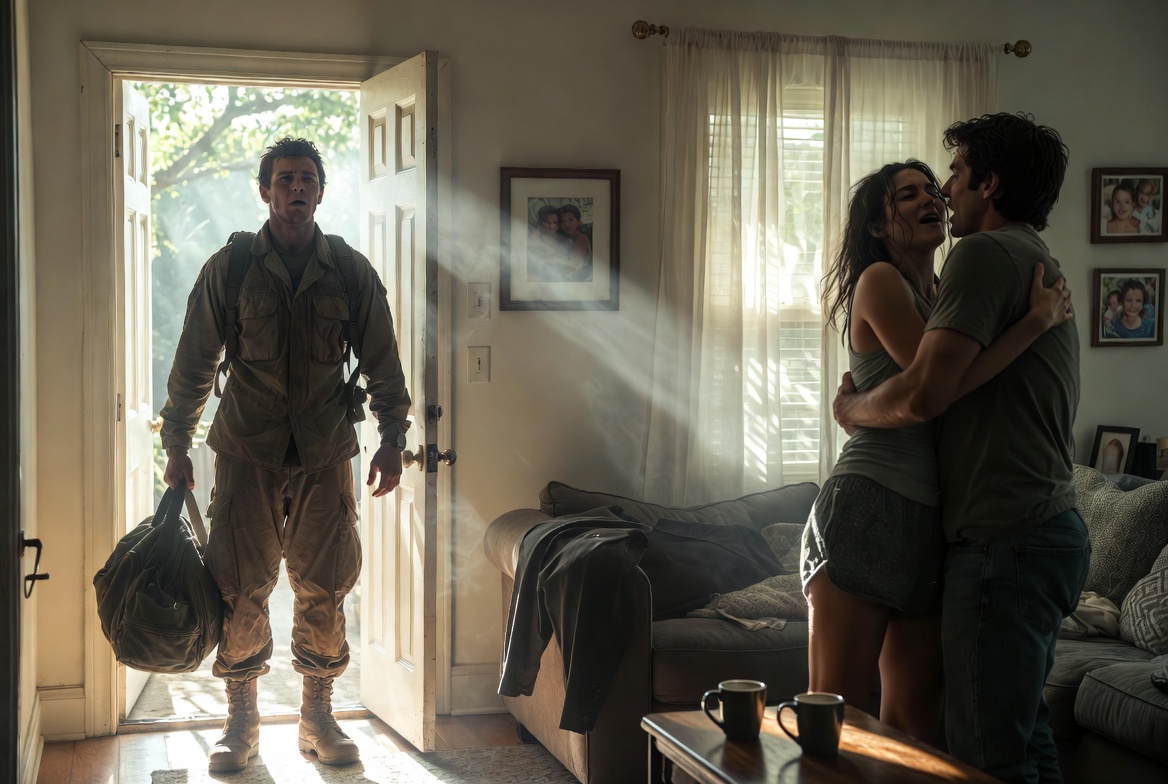
Cole Harrison enlisted at nineteen. By the time of this incident, he had completed four deployments.
He was known among his unit for his discipline, reliability, and quiet leadership.
At home, he was married to Emily, a woman he believed had stood by him through every separation.
Cole’s final month overseas was spent counting days, imagining the warmth of his own kitchen, and the familiar sound of Emily’s laugh.
He carried a small notebook where he wrote future plans:
Rebuild marriage
Start a family
Buy a home
He believed he was returning to stability.
Cole arrived unannounced, a day earlier than scheduled.
He wanted the moment to feel real, not staged for social media or family photos.
When he opened the front door, he immediately sensed the shift.
The house smelled different—perfume he didn’t recognize.
A jacket he didn’t own hung on the chair.
Two wine glasses sat on the counter, one with lipstick that wasn’t Emily’s usual shade.
He called her name.
No answer.
Cole walked down the hallway with the same controlled breathing he used clearing rooms overseas.
From the bedroom came a sound—soft laughter, then a man’s voice.
He froze.
Not because he was afraid.
Because the world he had built in his mind collapsed in one silent second.
When he opened the door, he saw Emily with another man.
The expression on her face was not guilt.
It was irritation—like he had interrupted something trivial.
Her first words were not “I’m sorry.”
They were:
“You weren’t supposed to be home yet.”
Cole did not yell.
He did not break anything.
Years of military conditioning taught him to absorb shock before reacting.
But inside, something tore.
He realized Emily had been lying for months.
Friends later admitted she had complained about being “lonely,” about wanting “a real partner who’s actually here.”
She had rewritten the narrative of their marriage while he was thousands of miles away.
Cole left the house without taking anything except his uniform bag.
Cole’s heartbreak manifested in several ways common among returning service members:
Emotional numbness — He reported feeling “hollow,” unable to process anger or sadness.
Social withdrawal — He avoided friends, believing they had known about the affair.
Identity disruption — His role as a husband had been central to his sense of purpose outside the Army.
Hypervigilance — Everyday noises triggered the same alertness he used in combat zones.
He moved into a small apartment near Fort Campbell, sleeping on the floor for weeks because a bed felt “too permanent.”
The turning point came during a mandatory reintegration briefing.
A counselor asked the group:
“What did you lose while you were gone?”
Most soldiers answered with jokes.
Cole said quietly:
“My home.”
The room fell silent.
That moment marked the beginning of his recovery.
He started attending weekly sessions, reconnecting with his unit, and rebuilding a life not defined by betrayal.
Cole Harrison’s experience reflects a recurring pattern in U.S. military society:
the emotional cost of service often extends far beyond the battlefield.
His story illustrates:
The fragility of relationships strained by long separations
The silent wounds carried by returning soldiers
The resilience required to rebuild after personal devastation
Cole did not return to the life he left.
But he returned to himself—slowly, painfully, and with the same determination that carried him through every deployment.