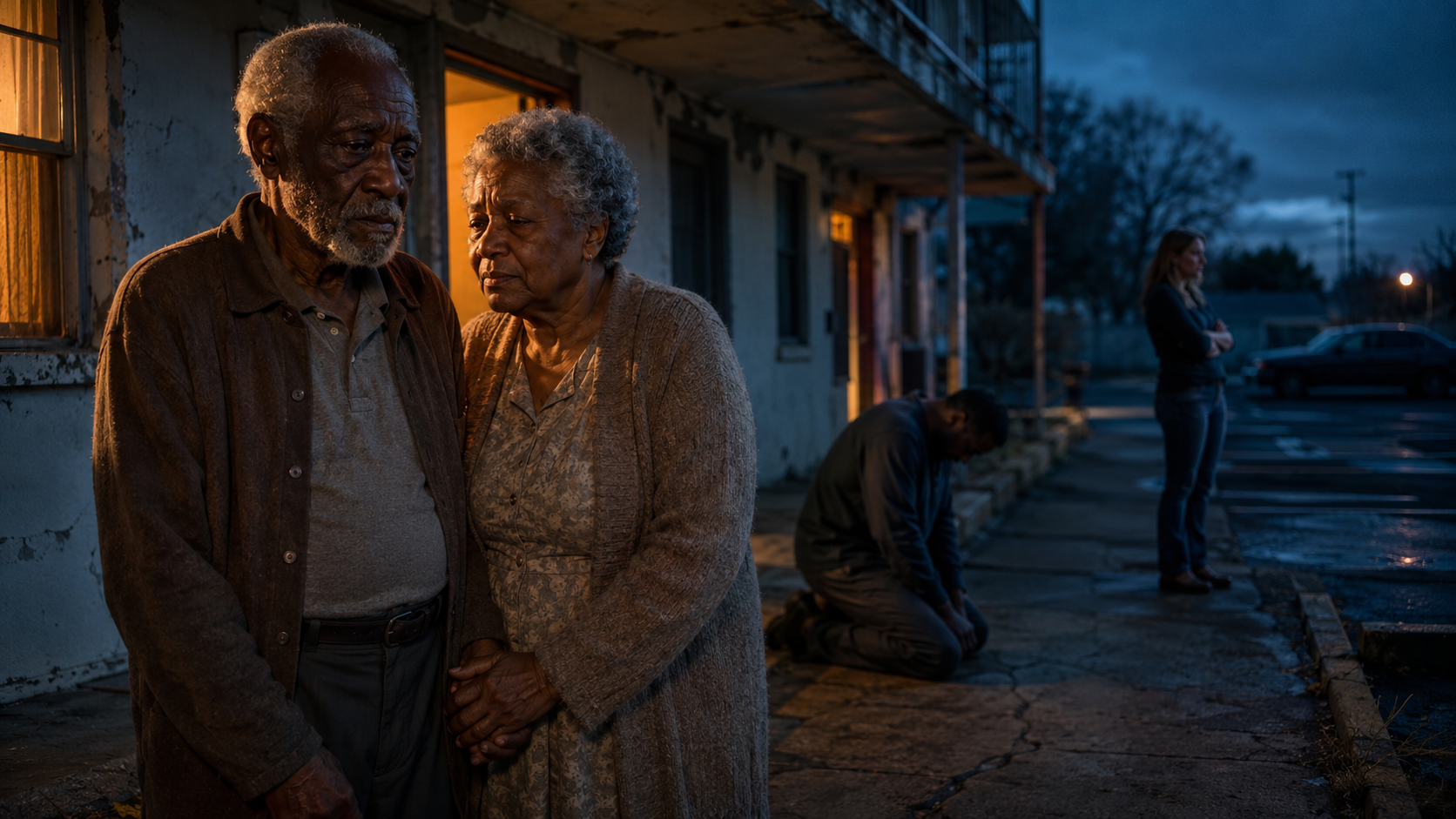
Back when the walls were young, the paint was fresh, and the world still felt wide enough for dreams. Back when Harold and Mabel Johnson—an old Black couple who had weathered every storm life threw at them—believed their greatest accomplishment wasn’t surviving poverty, racism, or illness… but raising a son who would never let them face the world alone.
But life has a cruel way of showing that love is not always returned.
Harold was 78 now, his back bent like a question mark life never answered. Mabel was 74, her hands trembling from arthritis, but still gentle enough to soothe anyone’s pain—except her own. They had lived in their small Georgia home for 42 years, building a life brick by brick, sacrifice by sacrifice.
Their son, Marcus, had once been the boy who ran barefoot through the yard, shouting, “Mama, Daddy, watch me!” Now he barely looked at them.
Everything changed the day he married Tiffany, a woman whose smile was sweet only when she wanted something. She was young, sharp-tongued, and carried herself like the world owed her comfort. She didn’t like Harold’s slow walk. She didn’t like Mabel’s soft voice. She didn’t like the old house, the old furniture, or the old people who came with it.
But most of all, she didn’t like sharing Marcus.
And Marcus—once the boy who cried when his mother scraped her knee—became a man who flinched when his wife raised her voice.
It was a Sunday morning when Tiffany snapped.
Harold had accidentally spilled a cup of water on the kitchen floor. His hands weren’t steady anymore. His knees shook. He apologized three times before Tiffany even opened her mouth.
“You know what? I’m done with this,” she said, her voice slicing through the room. “I’m not running a nursing home. I’m not cleaning up after two old people who can’t take care of themselves.”
Mabel lowered her head. She had heard worse in her life, but somehow this cut deeper.
Marcus walked in, rubbing his eyes. “What’s going on?”
Tiffany pointed at the water like it was a crime scene. “This. This is what’s going on. Your father can’t even hold a cup. Your mother moves like she’s stuck in slow motion. I’m tired, Marcus. I’m tired of living with your parents.”
Harold whispered, “I’m sorry, baby. I didn’t mean—”
“Stop calling me baby,” she snapped. “I’m not your baby. I’m your burden’s caretaker.”
Marcus swallowed hard. “Tiff… maybe we can talk about this later.”
“No. We talk now. Either they go, or I go.”
Silence.
A long, heavy silence that felt like betrayal dripping into the floorboards.
Harold looked at his son, the boy he raised, the boy he fed, the boy he protected. “Marcus… son… we ain’t got nowhere to go.”
Tiffany folded her arms. “Not my problem.”
Marcus didn’t look at his parents. He didn’t look at his wife. He stared at the floor, then exhaled.
“Mama… Daddy… maybe it’s time you two… find somewhere else. Somewhere that can take care of you properly.”
Mabel’s heart cracked. “Somewhere else? Baby, this is our home.”
Tiffany scoffed. “Not anymore.”
THE EVICTION OF LOVE
They were given one week.
One week to pack up a lifetime. One week to erase themselves from the home they built. One week to accept that the child they raised had chosen convenience over love.
Neighbors watched as Harold and Mabel carried boxes to the curb. Some offered help. Some offered pity. None could offer a place to stay.
On the last night, Mabel walked through the empty house, touching the walls like they were old friends she was saying goodbye to.
Harold sat on the porch, staring at the sky. “I never thought,” he whispered, “that the boy we raised would be the one to put us out.”
Mabel sat beside him. “We did our best, Harold.”
“Was it enough?”
She didn’t answer. Some questions hurt too much.
THE FERRYTALE BEGINS
They ended up in a small, run-down apartment on the edge of town. The kind of place where the walls were thin and the nights were long. But they had each other.
Every evening, Harold told Mabel stories—stories of their youth, their struggles, their victories. He called them ferrytales, because he said they carried them across the dark waters of life.
One night, he said:
“Once upon a time, there was a king and queen who raised a prince. They gave him everything—love, warmth, protection. But when the prince grew up, he forgot the kingdom that raised him. He chose a new queen who didn’t want the old rulers around. So he banished them.”
Mabel smiled sadly. “And what happened to the king and queen?”
Harold kissed her hand. “They built a new kingdom. Smaller, quieter… but full of love.”
THE SON RETURNS
Months passed.
Marcus never visited. Never called. Never checked if they were alive.
But life has a way of revealing truth.
One evening, Marcus showed up at their apartment door—alone, broken, and crying.
“Tiffany left me,” he said. “She said I wasn’t enough. She took everything.”
Harold looked at him, the son who had abandoned them. Mabel stood behind him, her eyes soft but tired.
Marcus fell to his knees. “I’m sorry. I’m so sorry. I don’t deserve forgiveness, but… I need you. I need my parents.”
Harold’s voice was steady. “Son… we needed you too.”
Marcus sobbed. “I know. I failed you.”
Mabel placed a trembling hand on his shoulder. “Baby… love don’t disappear. But trust… trust takes time.”
Harold nodded. “We ain’t turning you away. But you gotta earn your place back in this family.”
Marcus cried harder. “I will. I promise.”
And for the first time in a long time, the room felt warm again.
Not healed. Not whole. But beginning.
THE NEW KINGDOM
Marcus moved into the apartment with them. He cooked. He cleaned. He drove them to appointments. He apologized every day—not with words, but with actions.
Slowly, the ferrytale changed.
The prince who had banished the king and queen returned—not as royalty, but as a son learning how to love again.
And Harold and Mabel, though wounded, found peace in knowing that even broken families can rebuild.
Because ferrytales aren’t about magic. They’re about survival. About forgiveness. About finding your way back home—even when home is no longer a place, but the people who never stopped loving you.