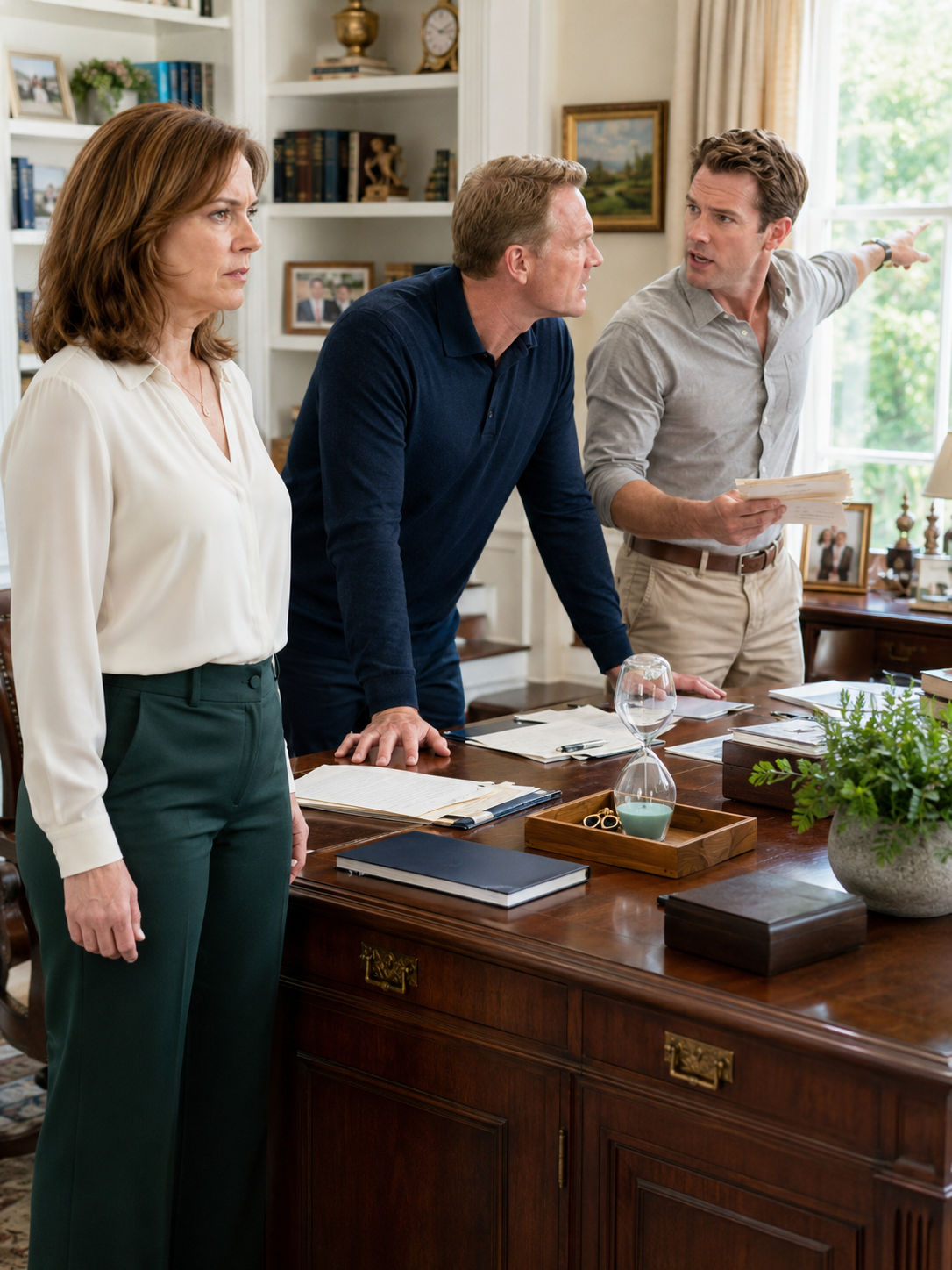
Eleanor Hayes had lived in the Portland home she shared with her husband, Richard, for twenty‑two years. The house had grown around their marriage like a second skin — the roses they planted together, the kitchen window where they drank coffee every morning, the study where Richard wrote letters he never mailed. When he died, the silence inside those walls became a physical weight. Even three days after the funeral, Eleanor still slept in the guest room because the master bed felt too large, too cold, too final.
Richard’s cardigan remained draped over her shoulders, and his coffee mug sat rinsed but untouched beside the sink. She could not bring herself to wash it. Doing so felt like erasing the last trace of him.
On the third morning after the funeral, the doorbell rang without warning. Standing on the porch were Richard’s two sons from his first marriage — Nathan, the older one, polished and controlled, and Caleb, the younger, quieter, and visibly uncomfortable. They entered the house without small talk, without condolences, and walked straight into Richard’s study, where funeral flowers still crowded every surface.
Nathan carried himself like a man accustomed to being obeyed. He removed a stack of legal documents from a leather folder and spread them across the desk. His tone was calm, almost clinical, as he informed Eleanor that she had thirty days to vacate the property. According to him, their father had intended the house to “stay in the family,” and Eleanor’s continued presence complicated the estate.
The phrasing stung. The family. As if she had never been part of it.
Eleanor listened in silence, her grief pressing against her ribs like cold water. She had been Richard’s wife for more than two decades. She had cared for him through surgeries, illnesses, and the long emotional recovery after the death of his first wife, Diane. She had tended his garden, paid bills, cooked meals, and built a life with him brick by brick. Yet now, his sons were speaking to her as if she were a temporary tenant whose lease had expired.
Nathan continued with the same detached tone, explaining that Richard’s medical bills had been substantial and that probate could become “messy.” He suggested that the life insurance payout would help her “transition” if she cooperated quickly. His words were smooth, but the implication was sharp: leave quietly, and they would make it easier for her.
Caleb stood near the bookshelf, hands folded, eyes lowered. He said almost nothing, but his silence was not neutral. It was the silence of someone who wanted the benefits without the responsibility of confrontation.
Eleanor finally asked the question that mattered most: “Did Richard tell you to do this?”
Nathan’s jaw tightened. He avoided the question, instead referencing the estate lawyers. When she pressed again, irritation flickered across his face. He straightened the papers into a neat stack and repeated that they were giving her “time to make arrangements,” as if generosity were being extended.
When they left, the house felt even quieter than before. Eleanor remained standing in the study long after the door closed. Rain tapped softly against the windows, and the lilies from the funeral filled the room with their heavy, suffocating scent. Richard’s framed photograph sat beside the lamp, watching over the room with the same gentle expression he had always worn.
Then her phone rang.
The caller ID displayed a name she recognized immediately: Victoria Camden — Richard’s attorney.
Eleanor answered with a trembling hand. Victoria did not offer condolences or small talk. Her voice was low, steady, and direct.
“He gave you the key,” she said.
Eleanor froze. “What key?”
Victoria’s next words shifted the ground beneath her feet.
Richard, it turned out, had prepared something privately — something his sons did not know about. He had left a sealed letter and a key in Victoria’s possession with instructions that they be given to Eleanor only after his death. The timing was deliberate. The secrecy was deliberate. And the contents, Victoria hinted, were significant enough to change everything about the estate.
Eleanor’s grief sharpened into something else — not anger, not relief, but a sense of awakening. Richard had known his sons. He had known their ambitions, their resentments, and their capacity to manipulate. He had also known Eleanor’s vulnerability. And he had acted accordingly.
The next day, Eleanor met Victoria at her downtown office. The attorney handed her a small, heavy key and a sealed envelope with Richard’s handwriting on the front. Eleanor recognized the handwriting instantly — the looping R, the careful spacing, the slight slant to the right. She held the envelope as if it were a living thing.
Inside the letter, Richard explained everything.
He wrote about his love for her, about the years she had given him, about the peace she brought into his life after Diane’s death. He acknowledged the tension with his sons — their belief that Eleanor had replaced their mother, their resentment of his remarriage, and their assumption that the house and assets were theirs by birthright.
But the most important part of the letter was the legal explanation.
Richard had transferred the Portland house into a living trust two years earlier. The trust named Eleanor as the sole beneficiary. The house was hers — fully, legally, and permanently. His sons had no claim to it. The medical bills were covered by a separate account he had set aside. The life insurance policy was also designated to Eleanor, not to the estate.
The key belonged to a safety deposit box containing the trust documents, updated wills, and a notarized statement explaining his decisions. Richard had anticipated that his sons might challenge Eleanor. He had prepared for it meticulously.
Eleanor felt her breath catch as she read his final lines. He apologized for the burden he knew she would face. He thanked her for loving him. And he told her not to be afraid.
Armed with the documents, Eleanor returned home. When Nathan and Caleb arrived again — this time with sharper tones and more aggressive demands — she did not tremble. She did not shrink. She did not apologize.
Instead, she placed the trust documents on the table and watched their expressions shift from confidence to confusion to disbelief.
Nathan argued. Caleb stammered. But the law was clear.
The house was Eleanor’s. The assets were Eleanor’s. The authority was Eleanor’s.
For the first time since Richard’s death, she felt the ground beneath her steady.
The sons left the house in silence, their plans dismantled by the father they thought they understood. Eleanor stood in the doorway, watching the rain fall across the garden Richard had loved. She felt grief, yes — but also a quiet, powerful sense of vindication.
Richard had not abandoned her. He had protected her in the only way he could. And his hidden letter had changed everything.