The first thing Mr. Bennett said after locking the truck doors sounded so ridiculous that I honestly thought I had misunderstood him.
“Your mother called the police,” he said quietly. “She told them there’s an escaped convict standing in her yard.”
For a moment, I simply stared at him.
The old mailman avoided my eyes as sheriff’s sirens echoed closer down the street. Outside the windshield sat the same small Virginia home I had dreamed about during endless nights overseas. The white paint had faded slightly over the years, and the front porch leaned more than I remembered, but it was still home.
Or at least it used to be.
I had spent four years serving overseas with the Army. Through sandstorms, exhaustion, fear, and loneliness, one thought kept me moving forward: eventually I would come home. I imagined my mother crying at the doorway. I imagined my father pretending not to get emotional before hugging me anyway. I imagined neighbors welcoming me back with pride.
Instead, my family was hiding from me.
The curtains inside the house shifted again.
Someone was watching.
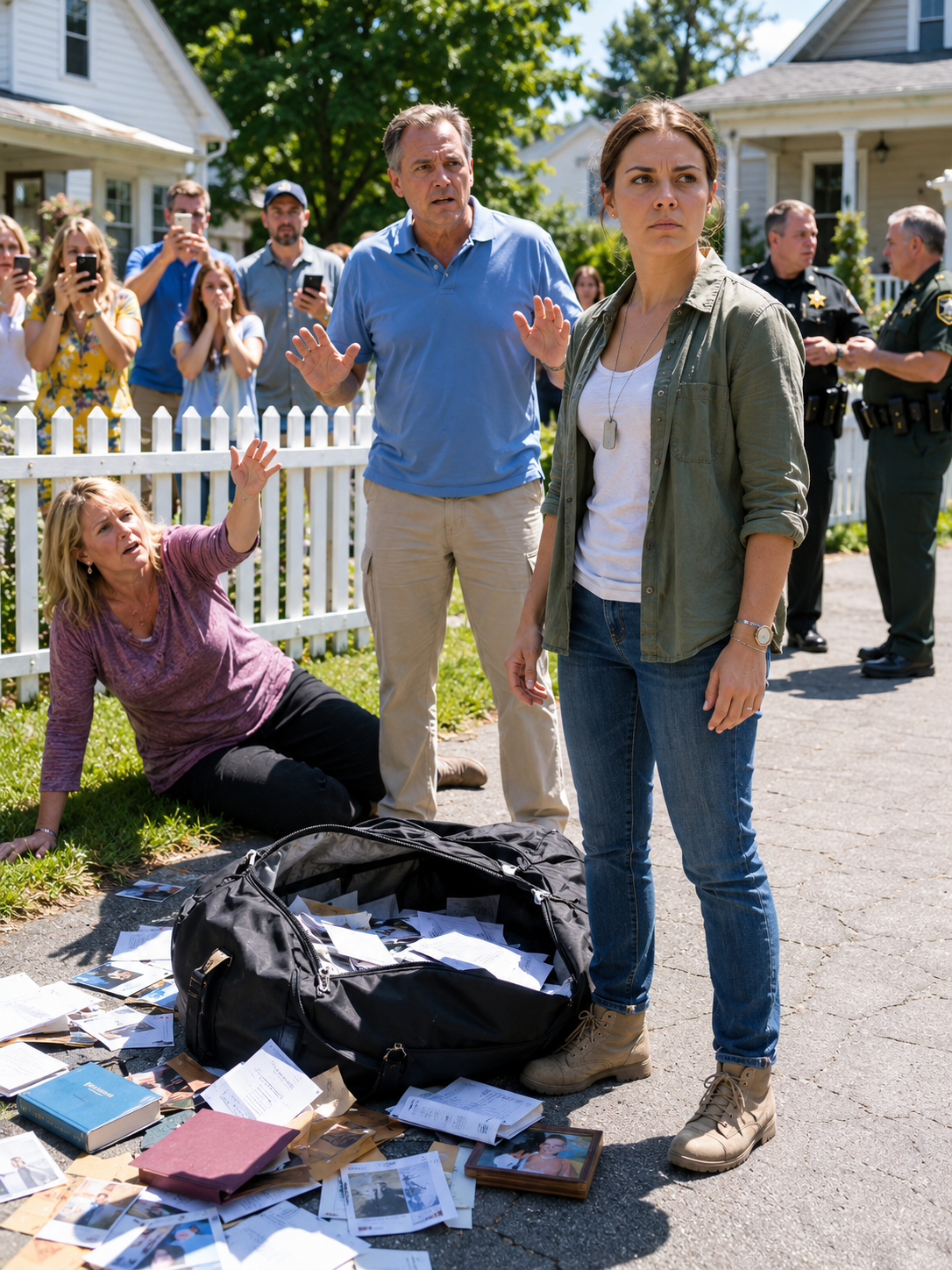
Three sheriff’s cruisers turned onto the street seconds later, lights flashing across the cracked driveway. Curious neighbors stepped onto lawns while church members and old classmates slowly gathered near the sidewalk. A local news van arrived not long after that, its camera already recording before the engine fully stopped.
I sat frozen in the passenger seat wearing my Army uniform while the entire town prepared to treat me like a criminal.
“What exactly did my mother say?” I asked carefully.
Mr. Bennett swallowed hard.
“She told dispatch you were released from prison early. Said the military uniform was fake. Said you might be dangerous.”
Dangerous.
The word hit harder than I expected.
I looked down at my hands. The same hands that had carried wounded soldiers to safety. The same hands that had written birthday cards home every year. The same hands that still carried scars from overseas.
Now my own mother was telling strangers to fear me.
Before I could process it fully, the front door opened.
My mother stepped outside dramatically, clutching her chest as if terrified for her life. My father followed close behind with an expression colder than I had ever seen before. Neither of them looked relieved to see me alive.
They looked furious.
“That’s her!” my mother shouted toward the deputies. “That’s the girl I warned you about!”
The crowd turned toward me instantly.
One deputy approached cautiously while resting his hand near his holster.
“Ma’am,” he said calmly, “can you step out of the vehicle slowly?”
I obeyed without argument.
The summer heat wrapped around me as cameras pointed directly at my face. People whispered behind their hands while I stood alone in my uniform surrounded by flashing lights.
“Identification?” the deputy asked.
My hands shook slightly as I handed him my military ID and discharge papers.
He studied them carefully.
Then he frowned.
“These documents appear legitimate.”
“That’s impossible,” my mother snapped immediately. “She’s lying.”
The deputy looked confused. “Ma’am, this confirms active military service.”
“No,” my father interrupted harshly. “She’s mentally unstable. She’s been lying for years.”
I stared at him in disbelief.
Lying?
For four years I had mailed letters, photographs, military updates, and holiday cards home regularly. I called whenever my deployment schedule allowed. Sometimes nobody answered, but I assumed life was busy.
I never imagined something worse.
The deputy handed back my papers slowly.
“Sir,” he asked my father, “when was the last time you spoke with your daughter?”
My father hesitated too long.
And that hesitation changed everything.
Before he could answer, Mr. Bennett suddenly stepped forward beside the truck.
“That’s not true,” the old mailman said loudly.
Everyone turned toward him.
Including my parents.
Mr. Bennett looked nervous, but he continued anyway.
“I delivered her letters myself for years. Hundreds of them.”
My mother’s face drained of color instantly.
“What letters?” I whispered.
The old man pointed toward the second-floor porch.
That was when my father panicked.
Without warning, he disappeared inside the house. Seconds later, a black duffel bag crashed onto the lawn from above. The zipper split slightly from impact, revealing stacks of envelopes spilling onto the grass.
The entire street fell silent.
A deputy walked forward carefully and unzipped the bag completely.
Inside were hundreds of letters.
Every single envelope carried my handwriting.
Birthdays.
Christmases.
Deployment updates.
Anniversary cards.
Photographs.
Care packages returned unopened.
Years of my life buried inside one bag like evidence from a crime scene.
Gasps spread through the crowd.
One reporter zoomed in on the letters while another whispered something urgently into a microphone.
I felt physically sick.
“They told me you stopped writing,” I whispered weakly.
My mother avoided my eyes.
The deputy picked up one envelope dated nearly three years earlier.
Still sealed.
Another deputy opened the bag further, revealing military commendations, photographs, and medals I had mailed home proudly during deployment.
None had ever been opened.
Not one.
The humiliation I felt standing there in front of the town quickly transformed into something colder.
Understanding.
My parents had not lost contact with me.
They erased me intentionally.
The sheriff himself arrived minutes later after hearing the growing commotion over police radio. Unlike the younger deputies, Sheriff Dalton had known my family for decades. He greeted my parents warmly at first—until he saw the letters.
Then his expression changed completely.
“What exactly is going on here?” he asked.
Nobody answered immediately.
Finally, I spoke.
“I came home from military service today,” I said quietly. “Apparently my parents told everyone I was a criminal.”
Sheriff Dalton looked stunned.
“That’s absurd.”
“It gets worse,” Mr. Bennett interrupted grimly. “Those letters were hidden upstairs.”
The sheriff crouched beside the bag, slowly reading envelope after envelope. His jaw tightened more with each one.
“Why were these hidden?” he asked my parents.
My father crossed his arms defensively.
“She abandoned this family years ago.”
“I joined the Army,” I replied sharply.
“You chose strangers over us.”
“No,” I answered. “I chose a future.”
The truth finally surfaced piece by piece while neighbors listened in complete silence.
My parents never supported my decision to enlist. My father wanted me to stay home permanently, help with bills, and eventually care for them as they aged. My mother considered military service shameful and believed women should remain close to family.
When I enlisted anyway, something inside them changed.
At first, they simply sounded disappointed during phone calls. Then came guilt trips, accusations, emotional manipulation. Eventually they stopped answering entirely.
Still, I kept writing.
I thought time would heal things.
Instead, they built an entirely different story about me.
According to neighbors, my parents spent years telling people I became unstable after leaving town. They implied I struggled with addiction, violence, and criminal behavior. Whenever anyone asked why they never heard from me, my mother cried dramatically and claimed the subject was too painful.
They turned my absence into a performance.
And everyone believed them.
The cruelest part was discovering why.
Three years earlier, my grandmother Rose died while I was overseas. Before her death, she left me a substantial inheritance including property rights connected to the family home.
But my parents never informed me.
Instead, they forged documents claiming I voluntarily surrendered my portion of the estate.
My stomach dropped when Sheriff Dalton explained it.
“They needed the town to believe you disappeared willingly,” he said carefully. “If questions arose later about the inheritance, people would already assume you were unstable.”
The world around me suddenly felt unreal.
My parents had not only erased me emotionally.
They profited from it.
My mother finally broke down crying—not from guilt, but fear.
“We did what we had to do!” she shouted. “She abandoned us first!”
“I was serving my country,” I replied quietly.
“You left us alone!”
“You buried me alive.”
The silence after those words felt unbearable.
Even the reporters stopped talking.
Sheriff Dalton eventually asked my parents to step aside for questioning regarding potential fraud connected to the estate documents. Deputies entered the house while neighbors whispered in disbelief nearby.
Some looked ashamed for believing the rumors.
Others refused to meet my eyes entirely.
Meanwhile, I stood in the center of the driveway realizing the home I missed for four years had never truly existed anymore.
Not because the building changed.
Because the people inside it had.
Hours passed before the crowd finally thinned. Reporters packed equipment slowly while deputies carried boxes of documents from the house into patrol vehicles.
Mr. Bennett remained beside me quietly the entire time.
“You okay, kid?” he asked gently.
I laughed bitterly.
“No,” I admitted. “But I think I finally understand something.”
“What’s that?”
I looked toward the house one last time.
The porch swing still moved slightly in the wind. Grandma Rose’s fountain still leaned left. The mailbox still carried our family name painted in faded black letters.
Everything looked familiar.
But familiarity is not the same thing as love.
Sometimes the people meant to protect you become the ones most determined to erase you.
And sometimes surviving means accepting that home is not always the place you came from.
Sometimes home is simply the place where people are honest about who you are.
By sunset, Sheriff Dalton confirmed an official investigation into the forged inheritance documents and false police report. My parents avoided looking at me as deputies escorted them toward separate vehicles for questioning.
Neither apologized.
Neither asked how I survived overseas.
Neither said welcome home.
And strangely, that hurt less than I expected.
Because by then, I understood the truth.
I had spent four years fighting to survive in foreign places while believing my family waited proudly for my return.
But the daughter they wanted no longer existed the moment I chose independence over obedience.
So they created another version of me instead.
A criminal.
A liar.
A disgrace.
Anything except the soldier standing in front of them.
As the police vehicles pulled away, I removed the small Army name tag from my uniform and stared at it quietly in my hands.
For years I believed coming home would heal everything I lost overseas.
Instead, coming home revealed what I had truly lost long before deployment ever began.
Not my family.
The illusion of one.