Margaret read through the night.
In 1951, on a ridge outside Chorwan, North Korea, it wasn’t Thomas Reed who ran through the fire. It was Private Calvin James — a young Black soldier from rural Georgia who had no business being overlooked, except that in 1951, overlooked was exactly what happened to men who looked like him.
Calvin had pulled all three soldiers to safety. Thomas had witnessed every second of it, bleeding from a shoulder wound, too injured to stand. When the smoke cleared, Calvin was gone — vanished into the chaos of retreat. No body recovered. No confirmation of survival.
The Army interviewed Thomas. In the confusion, exhaustion, and fog of war, the citation got written wrong. Thomas tried to correct it — twice. He was told the paperwork was filed. He was told to accept the honor.
He never could.
“Calvin James gave everything on that hill,” he wrote. “I gave nothing but silence, and I have been ashamed of that silence every single day.”
He had spent decades quietly searching — veterans’ records, church rolls in Georgia, anything. In 1987, he found Calvin’s sister in Macon. Calvin had survived the war. He came home to no parade, no medal, no recognition. He died in 1979 — thirty years before anyone thought to look.
Margaret contacted the Army. The Veterans History Project. A congressman’s office.
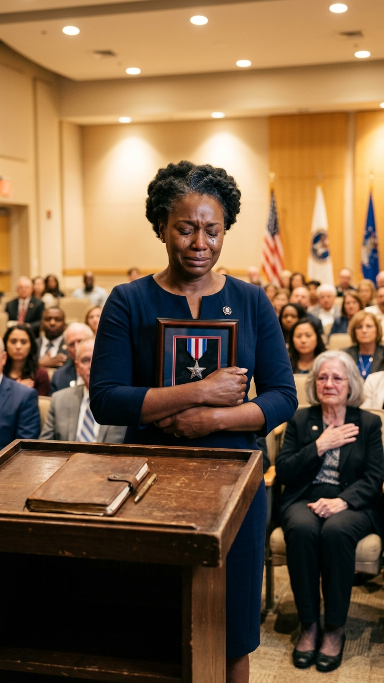
In October of that year, Calvin James was posthumously awarded the Silver Star. His granddaughter — a teacher in Atlanta — accepted it.
She held it to her chest and wept.
Thomas Reed’s notebook sat beside her on the podium. His words were read aloud to the entire room:
“I wore the wrong name long enough. Let the right one finally stand.”
Clover Falls built no monument to Thomas. He would have hated that.
They built one to Calvin instead.