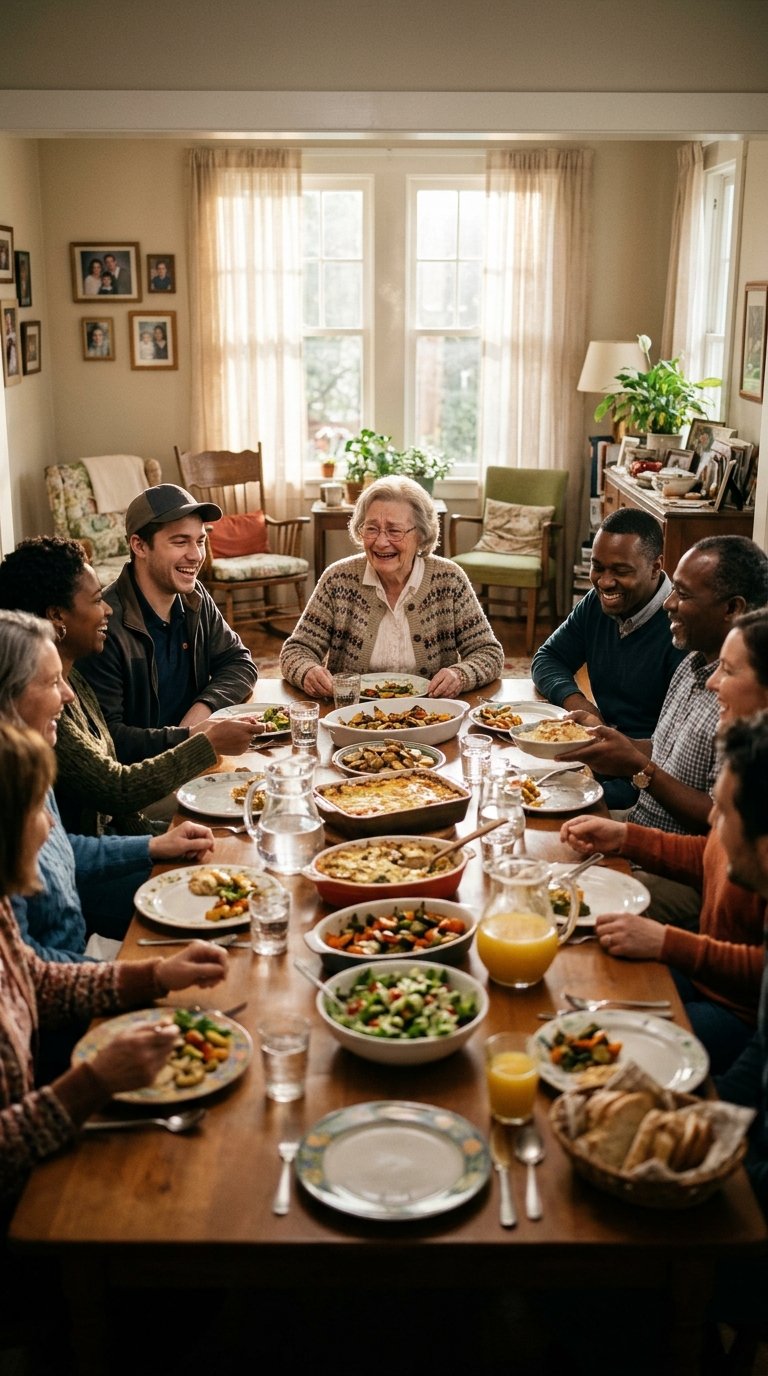
By March, there were nine people at the table.
Mrs. Pruitt brought a pie every week, and she’d started talking, really talking, about the husband she’d lost, her sister in Dayton, the garden she hadn’t touched in years. Mr. Okonkwo brought plantains and stories about Lagos. The young couple with the baby, Dana and Jerome, came in March and cried quietly into their napkins because it was the first meal in four months they hadn’t eaten over the sink. A retired bus driver named Earl arrived with a bag of oranges and never explained why. A teenager from down the block, Priya, started doing her homework at the end of the table, claiming it was quieter than home.
Margaret’s kitchen was too small. So in April, she dragged the old card table up from the basement.
That was when she found it.
Walter had scrawled something in pencil on the underside, in his blocky carpenter’s handwriting, probably decades ago. She almost missed it. She had to tilt the table toward the light.
Always room for one more. — W.
Under it, smaller, in a different pencil:
Don’t let it get quiet, Maggie.
She sat on the basement stairs with the table across her knees for a long time. She had no idea when he’d written it. Maybe in 1971, on their first night in the house. Maybe years later, after some lonely coworker had left their kitchen with a plate of leftovers. Maybe he had simply known, the way he’d always known things, that she would one day need to read it.
She cried, but it was a different kind of crying than before. It felt like being handed something.
She carried the card table upstairs and set it at the end of the long table, covered in a white cloth, and put a candle in the middle.
Susan arrived on the second Sunday in May, unannounced, with a rental car and a suitcase.
She had told herself it was to check on her mother. She told herself she’d be polite and observant, and she would quietly assess this “Marcus” person who’d wormed his way into the house. She walked up the porch steps, noting with suspicion how solid the new step felt, and opened the screen door without knocking.
The kitchen was warm and loud. Fourteen people sat at three tables pushed together, with plates and serving dishes crowding every surface. Someone was telling a story about a goat. Mrs. Pruitt was laughing so hard she had to wipe her eyes. A baby sat in a highchair, smearing sweet potato across its face with great joy. Her mother stood at the stove, flushed and bright, ladling gravy, wearing an apron Susan hadn’t seen in years.
Margaret looked up. “Susan! You’re just in time. Grab a plate.”
“Mom,” Susan said. “What is all this?”
“This,” Margaret said, “is Sunday dinner.”
Marcus stood and offered his chair. “Ma’am, I’m Marcus. I’ve heard a lot about you.”
Susan looked at him, at the tired young man with the kind eyes, and then around the table, at the faces turned toward her: not curious, not wary, just open. Somebody slid a plate in front of her. Somebody passed the potatoes.
She sat, and she ate, and about halfway through the meal she realized she was crying.
Later, in the kitchen, while Margaret washed dishes, Susan stood beside her with a dish towel.
“I thought you were lonely,” she said. “I thought I should’ve moved you out here. I thought…”
“I was lonely,” Margaret said. “Very lonely. You called every Sunday, and I loved it, and it wasn’t enough. That’s not your fault. Nobody can fill a chair like that by phone.”
“I should have come more.”
“You’re here now.” Margaret dried her hands and touched her daughter’s cheek. “And I’d like you to come more. But I don’t need you to rescue me, honey. I needed someone to knock on the door. A young man did. Now I knock on other doors.”
Susan laughed through her tears. “Dad would have loved this.”
“Your father started it,” Margaret said. She showed her the card table and the pencil marks underneath. Susan ran a thumb over her father’s handwriting and said nothing at all.
Paul flew in for Memorial Day with his wife and children. The kids ran in the backyard with Priya and Jerome and Dana’s baby, and Mr. Okonkwo taught Paul’s eight-year-old to play a clapping game from Nigeria. Paul stood at the edge of the garden with a plate in his hand and said, “Mom, we should’ve done this years ago.”
“We did,” Margaret said. “Every night at six. We just didn’t invite anyone.”
Marcus graduated from nursing school in June.
Margaret sat in the second row, in her blue Sunday dress, with Susan on one side and Mrs. Pruitt on the other. Mr. Okonkwo wore a tie. Earl brought oranges. Dana and Jerome held the baby up to see. When the dean called his name, the whole row stood and cheered so loudly that people turned around.
Afterward, Marcus found her in the crowd. He was holding his diploma in both hands, and for a moment he didn’t say anything.
“Margaret,” he said. “Rosa would’ve liked you.”
“She’d have liked you more,” Margaret said, and she hugged him, hard, the way she’d have hugged her own son.
“I’m going to work at the county hospital,” he said. “Nights, mostly. But I’ll be there Thursdays.”
“You’d better,” she said. “I’m making pot roast.”
On the first Sunday of autumn, Margaret stood in her kitchen at a quarter to six, with a roast in the oven and the smell filling the house.
Outside, the neighbors were already coming up the walk: Mrs. Pruitt with her pie, Mr. Okonkwo with a bag of plantains, Dana and Jerome with the baby, Earl and his oranges, Priya with a notebook she wouldn’t need. Marcus was on the porch, laughing, one hand resting on the step he’d fixed.
She set the last plate on the long table, the one at the head, and then she paused.
For one moment she set another beside it, a small, deliberate gesture, a plate for Walter. She wasn’t forgetting this time. She was remembering on purpose. She touched the back of his chair, and then she turned toward the door, because there were people waiting.
“Come in, come in,” she called. “There’s always room for one more.”
They filled the house with noise and warmth and elbows and laughter. When everyone was seated, Marcus lifted the lid off the roast and inhaled.
“What’s the verdict?” he asked, grinning.
“Pot roast,” Margaret said.
And Marcus, with the whole table listening, said the words that made her laugh and cry at the same time.
“Then I’m the luckiest man in Ohio.”
Margaret looked down the length of her table, at fourteen faces glowing in the candlelight, at every chair filled, at every plate full. For fifty-two years she had cooked for two, and for eight months she had cooked for no one.
Now the house was never quiet at six o’clock.