Maya didn’t sleep that night.
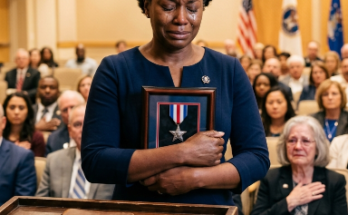
She printed the records. All of them. The citations, the commendations, the after-action reports. She read about the night of February 2nd, 1968 — a firebase outside Hue City, overrun before dawn. Twenty-two-year-old Corporal Charles Monroe had grabbed a machine gun position after its operator was killed and held the northern perimeter alone. Six hours. Wounded twice. Never retreated.
The official report used words like extraordinary valor and uncommon courage.
Charles Monroe used no words at all.
The next morning, Maya arrived early and sat beside him at breakfast.
“Mr. Monroe,” she said carefully, “why didn’t you ever tell anyone?”
He stirred his oatmeal. Long pause.
“Nobody asked.”
Maya contacted the local veterans’ organization that afternoon. Then the mayor’s office. Then a reporter at the Clover County Gazette named Patricia Walsh, who had spent fifteen years covering nothing more dramatic than zoning meetings and school board elections — and who recognized immediately that this was the story of her career.
The piece ran on a Thursday.
By Friday morning, Sunridge’s front desk had received over two hundred phone calls.
By Saturday, the parking lot was full.
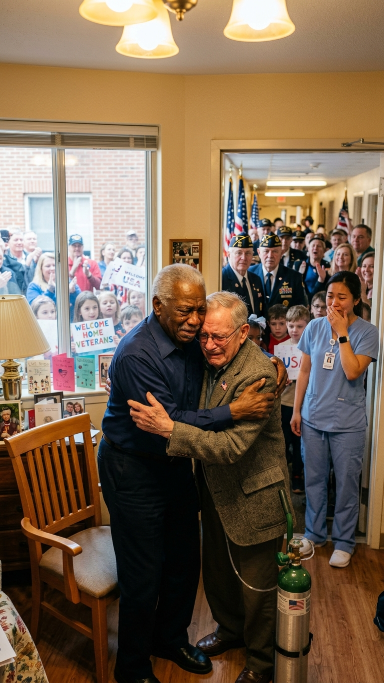
Veterans came in uniform. Schoolchildren came with handmade cards. A man named Gerald Foster — seventy-nine years old, oxygen tank, drove four hours from Knoxville — walked straight to Room 14, stood in the doorway, and said:
“You held that line, Charlie. I was one of the forty-one.”
Charles Monroe looked at him for a long moment.
Then he stood up — slowly, deliberately — and the two old men held onto each other in the middle of that small room while Maya stood in the hallway and wept quietly into her sleeve.
The visitor log for Room 14 was never blank again.
They had to add extra pages.