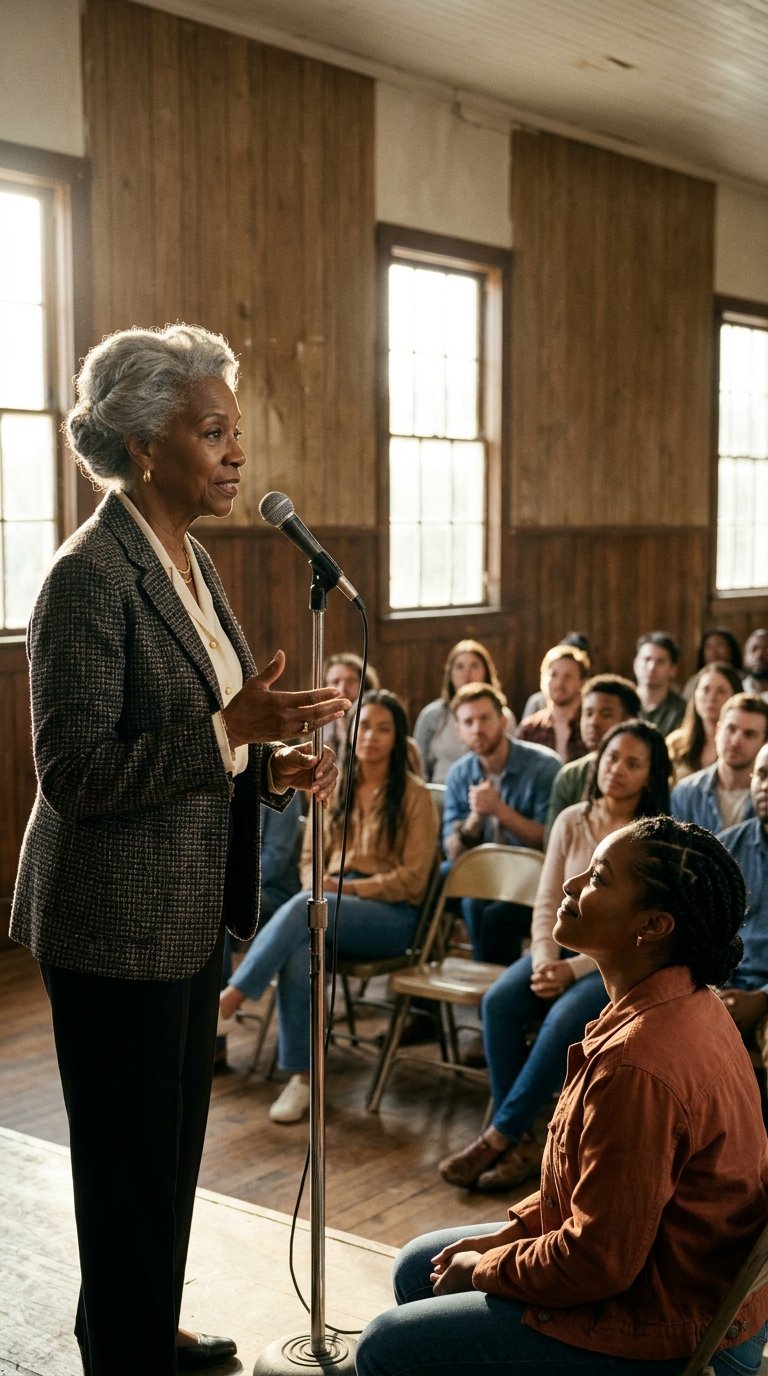
The Echo in the Community Hall The full disclosure of Eleanor’s story happened on a rainy Monday night in a packed community center. When it was Eleanor’s turn to speak, the room was buzzing with the usual complaints about parking and trash collection. She walked to the microphone, her gait steady, her head held high. Maya sat in the front row, her heart in her throat. Eleanor didn’t start with the grocery store; she started with her life. She told them about arriving in the city in 1964, about the stores she wasn’t allowed to enter, and the looks she had learned to ignore. She told them about raising her children in a world that saw them as threats before it saw them as children. And then, she told them about Derek. She described the shadow in Higgins & Sons, not as a single incident, but as a symptom of a disease that had never truly been cured. The room went silent—an absolute, heavy silence that stretched into the corners of the hall. Younger residents, who had grown up thinking of discrimination as something found in history books, sat frozen. They looked at the elegant woman at the microphone and realized that the ‘history’ they studied was still walking among them, still being followed in grocery stores. The manager of Higgins & Sons was in the audience, his face a deep shade of red as the community’s gaze turned toward him. Eleanor’s voice didn’t falter. She wasn’t asking for an apology; she was asking for a neighborhood where an eighty-year-old woman could buy kale without being a suspect. The impact was immediate. The following week, the store implemented mandatory bias training for all employees, and the manager personally visited Eleanor’s home to offer a sincere, public apology. But the real victory was in the community. A group of younger residents started a ‘Shop with a Senior’ initiative, ensuring that no elderly neighbor had to navigate the world alone. Maya watched her grandmother return to her daily walks, no longer looking at the ground, but meeting every eye with the confidence of a woman who had reclaimed her voice. The full disclosure is that Eleanor didn’t just change a store; she changed a neighborhood’s understanding of itself. She proved that courage has no expiration date and that the fight for respect is a relay race across generations. She lived to be ninety-five, and every time she entered Higgins & Sons, the employees didn’t follow her with suspicion; they greeted her with the honor she had earned. The story of the woman who faced racism at eighty ended not with humiliation, but with a community that finally learned to see the light she carried. THE END. Please everyone type “Next” and press “Like” so Facebook can boost the post’s engagement, allowing us to share the entire story right under the REPLY section of THIS COMMENT
THE PRICE OF A SHADOW: ELEANOR’S STAND AGAINST THE GHOSTS OF THE PAST