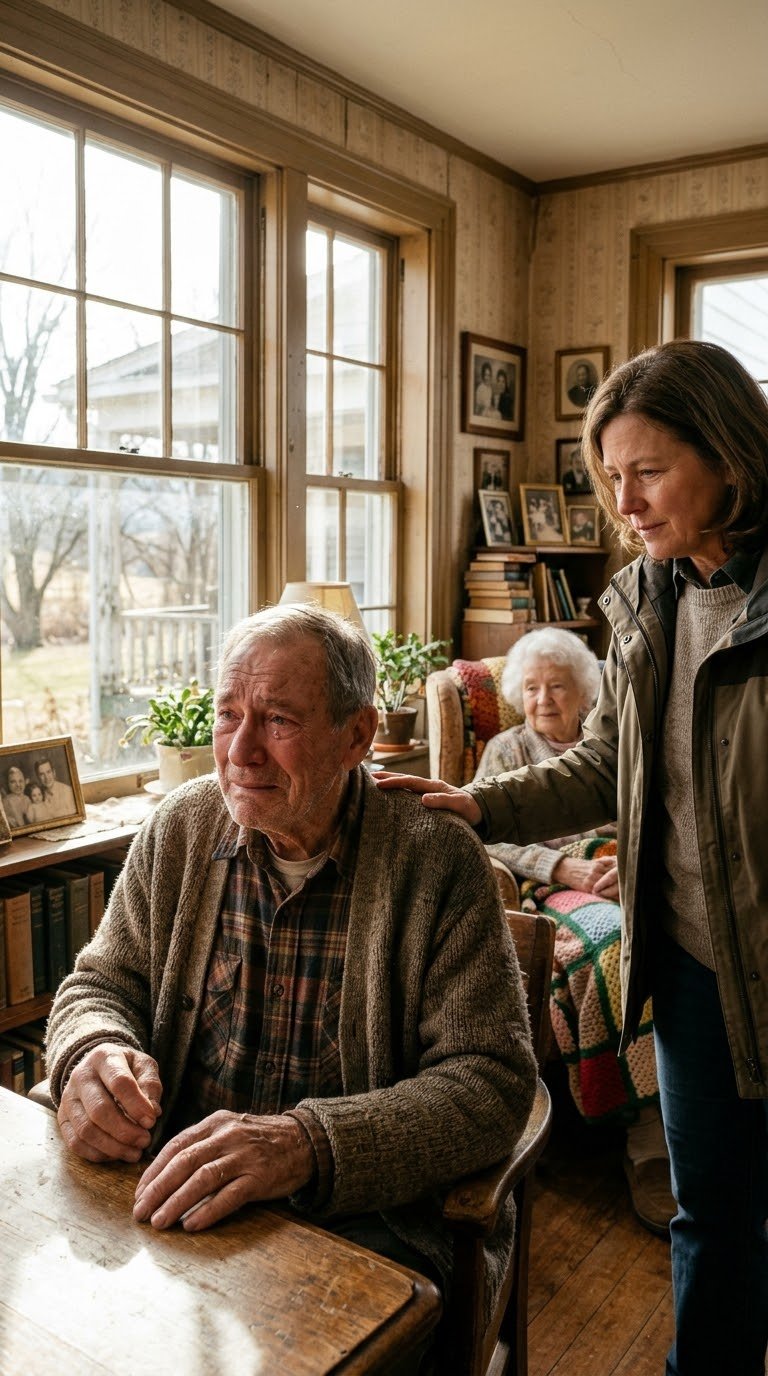
Eleanor Marsh had processed 847 LIHEAP applications in twenty years. She had never processed one faster than Walter and Dorothy Kowalski’s. She had never needed to explain to an eighty-year-old man that needing help was not the same as failing. And she had never cried in her car in someone’s driveway before — not until a Thursday in February when Walter walked her to the door and thanked her in the specific voice of a man who has been holding something for too long and has finally been allowed to set it down.
Eleanor arrived at nine AM on Thursday.
She was the kind of person whose professionalism was visible in the way she moved — organized, purposeful, with the specific efficiency of someone who understood that the people she helped were often in situations that had been building for longer than they were comfortable admitting and that the efficiency was a form of respect rather than a limitation of it.
She sat at the kitchen table with her folder and her laptop and looked at Walter and Dorothy across the table and said: “I’m going to ask you some questions and I want you to answer them as completely as you can, even the ones that feel private. Everything you tell me is confidential and the only thing that matters is making sure we get you the full benefit you’re entitled to.”
Walter said: “All right.”
Dorothy said: “Where do we start?”
Eleanor started with income. Then expenses. Then the medication costs — when Dorothy began describing the rationing, Eleanor made a note and said we’re going to address that separately with the calm certainty of someone who knows that the medication rationing is addressable and wants the people across the table to know it too before they finish the application.
The LIHEAP application took forty minutes.
Based on their income and household size and age and the state’s current benefit schedule, Eleanor calculated an estimated benefit that would cover the majority of their remaining winter heating costs and provide a credit toward spring.
She also — because Eleanor was the kind of navigator who understood that energy assistance was rarely the only gap in a fixed income household’s coverage — asked about the medications.
Dorothy described the prescriptions. The copays. The rationing schedule she had developed — taking slightly less than prescribed on the days she felt she could manage it, stretching a month’s supply to five or six weeks, calculating which medication could be reduced with less risk than the others.
Eleanor made notes.
She knew about three additional programs — two pharmaceutical company patient assistance programs for the specific medications Dorothy was taking and one state pharmacy assistance program for elderly residents below a certain income threshold — that between them could reduce Dorothy’s monthly medication costs by approximately $180.
“That would eliminate the rationing,” Eleanor said.
Dorothy looked at her hands.
“Yes,” she said.
“I’m going to give you the application forms for all three,” Eleanor said. “They’re straightforward. I can help you complete them if you’d like, or Carol can do them — I understand she’s nearby.”
“Carol is in Virginia,” Walter said.
Eleanor looked at him.
“She believes we’re fine,” he said.
“Are you going to tell her?” Eleanor said.
Walter and Dorothy looked at each other across the kitchen table in the way of people who have been communicating across a shared life for fifty-three years and can complete significant exchanges with a look.
“Yes,” Dorothy said. “I think we are.”
Eleanor completed the intake at ten-fifteen. She submitted the LIHEAP application electronically from the kitchen table. She left the medication assistance forms with a sheet of instructions she had prepared in large print because she had learned over twenty years that large print was not condescending — it was respectful of the reality that people were trying to manage paperwork in situations where stress was already affecting their concentration.
She walked to the door.
Walter walked with her.
At the door he said: “How did Agnes know to call you?”
“She’s been doing this for eleven years,” Eleanor said. “She knows what cold looks like.”
Walter nodded.
“I want to ask you something,” he said.
“Yes,” Eleanor said.
“Is it—” He stopped. Started again. “We worked. We saved. We paid off the house. We did what you’re supposed to do. And we still ended up here.”
He was not asking for pity. Eleanor had been doing this long enough to know the difference between a man asking for pity and a man asking for the dignity of an acknowledgment that he had done what was asked of him.
“Yes,” she said. “You did everything right. And the system changed around you in ways that the things you did right couldn’t account for. That is not a failure on your part. That is a gap in the system that these programs exist to address. You are not the exception. You are exactly who these programs are for.”
Walter looked at her.
“Nobody told us,” he said.
“I know,” she said. “That’s the part that needs to change.”
She walked to her car.
She sat in the driveway for four minutes.
She did not cry often. She had learned, over twenty years, to maintain the professional separation that allowed her to be effective rather than consumed by the work. But Walter’s question — we did what you’re supposed to do — and the four sweaters and the counted pills and the sixty-one degrees sat in the car with her and required the four minutes before she could drive.
She gave them the four minutes.
Then she drove to the next appointment.
The LIHEAP benefit was approved in eight days.
The notification arrived on a Tuesday — a letter that Eleanor had told them to watch for, that Walter opened at the kitchen table with Dorothy beside him, that contained a benefit amount that covered the outstanding heating bill and provided a credit for the remainder of the winter.
Walter called the heating oil company the same day.
He scheduled a delivery for Thursday.
He did not tell Dorothy what time the delivery was coming. He wanted her to be in the living room when the heat came on rather than watching out the window for the truck — he wanted it to arrive as warmth rather than as a process.
The truck came at one-fifteen PM.
Walter was in the kitchen when he heard the system start — the specific sound of the furnace engaging that he had not heard at full capacity since October.
He went to the living room.
Dorothy was on the couch with her blanket.
He sat beside her.
They waited.
The warmth arrived slowly, the way warmth arrives in a house that has been cold for long enough that it takes time to reach the corners. Walter felt it first in his hands — the specific sensation of warmth that is distinct from the absence of cold, which is a different thing and which he had not felt in his own house since October.
Dorothy closed her eyes.
She put her head back against the couch.
“Walter,” she said.
“Yes,” he said.
“It’s warm,” she said.
He put his face in his hands.
He had not intended to cry. He was eighty years old and had served his country and raised four children and worked thirty-eight years in a steel plant and he had not, across all of that, been a man who cried easily or often.
He cried.
Dorothy put her hand on his back.
“She can sleep,” he said. Not to Dorothy — to the room, to Frank, to the specific audience of his own relief. “She can sleep warm.”
Dorothy rubbed his back the way she had rubbed it across fifty-three years of moments that required the specific language of a hand on a back.
“I know,” she said. “I know.”
Carol called that evening.
Not a Sunday call — a Tuesday call, unexpected, which Walter answered with the slight confusion of someone whose established schedule has been disrupted.
“Dad,” Carol said. “I want to ask you something and I want you to answer me honestly.”
Walter was quiet.
“How are you actually doing?” she said.
He thought about Agnes at the kitchen table. Eleanor in the driveway. The four minutes. The eight days. The one-fifteen delivery. The warmth in his hands.
He told Carol the truth.
Not all of it at once — it came in pieces over forty minutes, the longest phone call they had had in years, with Carol asking questions and Walter answering them with the honesty he had been withholding from Sunday calls for two years.
Carol cried.
“Why didn’t you tell us?” she said.
“Because you called and asked if we were fine,” he said. “And we said yes because the question had a yes answer built into it.”
Carol was quiet.
“What question should we have been asking?” she said.
“Ask what the thermostat says,” Walter said. “Agnes told me that. Her daughter asked her what she meant and Agnes said: don’t ask if they’re fine. Ask what the thermostat says.”
Carol said: “I’m coming this weekend.”
“You don’t need to—”
“Dad,” she said.
“Yes,” he said. “Come.”
Thomas called Wednesday. Margaret called Thursday. Robert called Friday. Each of them had spoken to Carol. Each of them had the specific voice of someone who has received information they should have had earlier and is reckoning with what the gap between having it and not having it had cost.
Walter received each call with the patience of a man who understood that his children had not known because he had not told them and that the accounting for this was shared rather than one-directional.
He told each of them about Agnes and Eleanor and LIHEAP and the medication assistance forms and the Thursday delivery and the one-fifteen warmth.
He told each of them about the four sweaters.
Thomas said: “Dad. Four.”
“The fourth one was for evenings,” Walter said.
Thomas made a sound that was either laughing or crying and might have been both.
“Dad,” he said. “Never again.”
“No,” Walter said. “Never again.”
Carol came that weekend.
She brought groceries and a new blanket for Dorothy — a weighted one, thermal, the kind that the pharmacist at the local drugstore had told her was good for people with arthritis because the weight provided both warmth and joint support.
Dorothy received it with the specific expression of someone who has been given exactly the right thing by exactly the right person and is trying to contain how much it means.
“Carol,” she said.
“I know, Mom,” Carol said. “I know.”
The four children established the same kind of arrangement that Mark’s family had established for Patricia Holloway — equal contributions, automatic transfer, a shared account that addressed the gap between their parents’ income and their parents’ actual needs. Not charity. A correction. The specific correction of people who had been applying the wrong question for too long and had finally found the right one.
Walter said he did not need it.
Carol said: “Four sweaters, Dad.”
He said: “Fair enough.”
Agnes came on Wednesday.
She always came on Wednesday.
She knocked. Walter answered. He was wearing one sweater — the grey cardigan from 1987.
Agnes looked at him.
“One,” she said.
“One,” he said.
She smiled.
She came in.
Dorothy was on the couch with the new weighted blanket, reading — an actual book, held at a comfortable angle, without the hunched posture of someone conserving warmth.
Agnes delivered the meal.
She sat for a few minutes the way she had started sitting — not every week, but when it felt right, which was more often than not.
“Eleanor says the medication applications were approved,” Agnes said.
“All three,” Dorothy said. “She called Tuesday.”
“Good,” Agnes said.
Walter made tea — the good tea, the kind he had been saving for occasions, which he had started using regularly because he had decided that warmth was the occasion.
They sat at the kitchen table.
Agnes looked at the thermostat.
Sixty-eight degrees.
She did not say anything about it.
She did not need to.
The number said everything.
Walter followed her gaze.
“Sixty-eight,” he said.
“Sixty-eight,” she said.
It was just a number on a thermostat in a kitchen in Lancaster County, Pennsylvania.
It was also the specific number at which two eighty-year-old people could sit in their own home without calculating the cost of warmth against the cost of medicine.
It was the number at which Dorothy could sleep.
It was the number that Walter had cried about.
It was not a large number.
It was everything.
— As told by the man who wore four sweaters in his own house and was found, on a Wednesday afternoon in February, by a woman who had been paying attention for eleven years.