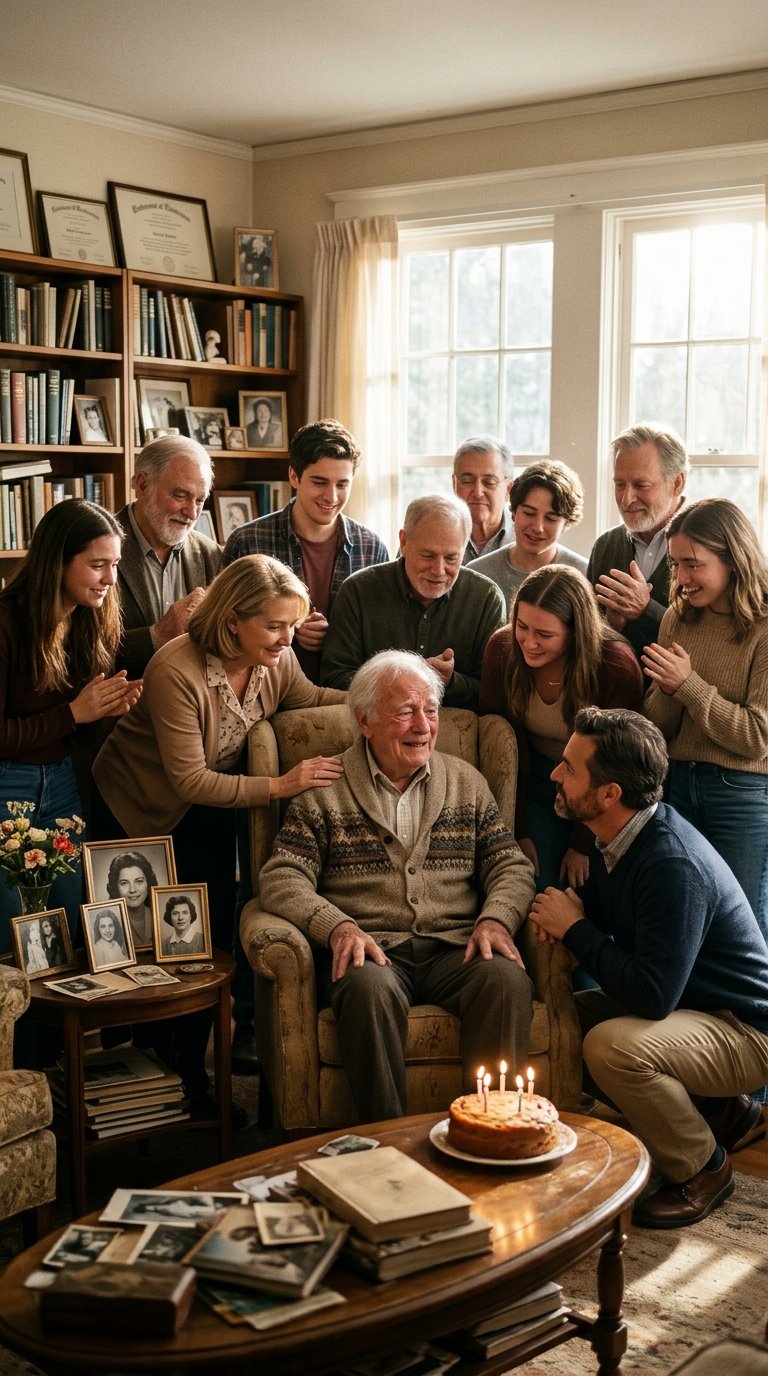
Seventy-three people showed up on a Wednesday morning in March to tell a man that his life had mattered. What Arthur Whitfield said when he opened the door — and what he told Teresa Grady in his kitchen afterward — is the reason she has written about it every year since.
Arthur woke on the morning of March thirteenth with the specific quality of the day after a birthday that has passed without ceremony — not devastated, he was not a man who permitted himself devastation over things he could not control, but quieter than usual, moving through the morning routine with the slight heaviness of someone carrying something they have decided not to examine too closely.
He made his coffee at seven.
He looked at the remaining cake on the kitchen table — he had eaten two pieces the previous evening and had covered the rest with plastic wrap and put it in the refrigerator and had taken it out this morning because there was no reason to eat birthday cake two days after his birthday and every reason to eat it on the day after, which was the closest available option.
He ate a piece of cake with his coffee.
He looked at Margaret’s photograph on the sideboard — the one from 1985 where she was laughing at something the camera had caught the aftermath of, her expression more itself than most photographs managed to capture.
“The children forgot,” he told her. “Or they didn’t forget. They didn’t remember, which is a different thing. You can’t forget something that wasn’t in your calendar.”
He had checked the phone before bed.
No calls.
He had checked it again at seven AM.
No calls.
He was not going to call them. He had decided this the previous evening with the specific quiet dignity of a man who understood the difference between being owed something and demanding it and who had decided that demanding it would produce a version of what he needed that would be worse than not having it.
He finished his coffee.
He went to the study.
He had been working, in the intermittent way of retirement, on a memoir — not for publication, he had no particular desire to be published, but because Margaret had said before she died that he had stories worth writing down and he had believed her and the believing had been enough to keep him at the desk for two years.
He opened the document.
He typed one sentence: I spent forty-one years believing that what a person does for a child stays with that child longer than any record can measure.
He looked at the sentence.
He saved it.
He went to make a second cup of coffee.
He was in the kitchen when he heard a car on the street.
Then another.
He looked out the kitchen window.
There were cars parking on Sycamore Drive. Not one car — several cars, arriving in the space of a few minutes with the organized quality of people who have coordinated arrival times. He watched a woman get out of a blue sedan and look up at his house with the specific expression of someone confirming an address.
He watched two more cars park.
He watched people getting out.
He recognized the way a person looks when they are someone you taught — the specific combination of features that time has aged but not changed fundamentally, the way adults carry their childhood faces in the structure underneath the grown-up surface.
He did not recognize any of them specifically.
Not yet.
He went to the front door.
He opened it before anyone knocked.
Teresa Grady was at the front of the group — forty-four years old, dark hair, the specific expression of a woman who has organized something and is watching it arrive at the moment of delivery with the combined anxiety and hope of all organized things at their moment of delivery.
She looked at him.
“Mr. Whitfield,” she said. “My name is Teresa Grady. I was in your literacy program in 2009. I’m a journalist now.”
He looked at her.
Then he looked at the people behind her — filling the front walk, standing on the sidewalk, more arriving, a gathering that his mind was not immediately able to process in terms of what it was or what it meant.
“You told me,” Teresa said, “when I was eleven years old, that I was going to be a writer. And I wanted you to know — I am.”
Arthur Whitfield looked at Teresa Grady.
Then he looked at the people behind her.
Then he looked at the cake — the large one, held by Marcus Webb, who was forty-two years old and who had been seven years old the first time Arthur had told him that the reason he was having trouble with reading was not that he was slow but that nobody had shown him the right door yet and that they were going to find it together, and they had.
Eighty-five candles.
Not literally — there were not eighty-five candles on the cake, there were the kind of number-candles that formed the digits eight and five, which was more practical and which caught the March morning light in a way that made them visible from the front door.
Arthur put his hand over his mouth.
He stood in his own doorway on the morning of March thirteenth and looked at seventy-three people who had driven to Sycamore Drive on a Wednesday morning to stand on his front walk with a cake and tell him something.
“May we come in?” Teresa said.
He could not speak for a moment.
Then he said: “There’s not enough room.”
“We’ll use the yard,” Teresa said. “It’s a good morning.”
It was a good morning. The specific March morning that comes occasionally in Ohio where the light is warmer than the temperature and the sky is the particular blue that makes everything look more deliberate than weather usually manages.
They used the yard.
They came in groups of ten or twelve at a time — into the house, through the living room, past Margaret’s photographs, to the kitchen table where Arthur had sat with his small cake the previous morning, and then out through the back door to the yard where Marcus had set up the folding chairs that Arthur’s neighbor had contributed when Teresa called her from the car and explained the situation.
Each group stayed twenty minutes or thirty.
They told him things.
Not general things — specific things, the specific things that people carry from the teachers and principals who changed something in them and that they have never had occasion to say directly to the person who changed it.
A woman named Diane Okafor, forty-one, who was a pediatric physician in Cleveland, told him about the afternoon in 1994 when she had been sent to the principal’s office for fighting — the specific fight of a girl who was being bullied and had responded — and Arthur had not called her parents or given her detention but had sat across from her and said tell me what’s actually happening and had listened for an hour and had called the other girl’s parents instead and had followed up every week for a month until the situation had resolved.
“I became a pediatrician,” she said, “because a principal sat across from me when I was eight years old and asked what was actually happening. I have asked that question ten thousand times to children in my clinic and every time I think of you.”
A man named Jerome Patterson, forty-seven, who ran a construction company, told him about the sixth grade reading group Arthur had personally run on Thursday afternoons for students who were behind grade level — an unofficial group, not part of the school program, that Arthur had organized and led himself because the school program was not sufficient and he had decided to make it sufficient.
“I couldn’t read at grade level when I was twelve,” Jerome said. “I run a company now and I write every proposal myself. Thursday afternoons. I never forgot.”
A woman in her fifties — a former colleague, not a student — told him about the year he had fought the school board to keep the art program when budget cuts had targeted it and had succeeded by presenting two years of academic performance data demonstrating that students in the art program showed measurable improvement in reading comprehension.
“You fought for things that didn’t have obvious advocates,” she said. “You taught everyone on that staff what advocacy looked like.”
Arthur sat in his yard on a folding chair that his neighbor had lent and he listened to all of it with the specific attention of someone receiving information that is rearranging things.
He had asked Margaret’s photograph whether his life had mattered.
He was receiving the answer in the form of seventy-three people on a Wednesday morning in March.
Teresa came to the kitchen at the end.
The groups had cycled through and the yard had thinned to the people helping with cleanup — Marcus and his aunt and a few others who had organized themselves into the end-of-event logistics without being asked.
She sat across from Arthur at the kitchen table where he had sat with the small cake.
The large cake — the one with the eight and five candles — had been mostly eaten. A quarter remained. Teresa had put it in the container she had brought and placed it in the refrigerator while Arthur was in the yard.
“You found a newsletter,” Arthur said.
“In a box,” she said. “I was looking for a photograph.”
“You organized all of this from a newsletter in a box,” he said.
“In about twenty-two hours,” she said. “Facebook helped.”
Arthur looked at the kitchen table.
“My children didn’t call,” he said. “I don’t say that as a complaint. I say it as the context.”
“I know,” Teresa said. “Your neighbor told me.”
“Agnes,” Arthur said. “She drove past. She reported back.”
“She was going to knock yesterday,” Teresa said. “I asked her to wait.”
Arthur looked at Teresa Grady — the forty-four-year-old journalist who had been eleven when he told her she was going to be a writer, who had found a newsletter and made seventy-three phone calls and organized a gathering in twenty-two hours.
“Why?” he said. “Why did you do this?”
She looked at him.
“Because,” she said, “I have written about a lot of things in twenty years of journalism. School funding. Community programs. The gaps between what people need and what systems provide. And every time I write about children and what they need — what actually changes the trajectory of a life — I think about Lincoln Elementary and a principal who understood that the job was not to administer a building but to see the children inside it.”
She paused.
“You saw us,” she said. “All of us. Every one of us in that yard today — you saw us when we were small and uncertain and didn’t know what we were going to be. And you told us. And then we went and became it.”
Arthur was quiet.
“I did my job,” he said.
“You did your job the way it was supposed to be done,” Teresa said. “Which is rarer than you think.”
He looked at Margaret’s photograph on the sideboard.
“She would have loved this,” he said.
“Tell me about her,” Teresa said.
He told her.
Not briefly — at length, the way you tell people about someone you have been carrying across six years of their absence and have not been given sufficient occasion to speak about. Margaret at twenty-three when they met. Margaret at the kitchen table at midnight when he was preparing for a difficult school board presentation and she was the one who found the argument that held. Margaret in this house across thirty-seven years.
Teresa listened with the complete attention of a journalist and the additional attention of a woman who understood that she was receiving something rare — the full account of a life from the person who had lived it.
She did not take notes.
This was not for an article.
This was for him.
Catherine called at four PM.
The phone rang while Teresa was still there — Arthur looked at the screen and said it’s my daughter with the expression of a man who was feeling something complicated about the timing.
He answered.
“Dad,” Catherine said. “Happy belated birthday. I’m so sorry — it was on my calendar and I got into the week and I—”
“Catherine,” Arthur said.
“I’m sorry, Dad,” she said.
“I know,” he said. “I want to tell you something. Are you somewhere you can listen?”
She said yes.
He told her about Teresa and the newsletter and the seventy-three people and the yard and Diane Okafor the pediatrician and Jerome Patterson who ran a company and wrote his own proposals and the woman who told him about the art program.
He told her about the small cake he had bought himself.
He told her about Margaret’s photograph and the question he had asked it.
Catherine was crying before he finished.
David called that evening. Daniel called the following morning. Arthur told each of them the same things. Each conversation was longer than the conversations they had been having on the first Sunday of the month.
Each one ended with: “We’re coming for Easter.”
All three of them came for Easter.
Arthur made the ham he had made every Easter since 1973.
He did not set extra plates — he was not that kind of man, he did not require symbolic gestures when the actual people were there — but he looked at the table before they sat down, at the fullness of it, and felt what the fullness felt like.
Teresa came to Easter.
Arthur had invited her. She had said she did not want to intrude on the family occasion. He had said: “You organized seventy-three people in twenty-two hours. You are family.”
She came.
She sat at the table.
Marcus’s aunt came. Agnes the neighbor came. Two of the former students from the yard who lived close enough to make Easter dinner a reasonable trip came.
The table was full.
Arthur finished the memoir in October.
He had been working on it intermittently for two years and had finished a sentence on the morning of his birthday — I spent forty-one years believing that what a person does for a child stays with that child longer than any record can measure — and had left it there because the day had required other things.
He came back to it in April. He wrote steadily through the summer. He finished it in October.
He sent it to Teresa.
She called him the week after she finished it.
“Mr. Whitfield,” she said.
“Arthur,” he said. He had been asking her to use his first name since March.
“Arthur,” she said. “This should be published.”
“I wrote it for my children,” he said.
“I know,” she said. “It should also be published.”
He considered this.
“I’m eighty-five years old,” he said.
“I know a publisher,” she said. “Give me permission to send it.”
He gave her permission.
The memoir was published the following spring.
The title was the sentence he had written on the morning of his birthday: What a Person Does for a Child.
Teresa wrote the foreword.
She wrote about the newsletter in the box and the Tuesday morning and the twenty-two hours and the seventy-three people in the yard.
She wrote about what Arthur had told her in the kitchen about Margaret.
She wrote: “I have interviewed governors and scientists and people who have done measurable things in the world. I have never sat across from anyone who made me understand more clearly what a life well-lived looks like. Arthur Whitfield spent forty-one years seeing children. This is the book of a man who was finally seen back.”
Arthur read the foreword at his kitchen table.
He had the cake container in front of him — the one Teresa had brought for the large cake, washed and returned, which he kept on the counter because it had become the container he used for leftovers and he saw no reason to replace something that was working.
He read the foreword twice.
He looked at Margaret’s photograph.
“She says I was finally seen back,” he told her. “I think she’s right.”
He had asked whether his life had mattered.
The answer had come in seventy-three people on a Wednesday morning and a book published the following spring and a table full at Easter and phone calls that were longer than they used to be and a journalist who used his first name.
The answer was yes.
It had always been yes.
He had simply needed the Wednesday morning to see it clearly.
— As told by the principal who spent forty-one years seeing children and was finally, completely, seen back.
👉 The full story has been shared. If this story moved you, please type “Next” and press “Like” so Facebook can boost the post’s engagement and allow us to share more stories like this one right under the REPLY section of THIS COMMENT 👇