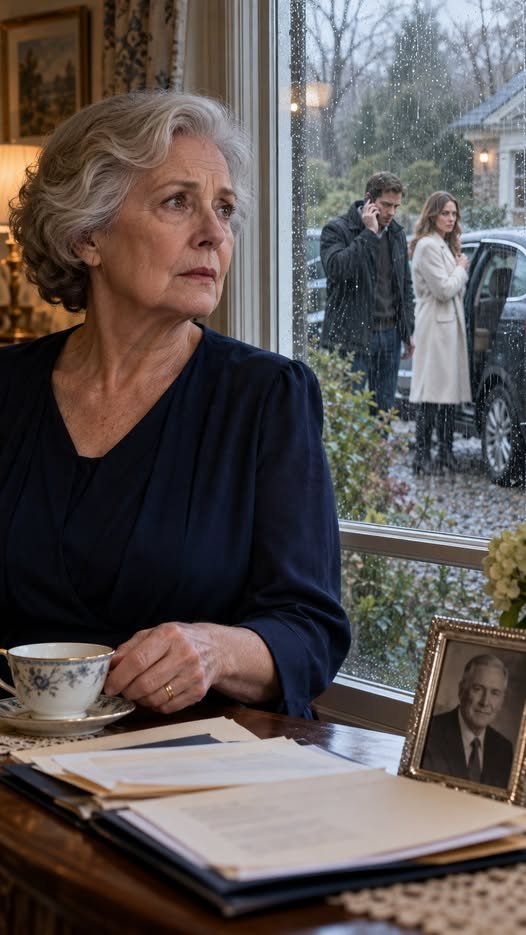
The third person was my granddaughter, Lily.
She stood on the gravel in her school uniform, a backpack hanging off one shoulder, looking at my front door as though it might vanish. Genevieve hadn’t wanted her there. I could tell by the way she gripped the girl’s elbow, steering her toward the porch like a shield.
I set down my cup, smoothed my cardigan, and opened the door before they could knock.
“Mom,” Benjamin said. His voice cracked on the single syllable. “We need to talk.”
“Good morning, Benjamin. Genevieve.” I looked down. “Hello, sweetheart.”
Lily let go of her mother’s hand and walked straight past her into my arms. She smelled like cereal and rain. Over her head I watched Genevieve’s jaw tighten.
“We can discuss this inside,” Genevieve said. “Like adults.”
“Lily can have hot chocolate in the kitchen,” I said. “The adults can have the front room.”
I sat in Thomas’s armchair. They sat on the sofa I had bought them two Christmases ago and then reclaimed when they moved to the townhouse, because they said it didn’t match.
Benjamin leaned forward, elbows on his knees. “The bank declined the mortgage payment this morning. And the insurance. And the club. Mom, what happened?”
“I canceled my authorizations.”
“All of them?”
“A hundred and seventy-four.”
Genevieve gave a small laugh, brittle as glass. “You’re punishing us over a dinner.”
“No,” I said. “I’m declining to finance a household where I’m not welcome. That’s different.”
“Nobody said you weren’t welcome.”
I took out my phone, found the message, and read it aloud in a calm voice. “You weren’t invited. My wife doesn’t want you there.“
Benjamin flinched.
“I wrote that out of context,” he muttered.
“What was the context, dear?”
He didn’t answer. Genevieve did, and for the first time in fifteen years she stopped being polite.
“The context,” she said, “is that we have a life, Margaret. Friends. A position to maintain. And you show up in the same navy dress every time, and you talk about Thomas, and you ask how much things cost, and it’s embarrassing.”
The room went very quiet.
From the kitchen came the clink of a spoon against a mug. A small, careful sound. Lily was listening.
“Thank you,” I said.
Genevieve blinked. “For what?”
“For telling me the truth. I have been paying fifteen years for someone to say it out loud.”
I stood, went to the desk, and brought back the folder marked BENJAMIN. I set it on the coffee table between us.
“Open it,” I said.
Benjamin did. He turned the pages slowly: tuition receipts, the mortgage assistance, the club dues, the preschool payments, the home repair that was supposed to be temporary. I watched his lips move as he added. I had added it for him. At the bottom of the final page, in my handwriting, was the total for that year alone.
“Ninety-three thousand six hundred dollars,” he read.
“That was this year. Over fifteen years, it’s closer to nine hundred thousand.”
He went white. “I didn’t know it was that much.”
“You never asked.” I sat back down. “That’s what I’ve finally understood, Benjamin. It wasn’t cruelty. It was convenience. Money arrived, so you stopped wondering where it came from. A mother became a utility, like water. You don’t thank the water. You only notice when it stops.”
Genevieve’s face flushed. “That’s unfair. We never asked you for anything.”
“You never had to. I anticipated it, and you let me.”
Benjamin put his face in his hands. For a long moment the only sounds were the rain and the ticking clock.
“Dad would be ashamed of me,” he said.
“Your father would be heartbroken,” I said. “Those are different. Shame ends a conversation. Heartbreak starts one.”
He looked up. His eyes were wet. “What do I do?”
“That depends on what you want.” I folded my hands. “I’m not leaving you to drown. I’m seventy-seven, not heartless. But I have conditions, and they are not negotiable.”
Genevieve opened her mouth. Benjamin lifted a hand without looking at her. “Let her finish.”
“First, you take over your own expenses. All of them. If you need a transition, I’ll cover three months of the mortgage, once, with a written budget attached. After that, nothing.”
“Fine,” Benjamin whispered.
“Second, Lily’s tuition stays paid. Directly to the school. That is not a punishment for her, and it will never be a bargaining chip.”
Genevieve’s shoulders dropped slightly. Something almost like relief crossed her face.
“Third.” I turned to her. “You will not speak of me, in this house or any other, as if I’m a stain on your evenings. I’m not asking you to love me. I’m asking for the basic courtesy you’d show a stranger at a bus stop.”
She was silent for a long moment. Then, very quietly, she said, “That’s fair.”
“Fourth.” I looked at my son. “Every Sunday, you will bring Lily here for lunch. Not out of obligation. Because grandmothers are not a line item.”
There was a small sound at the kitchen door. Lily stood there, holding her mug in both hands.
“Grandma,” she said. “Did you stop paying because Mommy said you weren’t invited?”
Nobody breathed.
I considered the answer carefully. Children deserve the truth, delivered gently.
“I stopped,” I said, “because I realized I’d been saying yes to everything for so long that I forgot I was allowed to say no. It wasn’t about the dinner, sweetheart. The dinner just showed me the door.”
Lily thought about this with the gravity of a nine-year-old. “Can I say no sometimes too?”
“Always.”
She walked across the room and climbed into my lap, mug and all. Over her head, I saw Genevieve’s eyes fill with tears, the real kind, the kind that don’t ask for anything.
It was not a tidy repair. Real ones rarely are.
Benjamin sold the club membership within a month. Genevieve took a part-time job at a design firm and, to everyone’s surprise, loved it. They gave up the townhouse for a smaller place near Lily’s school. The first Sunday lunch was stiff, with too many silences and a burned casserole. The second was easier.
The third Sunday, Genevieve arrived early, set down a small box, and said, awkwardly, “I thought you might want these.”
Inside were Thomas’s pearl earrings. I had left them on the mantel the night I took them off. She had retrieved them from the house when she came to pick up Lily’s things, and she had kept them safe.
“I should have said this years ago,” she said. “I’m sorry, Margaret. I was afraid you saw everything I wasn’t.”
“I saw a young woman trying very hard,” I said. “I just wish she’d let me help without making me feel small.”
She cried. I held her hand. It was a beginning.
That autumn, Clara from the bank called to say there was a small balance left in an old account of Thomas’s that I’d forgotten. It wasn’t much, but it was enough for something I’d wanted for years.
I booked a trip to the coast, a week alone with the sea, a notebook, and a very good cup of tea.
The night before I left, I stood at the mantel. The silver frame was warm from the lamp. I touched Thomas’s face and said, softly, “I finally learned it, dear. Giving isn’t the same as disappearing.”
Then I put on the pearl earrings, picked up my suitcase, and went out into the cool evening air.
Behind me, the porch light glowed. In my pocket, my phone buzzed with a message from my granddaughter: Have fun, Grandma! Bring me a shell!
I smiled and typed back: Always room for you in my suitcase.
For the first time in fifteen years, the only dinner I had to attend was my own.
I intended to enjoy every bite.