The truth I’d carried for twenty-six years wasn’t about who saved whom in that water — it was about who put us both in it, and why I let my brother believe a lie about himself for his entire adult life rather than tell him the truth about our father.
“Tell me,” Marcus said, leaning forward in his hospital chair, his son’s monitor beeping steadily somewhere above us on a floor we could both still hear through the ceiling. “Whatever it is, Ethan. Tell me.”
I hadn’t planned on saying any of this. I’d buried it so deep, for so long, that even I sometimes half-believed the sanitized version everyone else in the family knew — two boys playing too close to deep water, an accident, a scare, a happy ending. But twenty-six years of watching my brother disappear into a version of himself built entirely around outrunning a memory he’d never fully understood had exhausted whatever discipline I had left for keeping the real story buried.
“Dad took us out there that day,” I said. “You remember that part. What you don’t remember, because you were unconscious for most of it, is why.”
Marcus’s jaw tightened. Our father, Robert Whitmore, had died when Marcus was fourteen and I was eleven, three years after the swimming hole, from a heart condition nobody in the family liked to discuss in detail, mostly because the years leading up to it were tangled up with things nobody liked to discuss either — his drinking, his temper, the particular way our mother’s shoulders used to tense whenever his truck pulled into the driveway too fast.
“He’d been drinking that morning,” I said. “Before we even left the house. You probably don’t remember that either, because he was good at hiding it from you specifically. He always was. You were the oldest. The one he wanted to be proud of him. Me, he didn’t bother hiding it from as much, because somewhere along the way he’d decided I wasn’t worth the performance.”
“Ethan — “
“Let me finish,” I said, and something in my voice must have carried enough weight that he did. “He took us out to the swimming hole because he wanted to teach you to dive off the rock ledge. The tall one, the one Grandpa always told us to stay away from because the water beneath it ran deeper and colder than the rest of the pond, with a current underneath that could pull a strong adult swimmer under, let alone an eleven-year-old kid who’d never dived from anything higher than a pool ladder.”
Marcus’s face had gone pale in a way that had nothing to do with the hospital lighting.
“You didn’t want to do it,” I continued. “I remember that clearly, because it’s the only time I ever saw you refuse him about anything. You stood at the edge of that ledge and said you didn’t want to, and he grabbed your arm and told you that you weren’t going to embarrass him in front of his sons by being scared of a little water. And when you still hesitated, he pushed you.”
The hospital hallway went completely silent except for the distant hum of fluorescent lights.
“He pushed you off that ledge,” I said again, slower this time, making sure the words landed exactly as heavy as they’d sat in my chest for twenty-six years. “You hit the water wrong. I saw it from where I was standing on the bank — you went in at an angle instead of straight down, and I watched you not come back up the way you should have. Dad just stood there for a second. I want to be clear about that part, Marcus. Our father stood on that ledge for a full three or four seconds before he even moved, like he was deciding whether it was worth the trouble of jumping in after you.”
“Stop,” Marcus whispered, but I didn’t, because he needed to hear the rest of it as much as I’d needed, for twenty-six years, to eventually say it.
“I didn’t wait for him to decide,” I said. “I was eight years old and I couldn’t swim properly, not really, but I went in after you anyway because I understood, somehow, even at eight, that nobody else was going to. I got to you because the current had pulled you toward a fallen tree and pinned part of your shirt against it, which is honestly probably the only reason I was able to catch up to you at all. I got your head above water. I couldn’t get us to shore, not both of us, not at eight years old against that current. That’s the part I never told anyone. I couldn’t save us both, Marcus. I had to make a choice, in about four seconds, with no time to think it through, about what I was strong enough to actually do.”
Marcus was crying now, silently, the way people cry when they’re too stunned to make any sound at all.
“I held onto you and I screamed for Dad,” I said. “And by the time he finally got to us — by the time he finally decided it was worth getting his boots wet — I was going under myself. I remember the water closing over my head. I remember thinking, very clearly, in the specific way an eight-year-old thinks about things, that at least you were going to be okay, because I’d gotten your head above water and that was the part that mattered.”
“You almost died,” Marcus said, “and I don’t even remember it. I don’t remember any of it. I woke up on the bank with Dad doing chest compressions on you, not me, and I’ve spent twenty-six years believing the story where you nearly drowned trying to rescue me from a stupid accident that was nobody’s fault. I didn’t know he pushed me. I didn’t know you almost died getting me to the surface. I built an entire life around a debt I didn’t even understand the real size of.”
“You weren’t supposed to know,” I said. “That was the deal I made with myself, lying in a hospital bed that night at eight years old. Dad made it very clear, before Mom even got to the hospital, that the story was going to be an accident. Just an accident. Two boys playing too close to the deep water. He said it in a voice I understood, even at eight, wasn’t a suggestion. And I went along with it, not because I was protecting him, but because I understood something else, too — if the truth came out, it would break whatever was left of our family apart, and you would have had to grow up knowing your own father pushed you into water that nearly killed you both. I decided, lying in that hospital bed, that I would rather carry that truth alone for the rest of my life than watch you carry it at eleven years old.”
Marcus put his face in his hands.
“That’s why you never told anyone,” he said, muffled. “That’s why you never once, in twenty-six years, brought it up. Not when Dad died. Not at any family thing since. You just let me believe whatever version I needed to believe.”
“I let you build a life,” I said. “A good one. A successful one. I watched you become somebody, Marcus, and some small, ugly part of me used to wonder if you’d built all of it, without even realizing it, as some kind of unconscious answer to that day — like some part of you understood, underneath all the parts you’d buried, that you owed your entire life to something you couldn’t quite remember. And I let that motivate you instead of destroy you, because I thought that was the better outcome. I never once expected credit for it. I still don’t.”
“Then why,” Marcus said, lifting his face, red-eyed and stripped of every ounce of CEO composure he’d walked into that reunion wearing six weeks earlier, “why did I spend twenty-six years unable to look at you? If I didn’t remember the details, why did some part of me still avoid you like you were a reminder of something I couldn’t stand to face?”
“Because bodies remember things minds don’t,” I said. “I think some part of you always knew, underneath the story you’d been given, that you owed me something you couldn’t name and didn’t know how to repay, and it was easier to avoid the debt than to sit with not understanding it. I’ve read enough about trauma over the years, working dispatch, seeing what people carry after accidents, to know that’s not unusual. You didn’t choose to forget me at that reunion out of cruelty. I understand that now, sitting here. You chose it because some part of you has been quietly drowning in guilt you couldn’t even name for twenty-six years, and the easiest way to survive that was to stop looking at the person who reminded you it existed.”
We sat in silence for a long time after that, two grown men in a hospital hallway, finally saying out loud what an eight-year-old boy had decided, alone, in a hospital bed, to carry in silence instead.
“I want to know everything,” Marcus finally said. “The debt. The medical bills you’ve been drowning under for three years. Is any of that connected to this? To that day?”
I hadn’t planned on telling him that part either, but the dam had already broken, so I let the rest of it out too — a lingering shoulder injury from that day, never properly treated because our family couldn’t afford it at the time, that had worsened over the decades into a condition that required surgery I’d been putting off for three years because I couldn’t afford both the surgery and rent, the same shoulder I’d used pulling his eleven-year-old body out of that current, the same shoulder that had ached every single time I’d pulled a twelve-year-old boy — his son — out of a lake just hours earlier.
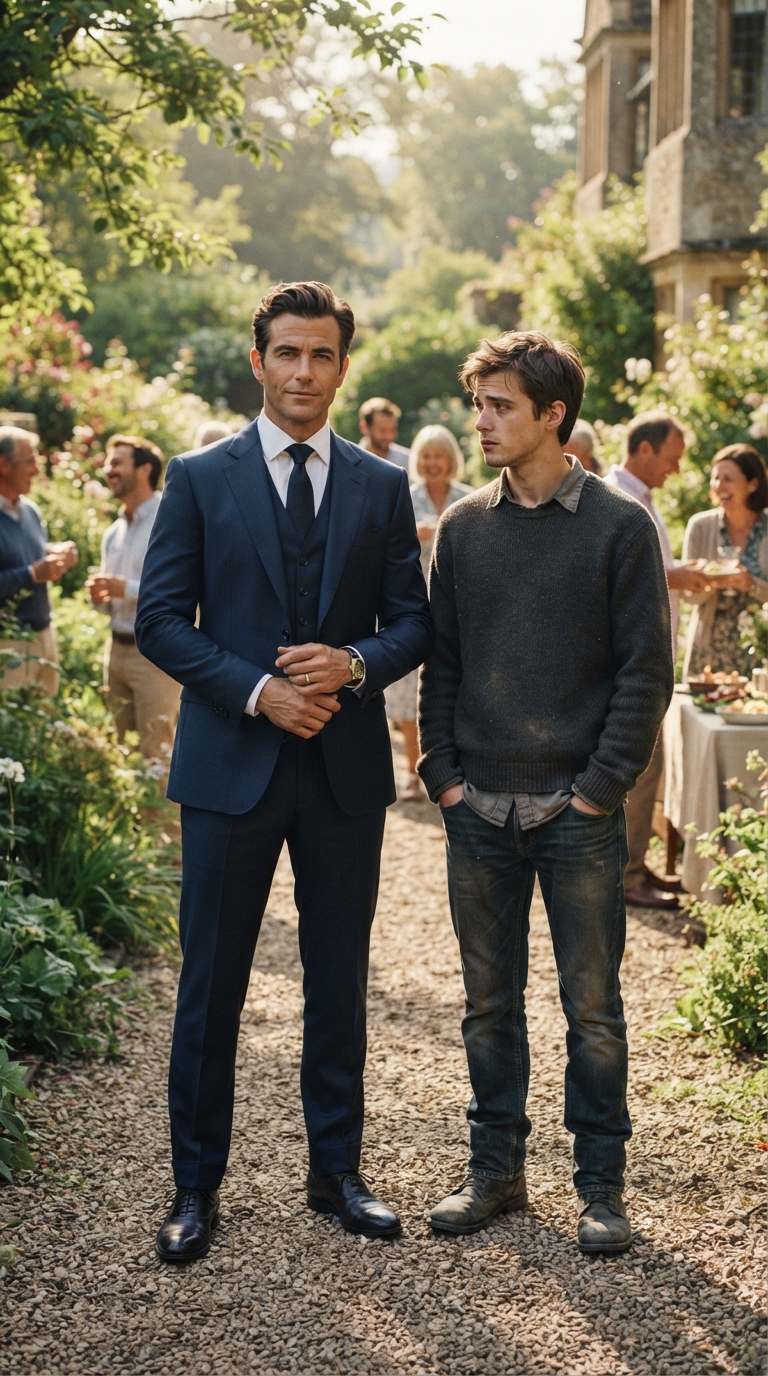
Marcus made one phone call the next morning, before Dylan was even discharged, and by that afternoon my surgery was scheduled, paid in full, at the best specialist in the state. But that wasn’t the part that mattered most, not really. What mattered was that three months later, at a small dinner Marcus hosted — no string quartet, no valet parking, just his family and mine, sitting around his own kitchen table for the first time in over a decade — he stood up before dessert and told the entire family the truth about that day at the swimming hole, all of it, including the part about our father, including the part about what an eight-year-old boy had done and what that same boy had carried alone in silence for twenty-six years afterward.
Our mother cried through the entire story. Dylan, sitting beside his father, reached over at some point and took my hand, a twelve-year-old kid who now understood, in a way few people ever get to understand about the adults who saved them, exactly what his uncle had once done and was capable of doing again.
Marcus didn’t just acknowledge me after that. He rebuilt, slowly and deliberately, over the following year, a relationship that had been buried under twenty-six years of a silence neither of us had fully chosen and both of us had somehow agreed to keep. We started having dinner every other week. He asked about my work, my life, the parts of me he’d spent years avoiding, with a genuine curiosity that felt, for the first time since we were children, like being truly seen by my brother again.
The millionaire who once walked past me at a family reunion like I was a stranger became, in the years after that hospital hallway, the brother who called just to check in, who showed up at my surgery recovery, who finally, finally understood the actual size of the debt he owed — not to guilt him into paying it, because I’d never wanted that, but simply so he could stop drowning in a version of it he couldn’t name.
Some debts aren’t meant to be repaid in money.
Some are only ever repaid in truth.
And once my brother finally heard the whole of it, he never once looked through me again.