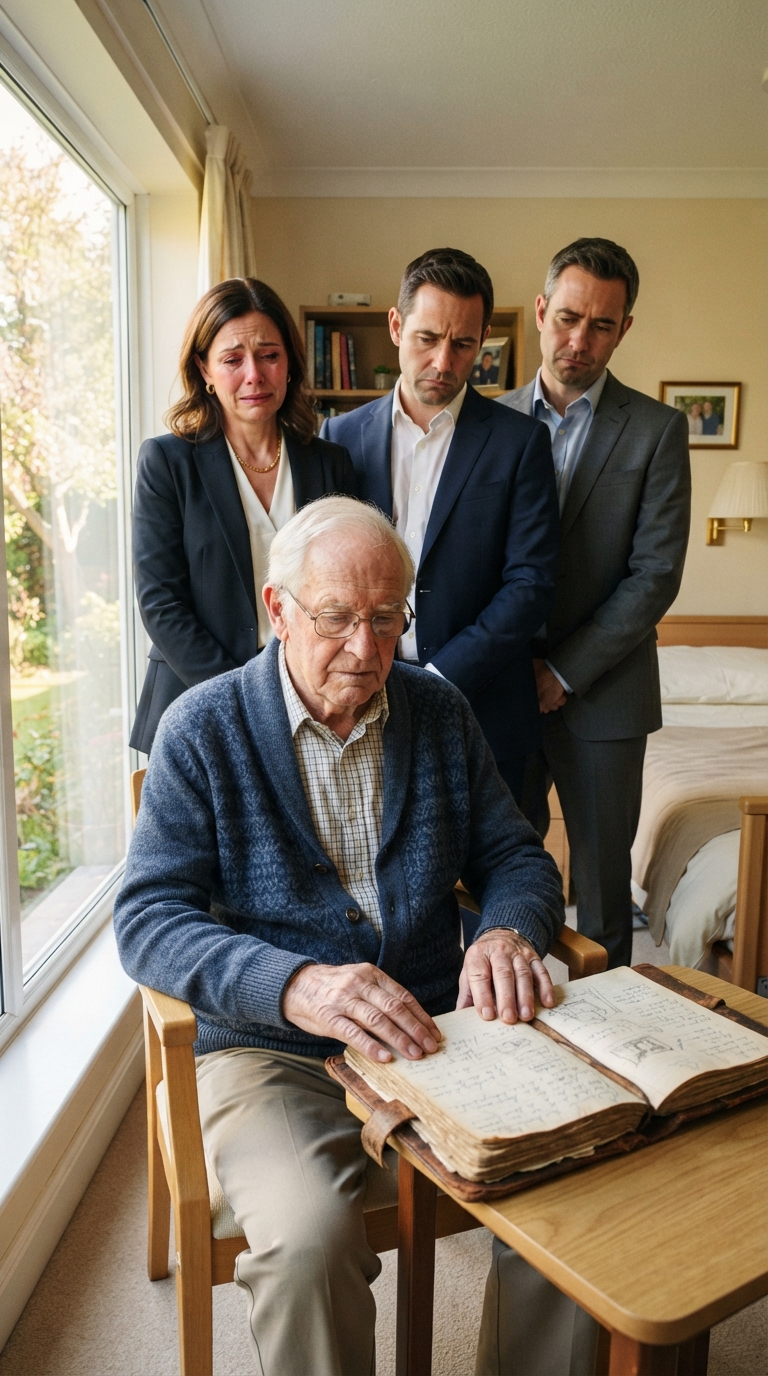
He spent forty years making himself invisible so his children could shine — and the moment they finally saw him, it nearly broke all four of them.
Walter Higgins was sitting by the window in Room 114 when the door opened, the late afternoon light turning the frost on the glass a pale gold. He expected Priya with his evening medication. He did not expect to see his three children standing in the doorway, still in the clothes they’d worn to work that morning, all of them pale, all of them silent, Renata clutching a worn spiral notebook against her chest like it might otherwise slip from her hands.
“Dad,” Daniel said, and something in the single syllable made Walter’s chest tighten in a way no cardiologist had ever quite managed to explain to him.
He looked at the notebook in Renata’s hands and understood, instantly, completely, exactly what had happened. Thirty-one years of careful secrecy, undone in an afternoon by an administrator with better instincts for grief than for accounting.
“That wasn’t meant for you,” he said quietly. “Not like this.”
“Then when?” Renata’s voice broke on the question. “When was it meant for us, Dad? After you were gone? Were you going to let us find out everything you did for us after it was too late to say thank you?”
Walter didn’t answer right away. He looked at his hands — hands that had loaded trucks and mopped office floors and, once, in 1994, unfastened a watch his own father had given him and sold it to a pawnshop three towns over so no one who knew his name would see the transaction. Hands that had held Margaret’s through eleven months of chemotherapy, and had held nothing but a phone that didn’t ring for the fourteen months since he’d moved into Willowbrook.
“I didn’t want gratitude,” he finally said. “I wanted you to have lives where you never had to think about what it cost to give them to you. That was the whole point. If you’d known, you would have carried it. I didn’t work three jobs so my children could grow up carrying my weight too.”
Thomas sat down hard in the chair beside the bed, his real estate portfolio and his business journal features and his carefully built life suddenly weighing nothing at all against a sentence like that.
“I thought you just weren’t around much,” Thomas said. “Growing up. I used to tell people my dad worked a lot, like it was just — a personality trait. Like you just liked working.”
“I liked you having what I never had,” Walter said. “That’s not the same thing. But I understand why a kid couldn’t tell the difference.”
Daniel finally moved from the doorway, crossing the small room in three steps, and did something none of them could remember him doing since he was very young — he knelt down beside his father’s chair, at eye level, the way you kneel for someone you finally understand you have to look up to, not down at.
“The watch,” Daniel said. “You sold Grandpa’s watch for my cleats.”
“You made varsity,” Walter said, and for the first time since they’d walked in, something like a smile moved across his face. “Scored nine goals that season. I kept every newspaper clipping. They’re in a box at the storage unit, if it’s still — ” He stopped. “If the storage unit’s still paid for. I fell behind on that too, near the end.”
Renata sat on the edge of the bed and finally opened the notebook again, not to a random page this time, but to the very last entry, the one written six days earlier, the one about her and Daniel arguing over who should cover his care.
“I heard you,” she whispered. “That day on the phone. I said I wasn’t covering it alone. I said Daniel makes triple what I do. You heard all of that.”
“I did,” Walter said, no accusation in his voice at all, which somehow made it worse. “And I want you to know something, Renata. I never once, not for a single day of your life, resented what I gave you. Not the jobs. Not the shifts. Not the plasma, not the watch, not any of it. But I won’t pretend that hearing my own children argue about the cost of keeping me alive didn’t feel like something breaking that I didn’t know I still had left to break.”
The room was silent except for the low hum of the heating vent and, somewhere down the hallway, the distant sound of a television playing a game show no one in Room 114 was watching.
“Why didn’t you ever ask us for help?” Thomas said. “Before it got to this. Why didn’t you ever just — tell us you were struggling?”
Walter considered the question longer than any other that afternoon.
“Because the version of fatherhood I understood,” he said slowly, “was that you protect your children from your problems for as long as you possibly can, and you keep protecting them even after they’re grown, because some part of you never stops seeing them as small enough to need shielding. I didn’t know how to switch that off. I’m not sure I wanted to. But somewhere in there, protecting you turned into disappearing from you, and I don’t think I noticed the difference until it was already done.”
Daniel, still kneeling, reached for his father’s hand — cracked knuckles, a faint tremor that had gotten worse over the past year, skin thin as paper in the way that happens to people who have worked with their hands for far longer than their hands were built to last.
“We’re going to fix this,” Daniel said. “Today. Not the money — the money’s nothing, Dad, the money was never actually the problem, we were just too much like you to say so out loud. We’re going to fix the part where you’ve been in this room alone for six weeks while we built lives you paid for and forgot to invite you into them.”
“You don’t owe me anything,” Walter said.
“That’s not how this works,” Renata said, closing the notebook gently and setting it in her lap. “You spent thirty-one years writing down everything you gave us so you’d never have to say it out loud and make us feel guilty. So now it’s our turn. We’re not going to write it in a notebook. We’re going to show you. Every week. Every day, if that’s what it takes.”
What followed, over the next several months, wasn’t a single grand gesture — no children’s book ending, no single dramatic scene that solved forty years of quiet distance in an afternoon. It was smaller than that, and truer for it. Daniel restructured his work schedule to eat lunch with his father twice a week, sitting in the Willowbrook dining hall in his business suit, utterly unbothered by the curious looks from other residents’ families. Renata, who had access to better specialists than Willowbrook’s contracted physicians, personally coordinated Walter’s cardiac care, sitting through two appointments herself instead of delegating the follow-up to an assistant. Thomas moved his father out of Room 114 entirely within three weeks, into a small guest house behind his own home, one with a porch and a view of something other than a parking lot, close enough that Walter could hear his grandchildren — Thomas’s kids, who barely knew their grandfather — playing in the yard most afternoons.
They found the storage unit. The newspaper clippings were still there, yellowed and carefully preserved in a shoebox, Daniel’s nine-goal season alongside Renata’s medical school acceptance letter and a ticket stub from Thomas’s first real estate closing, a closing Walter had somehow, on a diner-and-dock-work salary, found a way to attend in person, taking an unpaid half-day he never once mentioned costing him anything.
The notebook itself became something else entirely by the end of that year — not a secret ledger of sacrifice, but a shared family record. Walter kept writing in it, but the entries changed. Daniel brought lunch again today. Talked for an hour about nothing important. Best kind of conversation there is. Renata’s oldest asked me about the watch story. Told her the whole thing. She cried. I told her not to. Some debts are supposed to feel like love, not guilt. Thomas’s daughter calls me Grandpa Walt now. Nobody taught her that. She just decided it on her own.
Carol Whitfield, the administrator whose late-night reading had started all of it, received a card the following Christmas from all four Higgins family members, thanking her for a decision she almost hadn’t made — the decision to open a notebook that wasn’t hers to read, because something in her gut told her it mattered more than protocol.
Walter Higgins died two years later, peacefully, in the guest house behind Thomas’s home, with all three of his children in the room, none of them arguing about anything at all, each of them holding a hand or a shoulder or, in Renata’s case, the notebook itself, now filled front to back across thirty-three years instead of thirty-one.
They buried him with that notebook, at his own written request, tucked into the breast pocket of the suit he’d worn to Margaret’s funeral decades earlier — the only suit he’d ever owned, kept pressed and ready in a closet for exactly this kind of occasion, because Walter Higgins, even in his final written instructions, was still thinking about making things easier for everyone else.
But before they buried it, Renata copied every single page by hand into a new notebook, one she gave to her own children on their eighteenth birthdays, one at a time, with the same instruction each time: Read this before you decide what kind of sacrifice looks like love, and what kind of silence looks like distance. Your great-grandfather spent his whole life confusing the two. Don’t make the same mistake with the people who love you.
The old man they had once argued over in a phone call about payment plans became, in the end, the reason none of his grandchildren ever grew up wondering whether they were loved.
He had spent forty years making himself invisible so his children could shine.
In the two years he had left, they finally made sure he never had to disappear again.