Fourteen years of marriage. Her father’s inheritance as the down payment. Three days in the new house before her husband gave her bedroom to his mother. And a yellowed document with two signatures that explained why her father’s name had appeared in a message thread between her husband and his mother about a plan Claire had never been told existed.
Ethan turned the document toward me slowly.
My father’s handwriting was unmistakable — the careful, deliberate cursive of a man who had been an accountant for thirty years and who had understood that precision in writing was a form of respect for the person reading it. I had seen that handwriting on birthday cards and holiday letters and the note he had left me the Christmas before he died that I kept in the drawer of my bedside table.
I knew it anywhere.
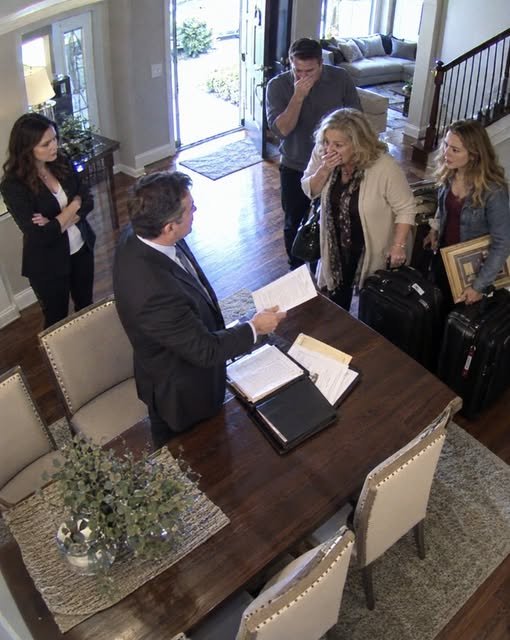
What I did not know was what it was doing on a document that Ethan had produced from a leather folder in my dining room while my husband stood in the hallway with no color left in his face.
The document was a promissory note.
Dated eleven years ago. During the second year of my marriage to Daniel.
My father — Robert Sutton, retired accountant, the man who had saved carefully across forty years to leave me something — had lent Daniel Mercer $180,000.
Not given. Lent. With a promissory note. With terms. With a repayment schedule that had been signed by Daniel and witnessed by Linda Mercer and notarized at an office in Columbus on a Tuesday afternoon in April of the year I turned thirty-one.
I had been thirty-one years old.
I had not known.
My father had been alive. He had been healthy — or what I understood as healthy, the year before the diagnosis that changed everything. He had been sitting across from my husband at some table somewhere and had written a check for $180,000 and had taken a promissory note in return and had said nothing to me about any of it.
Neither had Daniel.
For eleven years.
I looked up from the document.
“Daniel,” I said.
He was looking at the floor.
“Daniel,” I said again.
He looked up.
His expression was the expression I had seen three days ago when Linda called and he stood at the granite counter finding it fascinating — the expression I had recognized as nervousness rather than surprise and that had frightened me more than his anger. It was the expression of a man who has been managing a secret for a long time and has just watched the management end.
“It was a loan,” he said. “Between family. Your father—”
“Was not your family,” I said. “He was mine.”
Ethan set another document beside the first.
“The loan,” Ethan said, “was never repaid. The promissory note carried a ten-year term with a specific repayment schedule that Daniel signed in full acknowledgment of. The ten years ended fourteen months ago. The outstanding balance at that time, including the accumulated interest specified in the note, was $211,400.”
Linda made a sound.
I looked at her.
She had the expression of someone whose plan has been reached from a direction they did not anticipate and who has not yet located the response.
“Your mother,” Ethan continued, looking at Daniel, “was the witness on the note. She knew about the loan from the beginning. Which is why her message asking whether Claire knew about the old agreement was relevant to what I needed to verify.”
I thought about the message thread I had read on the iPad at midnight.
Are you absolutely sure Claire doesn’t know about the old agreement?
Her father is dead. Nobody’s going to bring that up now.
Her father is dead.
My father had died two years ago. He had died with a promissory note in his estate documentation — a note that Ethan, as the estate attorney, had found and that I had never been told about because Daniel had apparently been counting on the death of the only other person who knew to be sufficient cover.
He had been wrong.
“When Mr. Sutton passed,” Ethan said, “the promissory note became an asset of his estate. As the sole beneficiary of his estate, Claire, the debt transfers to you. Daniel owes you $211,400.”
The dining room was very quiet.
“Additionally,” Ethan said, “the down payment on this property — $127,000, funded by Claire’s inheritance — was made in Claire’s name and is documented as her separate property contribution to the purchase. In combination with the outstanding debt, Claire’s documented financial interest in this marriage significantly exceeds Daniel’s.”
Linda stood up.
“This is ridiculous,” she said. “She had no idea about the loan because her father chose not to tell her. That’s not Daniel’s fault.”
“Linda,” Ethan said, “you signed as witness on a document that created a legal obligation. You were aware of it for eleven years. You sold your condominium based on a plan that required Claire to be unaware of her legal position. I would recommend you speak to your own attorney before you say anything further in this room.”
Linda’s mouth closed.
Rebecca, who had been standing near the door with the box of family photographs since the suitcase had hit the floor, set the box down quietly and took a step backward.
Daniel tried twice more before Ethan and I were finished at the table.
The first time was a version of the loan being a family matter that my father had kept private because he understood that couples needed their own financial space and that his choice not to tell me was a form of respect for our marriage.
Ethan addressed this in the specific language of a man who has spent thirty years in estate law and is not interested in creative reframing.
The second time was a version of Daniel being under pressure during those years — his business had been struggling, my father had offered, it had been temporary, he had always intended to repay it, the circumstances had changed, time had passed.
I let him finish.
Then I said: “When did you intend to tell me?”
He was quiet.
“When did you plan to tell me that my father had lent you money that you never paid back? When did you plan to tell me that your mother knew and that the two of you had been in contact about it for eleven years? When did you plan to tell me any of it, Daniel?”
He said nothing.
“You weren’t going to,” I said. “Her father is dead. Nobody’s going to bring that up now. That was the plan.”
He looked at the table.
“That was the plan,” I said again. “And then use my father’s inheritance as the down payment on a house that your mother was going to move into and take over, and I was going to be the spoiled wife who didn’t understand that family comes first.”
I thought about the sticky notes she had been putting on furniture. Our wedding photograph leaned against the wall. Get your stuff out of my bedroom.
I thought about my father, who had known something about Daniel that he had decided to manage through a promissory note rather than a conversation with his daughter, and I thought about why he might have done it that way — why a careful, precise accountant might have chosen documentation over disclosure.
I thought about what he had told me once, years before any of this: When you lend someone money, you are also lending them the opportunity to show you who they are when the pressure arrives.
My father had lent Daniel $180,000.
He had watched for eleven years.
He had kept the note.
He had not told me. But he had kept the note.
And he had left his estate to Ethan — a man with close-cropped silver hair and a reputation for being impossible to intimidate — with the specific instructions of someone who understood that the documentation might someday be needed and wanted it in the hands of someone who would use it correctly.
My father had known.
He had not warned me. But he had prepared for me.
Linda left the house that afternoon.
Not immediately — there was a period of approximately forty minutes during which she alternated between insisting that the document was irrelevant and that I was being deliberately cruel to a widow who had sold her home and that Daniel would handle this and that I had never deserved my father’s money in the first place.
Ethan sat at the table throughout.
He did not argue. He did not raise his voice. He occasionally noted, in the measured tone of a man who has been impossible to intimidate for thirty years, that Linda was welcome to retain her own counsel and that he looked forward to discussing the matter with that counsel at a mutually convenient time.
Rebecca took her mother home.
The box of family photographs stayed by the door.
Daniel did not leave that day.
That process was longer — the specific length of fourteen years of shared life, which does not end in an afternoon regardless of what an afternoon reveals. There were conversations and silences and the specific difficult work of two people looking at something true about their marriage and deciding what to do with the truth.
I want to be honest about what I did and did not do.
I did not immediately file for divorce. I was forty-two years old and I had been married for fourteen years and I was not going to make the final decision about the marriage on the day the document appeared on the dining room table. I needed time that the dining room table could not provide.
What I did was establish, with Ethan’s guidance, a legal framework that acknowledged my financial position clearly and protected it going forward. The $211,400 debt was formally documented as a marital asset. The down payment contribution was formally documented as separate property. Nothing moved without my knowledge and my attorney’s review.
I slept in my bedroom.
Linda did not move in.
The marriage ended eight months later.
Not because of the money — or not only because of the money. The money was the document. The money was the evidence of something that had been true before the document existed and would have continued to be true without it.
The marriage ended because of the eleven years of choosing not to tell me. Because of the midnight messages and the sticky notes and the spare key and the silence at the granite counter. Because of my mother comes first said to a woman who had funded the house with her father’s memory and her father’s savings and her father’s careful forty years of work.
Because of a man who had looked at the death of my father and thought: Nobody’s going to bring that up now.
My father had brought it up.
Not through a conversation — through a promissory note in an estate file and a lawyer with close-cropped silver hair who had answered my midnight email within the hour.
The settlement reflected the documented financial reality. Ethan was thorough.
I am still in the house on Maple Avenue.
The pale hardwood floors are mine. The sunny kitchen is mine. The backyard where I imagined Thanksgiving dinners is mine.
I had Thanksgiving there last November.
Ethan came. A colleague from work. My neighbor who had brought meals the week of the moving boxes. My friend Patricia who had listened to fourteen years of things I had explained away and who had never stopped listening.
Not a large gathering. Enough.
I set the table myself.
I stood in the kitchen at four-thirty in the morning before the turkey went in — the same time I used to get up for the hospital shift, the body remembering the rhythm even after the reason has changed — and I made the coffee and I thought about my father.
He had pressed a brass key into my palm in a hospital room.
He had left a promissory note in a file.
He had known.
He had not warned me because warning me would have required me to act before I was ready and he had understood that readiness cannot be manufactured by external pressure. What he had done instead was prepare. He had documented. He had placed the documentation in the hands of a man he trusted and had left it there for however long it took.
He had trusted me to find it when I needed it.
He had been right.
I stood at the kitchen counter with my coffee and the backyard visible through the window in the November dark and I told my father what I tell him every morning in the specific one-sided conversation of someone who has lost a person and has not stopped talking to them.
I told him the house was warm.
I told him the floors were exactly right.
I told him about Ethan and the document and the afternoon Linda’s suitcase hit the hardwood with a tremendous thud and the color left Daniel’s face.
I told him I understood now why he had kept the note.
When you lend someone money, you are also lending them the opportunity to show you who they are when the pressure arrives.
Daniel had shown me.
My father had prepared me to see it.
I drank my coffee.
The November dark turned to November light.
I started the Thanksgiving preparations.
The house smelled like coffee and warmth and the beginning of something that was entirely, completely, without question mine.
— As told by the woman who stood in her master bedroom on moving day and said “we finally did it,” and who stood in her kitchen fourteen months later and understood that what she had finally done was find out.