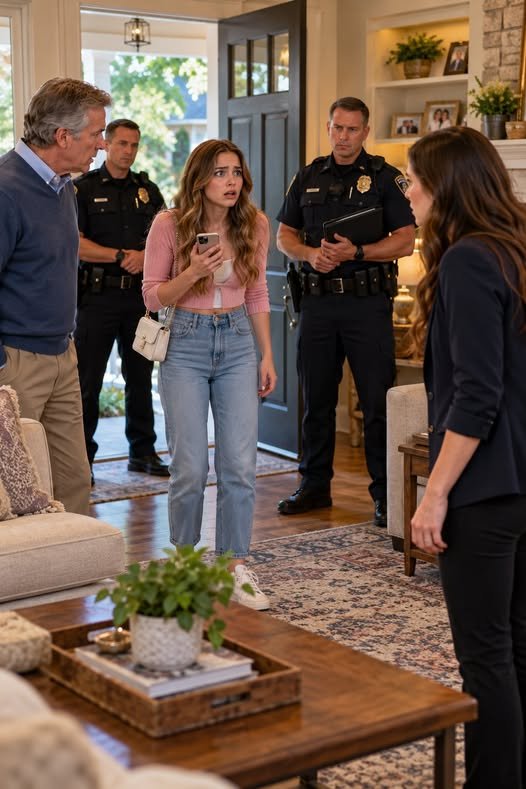
Officer Ramirez turned his tablet toward Tessa, displaying a high-resolution freeze-frame from the forty-six-second video she had uploaded to her social media account.
“Ms. Bell,” Officer Ramirez said, his voice flat and authoritative. “We aren’t here because you posted your sister’s paycheck. We’re here because of what was visible on the desk right next to her laptop.”
Tessa blinked, her eyes darting nervously between the officers and our father. “What are you talking about? It was just a stupid video! I deleted it!”
“Deleting a video doesn’t erase a crime, Tessa,” Officer Ramirez replied. He zoomed in on the top right corner of the screen. Resting on Dad’s desk, partially obscured by Tessa’s designer handbag but clearly visible in 4K resolution, were three thick manila envelopes stamped with red security wax and bold black lettering: CONFIDENTIAL – U.S. DEPARTMENT OF DEFENSE – PROPRIETARY ASSET SURVEY.
I gasped, my hand flying to my mouth.
Dad wasn’t just a retired high school history teacher. For the past six years, he had been working as a contract archivist for a defense logistics firm, processing restricted land and infrastructure records for regional military installations. He kept those encrypted files locked inside a heavy steel safe in his study—a safe he had opened earlier that afternoon to perform a routine audit before going to the grocery store.
When Tessa swung her phone around to capture my laptop screen, her high-definition camera had zoomed directly over those documents, clearly capturing classified project code names, property serial numbers, and sensitive geographic coordinates.
“Within eight minutes of your video going live,” Officer Ramirez explained, “it was flagged by automated threat-monitoring algorithms operated by federal cyber-security contractors. Because your video went viral so quickly, those classified serial numbers were downloaded, cached, and circulated across three foreign-hosted data scraping servers before you took the post down.”
Tessa’s phone finally slipped from her fingers, clattering loudly against the hardwood floor. “No… no, that’s impossible. I didn’t even look at those papers! I was just making fun of Lauren!”
“Ignorance is not a defense against federal security violations, Ms. Bell,” the second officer added, pulling a set of official papers from his binder. “Ellison Risk Group reported the breach of their secure terminal, but the Department of Defense Cyber Crime Center issued the immediate warrant for the seizure of all recording devices present in this house.”
“Seizure?!” Tessa shrieked, backing away toward the door. “You can’t take my phone! My whole life is on that phone! My business, my sponsorships, my followers!”
“Tessa, stop!” Dad shouted, his voice cracking with an agonizing mixture of heartbreak and anger. It was the first time I had ever heard my father raise his voice at her. “You breached a federal security protocol because you wanted strangers on the internet to laugh at your sister! Look at what you’ve done!”
The officers stepped forward. “Tessa Bell, you are being placed under federal administrative detention pending a full forensic audit of your digital accounts and devices under the Computer Fraud and Abuse Act, as well as federal espionage preservation statutes.”
“Dad! Lauren! Do something!” Tessa sobbed hysterically as Officer Ramirez pulled her arms behind her back and clicked the steel handcuffs around her wrists. “Lauren, tell them it was an accident! Tell them I’m just an influencer!”
“I can’t fix this for you, Tessa,” I said quietly, tears stinging my eyes. “You spent years ignoring everyone’s privacy for views. You finally filmed something you weren’t allowed to touch.”
They led my crying, frantic sister out the front door and into the back of a black police sedan parked in Dad’s driveway.
The fallout over the next six months was absolute and devastating.
Federal investigators spent three weeks auditing Tessa’s phone, laptop, and cloud storage. While they eventually concluded that she had not intentionally engaged in espionage or treason, her reckless negligence had caused a severe corporate and governmental security breach.
To avoid a lengthy federal prison sentence, Tessa’s attorney negotiated a plea agreement. She pleaded guilty to misdemeanor unauthorized access to a protected computer system and reckless endangerment of classified data.
The legal consequences stripped away every single thing she had built her life around. The court imposed a mandatory three-year ban on all social media activity, ordered her to complete 500 hours of community service, and levied heavy fines.
Furthermore, every single brand partnership and corporate sponsor dropped her within forty-eight hours of the news breaking. The high-end production studio she had tried to open collapsed before it ever started, as her potential partners publicly distanced themselves from her legal nightmare.
To pay her legal fees and court fines, Tessa was forced to sell her luxury wardrobe, give up her high-end apartment, and take a night shift job as an administrative clerk at a local warehouse—a job where she spends eight hours a day sitting in front of simple spreadsheets, completely offline.
My company, Ellison Risk Group, conducted a thorough internal review of my conduct. Because I had followed protocol by leaving my workstation in a private residence and had immediately reported the situation when contacted by security, I was cleared of all wrongdoing. In fact, three months later, I received a promotion to Senior Risk Analyst—along with a substantial salary increase that far exceeded the numbers Tessa had tried to mock online.
Dad retired completely from his contract work, relieved that his security clearance remained intact after investigators verified he had locked the study door prior to leaving.
Tessa now lives in a modest, one-bedroom basement apartment. The sister who used to mock me for being “boring” and “financially boring” now lives a completely quiet, private life out of necessity.
Last month, during a quiet Sunday dinner at Dad’s house, Tessa sat across from me at the dining table. She didn’t have her phone out. There were no cameras, no iced-coffee photoshoots, and no mean-spirited jokes for an online audience.
She looked down at her plate and whispered, “I’m sorry, Lauren. For everything.”
I looked at my sister, seeing her clearly for the first time in years without the filter of a screen.
“I know, Tessa,” I replied gently. “Sometimes the quiet life is the only one that actually matters.”