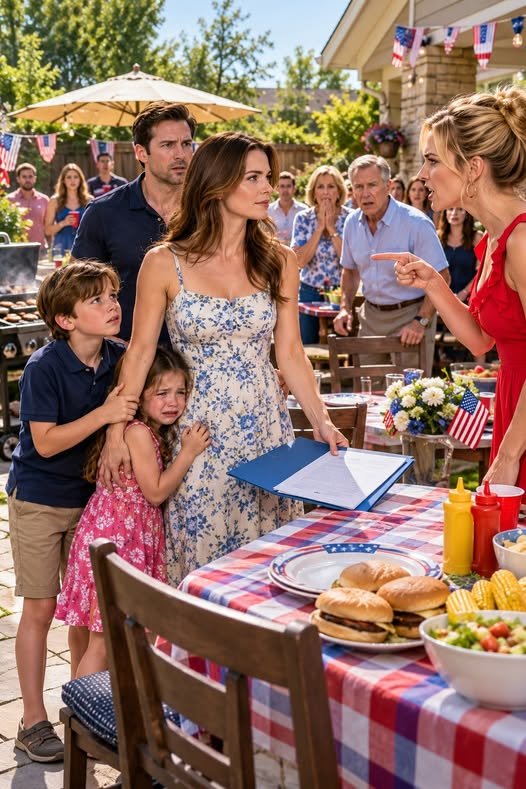
“Since you brought it up,” I said, “let’s start with who signed the first page.”
I turned the document so the whole backyard could see it. At the top, in bold type: Petition for Voluntary Termination of Parental Rights. At the bottom, in blue ink, was a signature everyone in that family knew. Brooke Hendricks.
Nobody breathed.
“Ethan and Lily are Brooke’s children,” I said. “She gave birth to them. Then she signed them away. I didn’t take them. She chose not to keep them.”
Brooke made a sound like a cough. “That’s private.”
“You made it public,” I said, “when you told my son I wasn’t his mother.”
I need to explain what the family never knew, because Brooke made sure they never would.
Nine years ago, Brooke was twenty-four, unmarried, and pregnant by a man who vanished. She hid it from everyone. She gave birth to Ethan in a hospital two states away, and when he was three weeks old, she called Daniel, her brother, at two in the morning, sobbing that she couldn’t do it.
Daniel and I drove through the night. We had been trying to have children for four years. We hadn’t asked her for anything. She begged us to take him.
Two years later, it happened again. Another man, another crisis, and a baby girl named Lily. Brooke stood in our kitchen and said, “I can’t raise them. I’ll ruin them. Please.”
She signed the papers both times, in front of a judge and a court-appointed attorney, with full counseling and every chance to change her mind. The adoptions were finalized. She asked for one thing: that nobody in the family ever know.
“She was ashamed,” I said quietly. “She’d told your parents she was traveling. She said she couldn’t bear it if anyone knew she’d given up her children. So we kept her secret, even when she began telling people I’d stolen them.”
Barbara had sat down hard. Her hand covered her mouth, and tears were running down her cheeks.
“Brooke,” she whispered. “Those are your babies?”
Brooke didn’t answer. She was staring at the grass.
“Why did you do it?” Richard asked, his voice shaking. “Why would you stand here and say those things to your own children?”
“Because I couldn’t stand it,” Brooke burst out. She looked up, mascara streaked, and for the first time, there was no performance in her face. “Every holiday, every birthday, I watch Clare hold them, and they run to her. They love her. They should be mine, and I gave them away, and I can’t stand that she’s good at it. So I made her the villain. It was easier than being the one who left.”
The backyard was silent except for the radio, still playing something cheerful.
I knelt beside Ethan and Lily and took both their hands.
“I want to tell you the truth,” I said, “and I’m going to say it simply. Aunt Brooke gave birth to you. She wasn’t able to take care of you, and she made a very hard choice. Daddy and I adopted you because we wanted you more than anything in the world. I’m your mother. She’s your birth mother. Both things are true.”
Ethan’s lip trembled. “Did she not want us?”
I could have lied. Instead I looked at Brooke. “I think she wanted you very much, sweetheart. I think she was scared.”
Brooke covered her face and began to sob.
Lily, six years old and fearless, walked over to her aunt and stood in front of her. “You made me cry,” she said.
“I know,” Brooke whispered. “I’m so sorry, Lily.”
Lily considered this with great seriousness. Then she said, “Okay. But you have to say sorry to Mommy too.”
The rest of the afternoon didn’t go as I’d imagined.
I had walked into that yard half hoping for vindication. What I got was a family quietly coming apart and rebuilding. Barbara held Brooke while she wept. Richard stood with his hand on Daniel’s shoulder, saying, “You should have told us,” and Daniel answered, “She asked us not to.”
Aunt Carol and Renee approached me one at a time, red-eyed and ashamed.
“I believed her,” Carol said. “I’m so sorry.”
“You couldn’t have known.”
“I could have asked,” she said.
The fireworks didn’t happen that night. Nobody had the heart. We sat on the patio until dark, and the children fell asleep on the glider with a blanket over them, and Brooke sat on the step below, a few feet away, not touching them, only watching.
Daniel and I talked that night in our kitchen with the lights low.
“I should have stopped her years ago,” he said. “I thought if I kept quiet, she’d calm down.”
“I let her too.”
“You carried it alone.”
“So did she,” I said, and was surprised to realize I meant it.
He took my hand. “Are you angry with me for asking you not to open the folder?”
“I was. Not anymore.” I shook my head. “You were protecting your sister. I understand. But the children needed me to protect them more.”
“You did,” he said. “You always do.”
It took a year of therapy, family counseling, and many long, awkward conversations.
Brooke started seeing a counselor on her own. She told the family everything, the shame, the fear, the guilt she had buried under cruelty. She wrote me a letter. It was two pages, and I read it three times.
I told myself you stole them because it was easier than admitting I couldn’t keep them. You never stole anything. You were the one who stayed. I’ll spend my life being grateful, if you’ll let me.
I didn’t answer for a month. Then I invited her to dinner.
She came with a store-bought pie and shaking hands. She sat at the far end of the table. Ethan and Lily studied her warily, the way children do when an adult has hurt them and is trying to earn their way back.
“Aunt Brooke,” Ethan said finally, “are you still sorry?”
“Every day,” she said.
He nodded. “Okay. You can sit closer.”
She moved down two chairs and cried quietly into her napkin.
We built something new, slowly. Brooke visited on Sundays, never as a mother, never as a rival, but as a third kind of family we had no word for. She came to school plays and sat in the back. She taught Lily to braid hair. She and Ethan bonded over comic books. When they eventually asked more questions about their birth, she answered each one honestly, with me beside her.
On the next Fourth of July, the whole family gathered in the same backyard. The radio played country music. The burgers sizzled on the grill. The sparklers sat in their bucket by the steps.
As dusk fell, Ethan lit one and held it up, a tiny star in his hand. Lily stood on one side of him. On the other stood Brooke, careful and quiet, her hand just over his shoulder.
“Mommy,” Lily called, “come see!”
I crossed the lawn. My daughter reached up and took my hand. My son leaned against my hip. Brooke looked at me over their heads, her eyes full, and mouthed two words.
Thank you.
I nodded.
The sparkler burned down. The fireworks began, bursting red and blue over the field. Daniel slipped his arm around my shoulders.
Somewhere in the glittering dark, I understood what I had never been able to say in that backyard a year earlier.
A mother isn’t the person who gave birth. She isn’t the person who signed a paper. She is the one who stays, who tells the truth gently, who stands in the doorway when the world gets loud.
And I stayed.