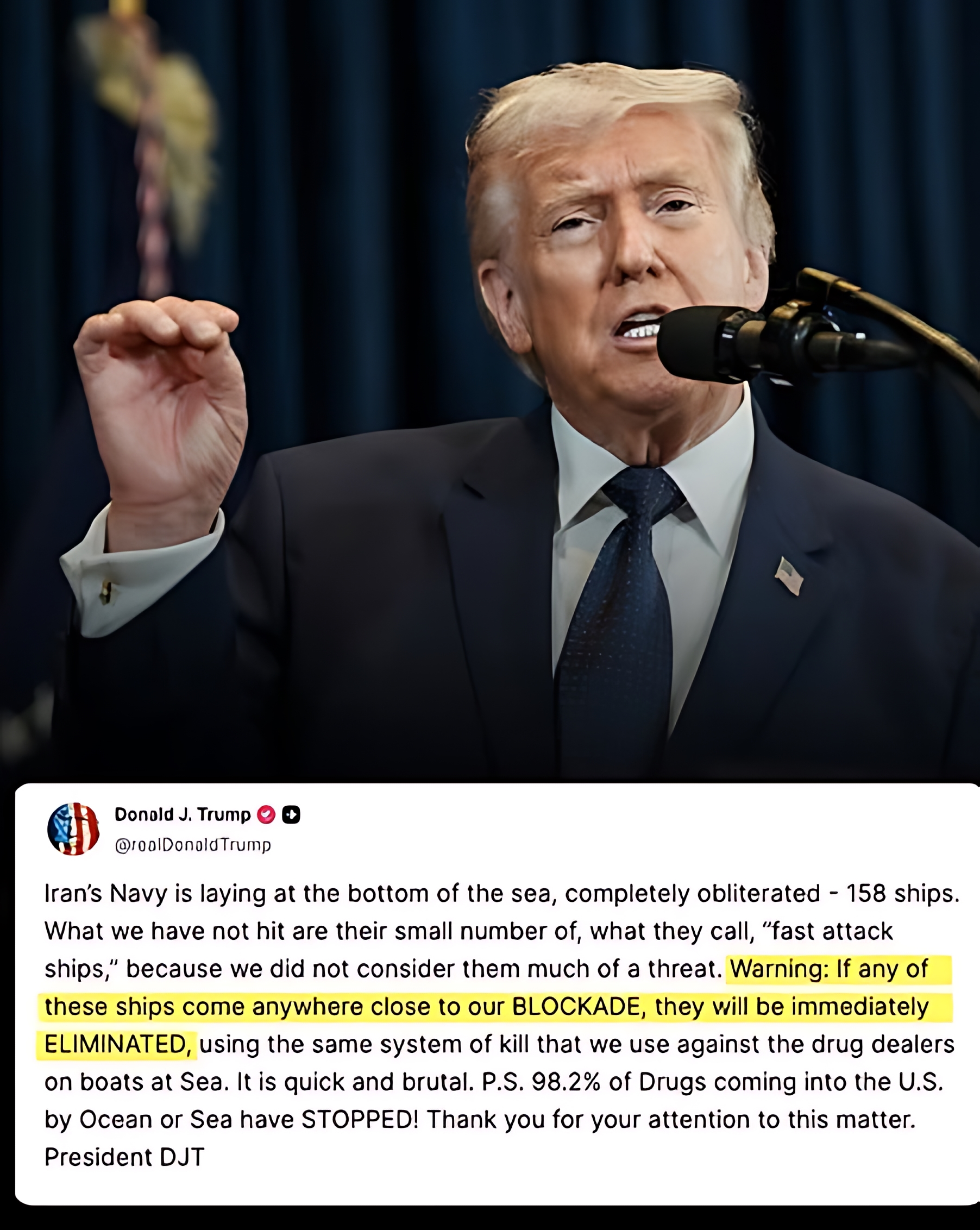
WASHINGTON — President Donald Trump delivered one of his most forceful warnings yet on Tuesday, declaring that any vessel approaching the U.S.‑enforced blockade near Iran would be “immediately eliminated,” a statement that drew swift international attention and raised concerns about potential escalation in the Persian Gulf.
Speaking to reporters before a national security briefing, Trump compared the rules of engagement for the blockade to U.S. operations targeting drug‑smuggling boats in international waters.
“If any of these ships come anywhere close to our blockade, they will be immediately eliminated, using the same system of kill that we use against the drug dealers on boats at sea,” Trump said.
The White House later clarified that the President was referring to defensive maritime interdiction protocols, not indiscriminate attacks, and emphasized that the policy applies only to vessels that ignore repeated warnings and pose a threat to U.S. forces.
Background: A High‑Tension Maritime Standoff
The warning comes as the U.S. continues to enforce a naval blockade aimed at pressuring Iran to reopen the Strait of Hormuz, a critical chokepoint for global oil shipments. Iran has restricted tanker traffic for weeks, prompting sharp increases in global energy prices and heightened military activity in the region.
U.S. officials say the blockade is intended to prevent Iranian military vessels from interfering with commercial shipping, while Iran has condemned the action as an “illegal act of aggression.”
International Reaction
The President’s remarks prompted immediate responses from global leaders:
- European Union diplomats urged restraint, warning that miscommunication at sea could trigger unintended conflict.
- Gulf states expressed support for strong enforcement but encouraged both sides to pursue diplomatic channels.
- China and India, major importers of Gulf oil, called for de‑escalation and the reopening of shipping lanes.
Maritime security analysts said the President’s language was unusually blunt, even for a period of heightened tension.
Pentagon Response
Defense officials did not comment directly on the President’s phrasing but reiterated that U.S. naval forces follow strict engagement protocols designed to prevent unnecessary escalation.
A senior defense official said U.S. ships will continue issuing multiple warnings — including radio calls, signal flares, and maneuvering instructions — before taking action against any vessel deemed a threat.
Iran’s Position
Iranian state media condemned Trump’s remarks, calling them “reckless” and accusing the U.S. of attempting to provoke a confrontation. Iranian officials said they would hold the United States responsible for any incident resulting from what they described as “dangerous and unlawful threats.”
What Comes Next
Diplomatic efforts to resolve the standoff remain ongoing, with European and Gulf intermediaries attempting to broker a temporary agreement to ease tensions. U.S. officials say the blockade will remain in place until Iran lifts restrictions on tanker traffic.
For now, the President’s warning underscores the volatility of the situation — and the risks that even a single miscalculation at sea could spark a broader conflict.