I didn’t sleep much that night. Not out of anger — out of clarity. For the first time in months, I could see the shape of things clearly, the way you can suddenly see a room once someone turns the lights back on.
The next morning, I drove to the hardware store and bought new deadbolts for every exterior door in the house. Then I called a locksmith to come finish the job professionally, front door to garage entry, by early afternoon.
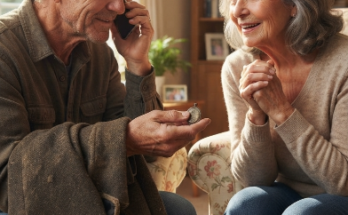
While that was happening, I sat down with my parents at the kitchen table. My mother’s hands were folded tightly in front of her, the way they always were when she was trying not to cry. My father just watched me, steady, the way he’d watched me through every hard decision of my adult life.
“I heard what she said to you,” my mother said quietly. “Through the wall. I’m sorry, Marcus. We never wanted to be a burden.”
“You’ve never been a burden,” I said. “You built this house with me before it ever existed. You raised my son when I didn’t know how to get out of bed some mornings. This is your home. It always will be.”
My father just nodded once, the way he does when words feel unnecessary.
Then I called Caleb into the room. Seventeen years old, trying to look unaffected, though I could see the tightness in his jaw. “I heard some of it too,” he admitted. “I figured you’d pick her.”
“I’m not picking anyone over you,” I told him. “Not now, not ever. That was never a real question.”
By early evening, the new locks were in. I packed two suitcases — Renata’s and one for each of her children — and set them neatly by the front door. Not thrown. Not spiteful. Just packed, the way you’d help a guest whose visit had come to its natural end.
Renata came home around 6:30, expecting, I think, a serious conversation and maybe a tearful apology from me. Her key didn’t work. She tried it twice, jiggling the lock, confused, before she rang the doorbell.
I opened the door myself.
Standing behind me — not hiding, not staged, just there, the way they always had been — were my parents and my son. Walter with his cardigan and steady eyes. Josephine with her hand resting gently on Caleb’s shoulder. Caleb standing a little taller than I think he realized.
Renata’s face shifted from confusion to disbelief. “Marcus, what is this?”
“You asked me to choose,” I said. “So I did. I chose the people who built this life before you were ever part of it, and who never once asked me to prove my love by pushing someone else out.”
“You’re really doing this over your elderly parents and a teenager who doesn’t even talk to me?” she said, her voice rising. “Over people who don’t even need this house the way we do?”
“They don’t need the house,” I said. “They earned it. There’s a difference.”
Her children stood a few steps behind her on the porch, confused and a little frightened by the tension, and for a moment, my chest ached for them — they hadn’t asked for any of this, hadn’t asked to be pawns in an ultimatum their mother had chosen to make. I told her, calmly, that I’d help cover a rental deposit for her and the kids for the next few months, no strings attached, because whatever happened between us, her children didn’t deserve instability because of a decision that was hers, not theirs.
“That’s it?” she said. “After everything?”
“You told me to choose between the people who raised me and the woman who’d been in my house for six weeks,” I said. “I think the fact that it was even a question tells you everything you need to know about how this was always going to end.”
She left that night, angrier than I’d ever seen her, calling me cruel, cold, controlling. Maybe to her, I was. But cruelty, to me, looks like asking a man to throw away the people who sacrificed everything for him, in exchange for someone who’d been counting his rooms and his attention like inventory.
My parents didn’t say much that night. My mother just made tea, the way she always does when the house needs to feel calm again. My father sat beside me on the porch steps long after everyone else had gone inside.
“You did right by us,” he said eventually. “But more than that — you did right by yourself.”
Caleb came out a few minutes later and sat on the other side of me, saying nothing, just staying close, the way he used to when he was small and the house still felt too big and too quiet after his mother died.
It felt, for the first time in months, like my home was actually mine again — full of the people who never once needed an ultimatum to prove they belonged there.