I didn’t stay for coffee hour. I got in my car still in my church clothes and drove, following an address my sister gave me over a shaky phone call, my hands tight on the wheel the entire way.
I sat outside Naomi’s house for nearly ten minutes before I could make myself get out of the car. It was a modest brick house with a wheelchair ramp built alongside the front steps — for patients, I’d later learn, who visited her home office on weekends when her clinic overflowed. There were two bikes on the lawn, one pink, one blue, and a wreath on the door that was neither Christmas nor obviously religious — just simple, warm, welcoming.
I walked up and raised my hand to knock, and for a moment I froze completely, sixteen years of self-justification suddenly feeling as flimsy as wet paper. What was I even going to say? I’ll regret this, I’d told her once. I finally understood, standing on that porch, that the regret had been mine the entire time, just delayed by a decade and a half of pride dressed up as principle.
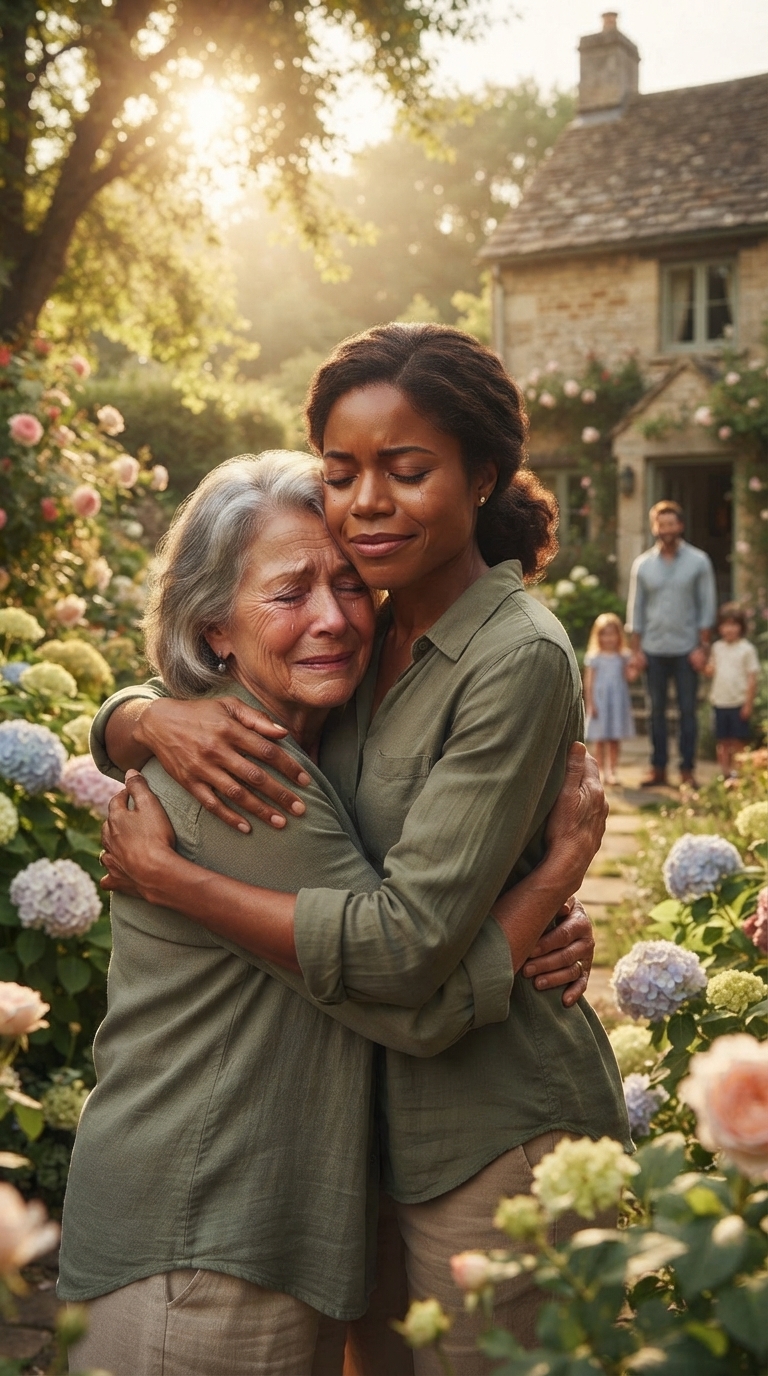
The door opened before I even knocked. Naomi stood there in casual weekend clothes, a little girl balanced on her hip, and for a second neither of us said anything at all.
“Mom,” she finally said. Not cold. Not warm either. Just quiet, careful, like she was testing whether the ground beneath the word was solid.
“I saw the announcement,” I said. My voice came out smaller than I intended. “The scholarship. I didn’t know. I didn’t know about any of it — the clinic, the kids, none of it.”
She stepped back and let me in. That’s the part I still can’t quite believe, sixteen years later — that she let me in at all.
Her husband, Daniel, was in the kitchen making lunch, and he greeted me with a level of grace I genuinely hadn’t earned, shaking my hand and introducing himself like we were meeting for the first time, because in every way that mattered, we were. Their older child, a boy of about ten, was doing homework at the counter. The little girl on Naomi’s hip, I learned, was named after my late mother — a detail that nearly broke me right there in the entryway.
We sat at their kitchen table — not unlike my own, just newer, brighter — and Naomi told me pieces of the sixteen years I’d missed. Medical school on scholarships and loans she was still paying off. A grueling residency in a hospital two hours from anyone she loved because “anyone she loved” had shrunk down to a very small circle after our estrangement. Meeting Daniel during a rotation, the two of them building a life, a family, a practice together, brick by brick, without a single plate ever set for me at their table either, because she genuinely hadn’t known if I’d ever want one.
The clinic, she explained, treats patients regardless of ability to pay — something she built specifically because of a rotation she did early in her career, watching families choose between medication and groceries. The scholarship fund was seeded with money she and Daniel had set aside for years, finally large enough this year to make a real difference for graduating seniors in our county, some of whom, she told me quietly, remind her of the version of herself I once refused to walk down an aisle for.
I didn’t try to explain away what I’d said in 2010. I told her plainly that I had been wrong, not just about Daniel, not just about that day, but about the sixteen years of silence I let follow it, every single Christmas I set out six plates and then talked myself out of what that meant. I told her the truth: that pride had cost me sixteen years with grandchildren I’d never met, and that no theological conviction I held was worth what I’d traded it for.
We are not fully healed. You don’t undo sixteen years over one Sunday lunch. But I left her table having met my grandson and my granddaughter for the first time in their lives, with a standing invitation to come back — and this Christmas, for the first time since 2009, I will set out six plates and not put a single one away.