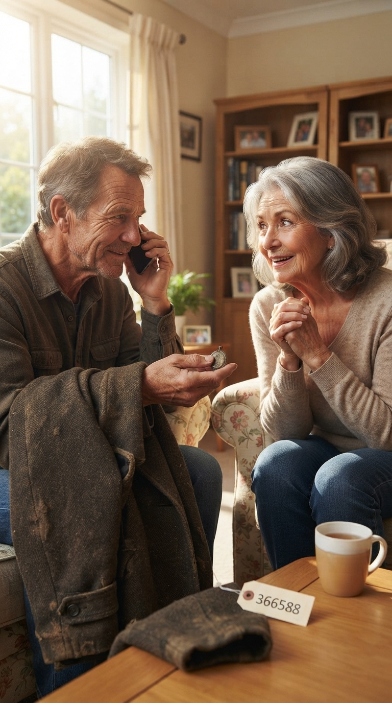
Robert’s voice was gentle, like he’d rehearsed this call more than once before actually making it. “There’s an inside pocket,” he said. “Sewn kind of deep, easy to miss. I almost didn’t find it myself — I was checking the lining because a button was loose. There was an envelope in there. Sealed. Your name was on the front.”
My hands were shaking so badly I nearly dropped the phone. “Did you open it?”
“No, ma’am. It’s got your name on it. That’s not mine to open. But I’ll be honest, it’s old — the paper’s yellowed, the ink’s faded some. Whatever it is, it’s been in there a long while.”
We arranged for him to meet me the next morning at a coffee shop near my house. Robert turned out to be a soft-spoken man in his sixties, recently on hard times himself, grateful and a little embarrassed to be accepting donated coats at all. He handed the envelope over like it was made of glass and told me, again, that he was sorry to intrude on something so personal, that he almost just kept quiet and let it go, but it felt wrong not to say something.
I didn’t open it in front of him. I thanked him more times than was probably necessary, and I drove home with the envelope on the passenger seat like it might disappear if I looked away from it.
Inside, in Walter’s unmistakable handwriting — cramped, slanted, the same hand that used to leave me grocery lists — was a letter. It was dated eleven years earlier, the year his mother died and, I now understood, the same year he’d started seeing a cardiologist for chest pains he never once mentioned to me.
The letter wasn’t a confession of some hidden affair or secret family, the kind of thing you brace yourself for in moments like this. It was something quieter, and in some ways harder to carry. Walter had written it the week he found out his heart condition was more serious than he’d let on — a letter meant for me, in case he didn’t make it through a procedure he never told me he was scared of.
In it, he apologized for things I never knew he felt guilty about — for working too many hours when our kids were young, for a fight we’d had decades earlier that I had genuinely forgotten and he apparently never had, for not saying “I love you” enough out loud even though, he wrote, he felt it every single day for thirty-one years. He wrote about our wedding day, about the specific blue of my dress, about how he used to practice what he’d say to me in the mirror before he worked up the nerve to actually say it.
He’d survived that procedure. He must have written the letter, tucked it into the coat’s inside pocket for safekeeping, and then — once the danger passed — simply forgotten it was there, or perhaps never found the courage to bring it back out and hand it to me directly. Either way, it sat sewn into the lining of a coat he wore for another decade, through a hundred ordinary winter days, without either of us knowing it was there.
I called Claire that night and read her the letter over the phone, both of us crying in that particular way that’s half grief and half something closer to gratitude. I called Robert the next day to thank him properly, and I’ve since learned he’s between jobs and struggling to keep up with rent — so my children and I have quietly been helping him out, because it felt like the least we could do for a stranger who chose honesty over convenience.
I still have the coat. Robert insisted I take it back once he understood what it meant, though I told him to keep it if it was helping him through a cold winter — we settled on splitting the difference, and I bought him a new coat instead so we both got to keep what we needed.
Grief has a way of making you think you already know everything about the person you lost, every corner of them, every hidden pocket. I’ve learned that isn’t true. Sometimes love keeps speaking to you long after the person who felt it is gone — you just have to be brave enough, eventually, to check the pockets.