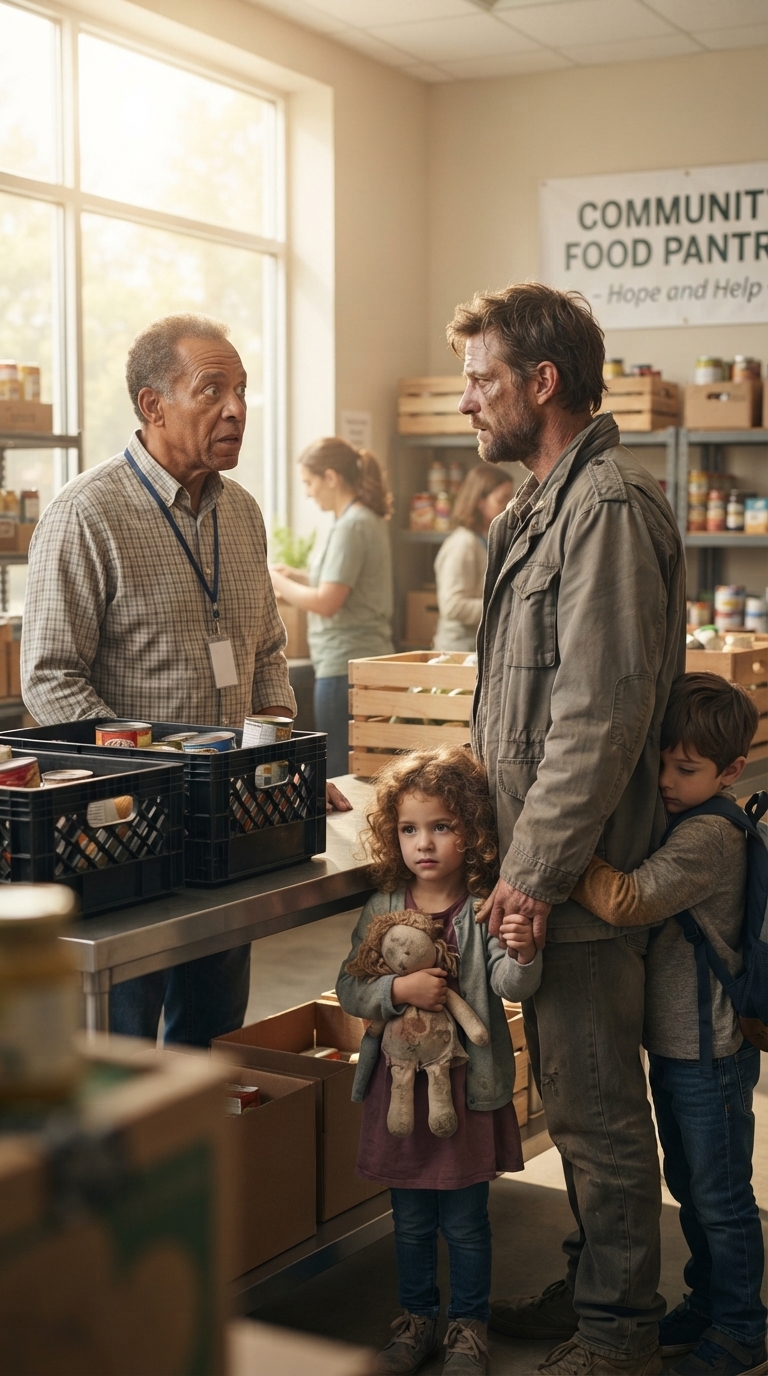
He recognized me the instant our eyes met — I watched it happen, watched fifteen years collapse into a single second on his face. Neither of us said anything at first. The little girl tugged his hand, asking about the bread tray a few feet away, and he let her go look, buying himself a moment before he had to say anything at all.
Then he stepped closer, close enough that only I could hear him, and said, “Dad… I didn’t come here for food. I came because I—”
He stopped there. His jaw tightened. I realized, watching him, that this wasn’t hesitation from nerves. It was a man trying to figure out how to say something he’d been rehearsing and still hadn’t found words solid enough for.
“I came because I found out three weeks ago that I have a heart condition,” he finally said. “Something congenital. The kind that runs in families. The doctor asked about family history and I realized I didn’t actually know yours — not really. Grandpa’s, yours, none of it. I’ve been carrying around fifteen years of not knowing basic things that might matter for my own kids someday.”
I felt something crack open in my chest that had nothing to do with any diagnosis.
We sat in the back office of the pantry — the one with the space heater that never quite works right — and Ethan told me everything the last fifteen years had held. He and Priya never married; she’d left when their son, Marcus, was two, overwhelmed by a life neither of them had been ready for and neither had much support building. Ethan raised Marcus mostly alone after that, working construction, moving between apartments and, for one bad stretch two years ago, a shelter, before he met his current partner, Danielle, and they’d had their daughter, Rosie, together.
Three weeks ago, a routine physical turned into something more serious — arrhythmia, tests, a cardiologist using words like “monitoring” and “family history” that Ethan realized he had no real answers for. He’d spent fifteen years assuming pride would keep him from ever calling me, and then a heart monitor made him realize pride was a luxury he could no longer afford, not with two kids who might need to know the same medical history someday.
He hadn’t come to the pantry looking for me specifically — he told me it was just the closest place with a hot meal and warm room on a cold Tuesday, and finding me there was pure chance, the kind of coincidence that makes you wonder if some things are simply overdue. But once he saw me, he said, the fear of dying without ever asking the questions he needed to ask outweighed fifteen years of not calling.
I told him what I knew. My own father’s heart had given out at sixty-one, sudden and without warning, something we’d always chalked up to “just how the men in this family go” instead of examining as an actual pattern. My mother’s side had its own history of arrhythmia I’d never taken seriously because it never affected me directly. It was, in hindsight, exactly the kind of information a son deserves to have long before a cardiologist has to ask for it in an exam room.
That night, I did something I should have done fifteen years earlier — I told him I was wrong. Not just about the three hundred dollars, not just about “leave this house,” but about every year after that I let pride convince me silence was easier than an uncomfortable phone call. I told him I’d spent fifteen years protecting a version of myself that never had to admit fault, while he spent those same fifteen years raising two kids essentially alone.
Ethan, Marcus, and Rosie came back to my house that night — not permanently, not yet, but for a start. Marcus is quiet and careful in a way that reminds me painfully of Ethan at that age. Rosie has already claimed the recliner in my living room as “her chair,” and I haven’t had the heart to argue.
Ethan’s cardiologist appointment is scheduled for next week, and I’m going with him this time, filling out every page of family history I can remember, determined that his kids will grow up with more answers about where they came from than I ever gave him.
I don’t know how to undo fifteen years. I’ve learned you can’t, not really — you can only start telling the truth today instead of tomorrow. But if there’s one thing I’d want another parent reading this to take from it, it’s this: don’t wait for a diagnosis, a coincidence, or a food pantry line to reach out to a child you pushed away out of pride. Some of us get lucky enough for a second chance. Please don’t count on getting one.