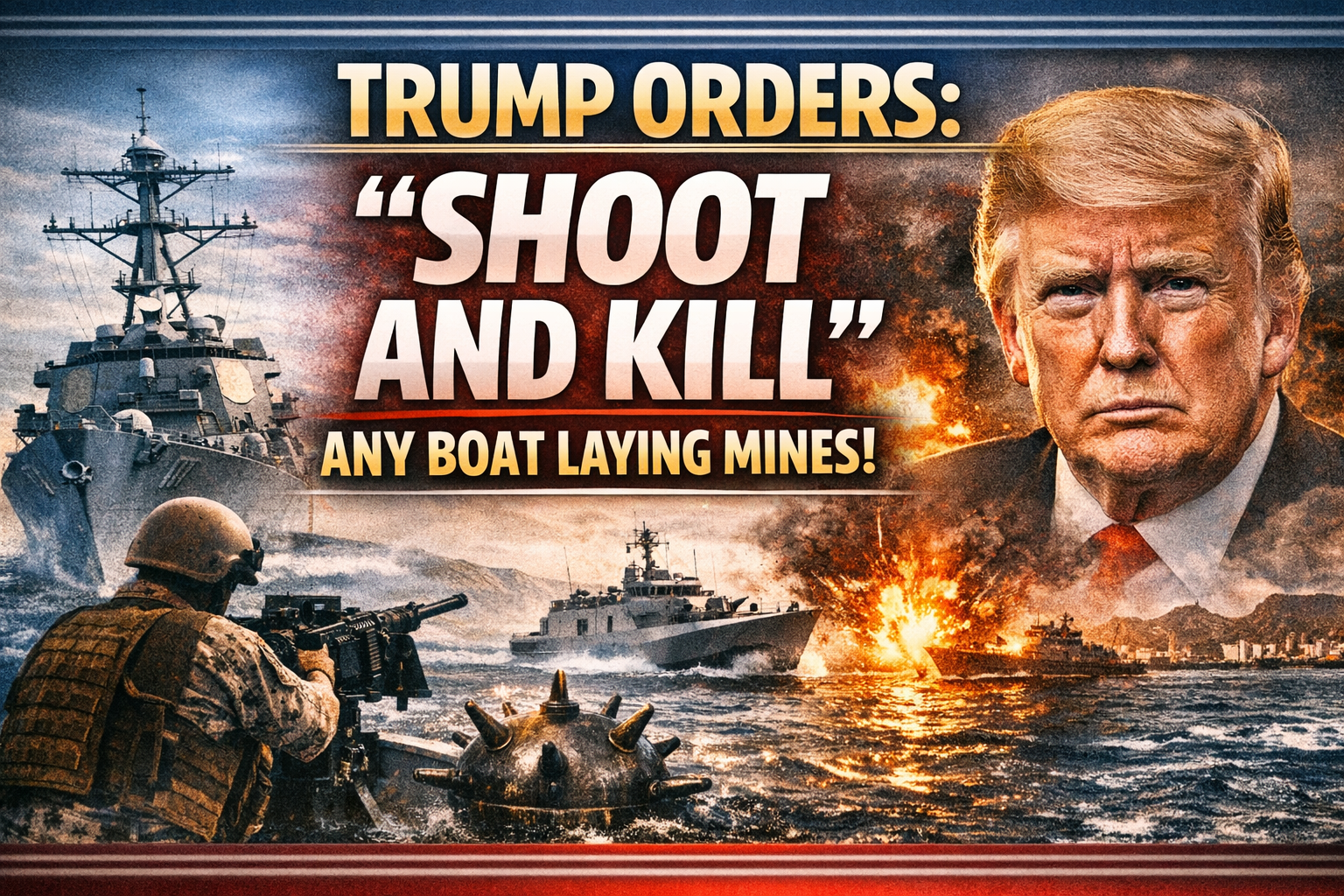
WASHINGTON — President Donald Trump on Thursday issued one of his strongest directives yet in the ongoing standoff with Iran, announcing that he has ordered the U.S. Navy to “shoot and kill any boat” caught placing naval mines in the Strait of Hormuz. The president delivered the warning in a social‑media post, adding that Iran’s larger naval vessels had already been destroyed in earlier clashes — a claim U.S. officials have not independently confirmed.
“There is to be no hesitation,” Trump wrote, saying the order applies specifically to small craft believed to be used by Iran’s Islamic Revolutionary Guard Corps (IRGC) for mine‑laying operations.
The statement comes amid heightened tensions in the region, where the fragile ceasefire between the United States and Iran has been repeatedly tested by maritime confrontations, drone interceptions, and competing claims about control of the strategic waterway.
Pentagon: Rules of Engagement Already Allowed Defensive Action
Defense officials said the president’s directive largely reinforces existing rules of engagement, which permit U.S. forces to take action against vessels posing an imminent threat. However, the explicit public framing — “shoot and kill” — marks a significant escalation in tone.
A senior Navy official said commanders in the region have been briefed on the order but emphasized that U.S. forces will continue to follow international maritime law.
Iran Accuses U.S. of Escalation
Iranian state media condemned the president’s remarks, accusing Washington of attempting to provoke a confrontation. Tehran has denied laying new mines in the strait and claims the U.S. blockade of Iranian ports violates the ceasefire agreement.
The IRGC warned that any attack on its vessels would be met with a “decisive response,” though it did not specify what actions it might take.
Strategic Importance of the Strait
The Strait of Hormuz remains one of the world’s most critical shipping lanes, with roughly 20 percent of global oil passing through its narrow waters. Mine‑laying has long been one of Iran’s most effective asymmetric tools, capable of disrupting commercial traffic and raising global energy prices.
U.S. officials say intelligence reports indicate increased IRGC small‑boat activity in recent days, though they have not publicly released evidence of new mine deployments.
Diplomatic Efforts Under Strain
The president’s order comes as Pakistan attempts to revive indirect negotiations between Washington and Tehran. Diplomats warn that any maritime incident — especially one involving lethal force — could collapse the ceasefire entirely.
European allies urged both sides to avoid escalation, with one EU official saying the situation is “one miscalculation away from a wider conflict.”
What Comes Next
U.S. naval forces in the region remain on high alert, and officials say they expect increased patrols in the coming days. Whether the president’s directive deters mine‑laying or triggers further confrontation will likely determine the fate of the ceasefire.