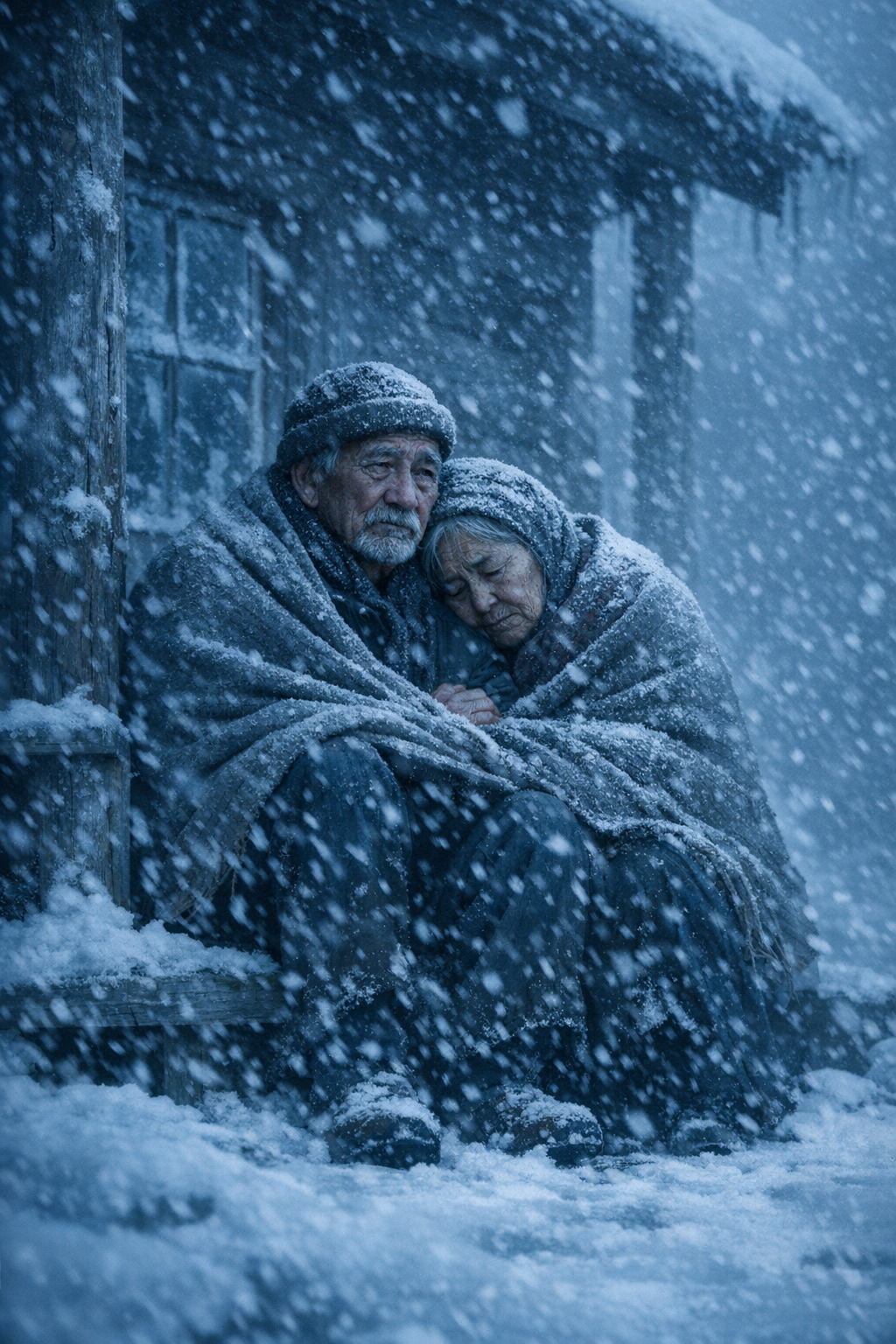
The first snow of the season arrived early that year, drifting down in slow, heavy flakes that clung to the old wooden house like memories refusing to let go. Inside, the fire crackled weakly, its warmth barely reaching the corners of the room where shadows gathered like silent witnesses.
Mai and Thuan sat close together on the worn-out sofa, wrapped in the same thick blanket they had shared for forty years. Their hands, knotted with age, rested on top of each other. They didn’t speak. They didn’t need to. The silence between them had grown familiar—soft, heavy, and full of things they no longer dared to say aloud.
On the table lay a single sheet of paper. A contract. Signed by both of them. Signed by their son.
The house—their house—was no longer theirs.
It had been his idea. “It’s just for easier management,” he had said. “Let me handle the paperwork. You’re getting older. I’ll take care of everything.”
They believed him. Of course they did. He was their only child.
But the truth revealed itself like a knife sliding out of its sheath.
He had sold the house.
Not to fix it. Not to help them. Not to build a future together.
He sold it to pay off debts they never knew he had.
And he didn’t even come to tell them in person.
He sent a text message.
“It’s done. Please don’t make this harder.”
Mai read that message until the words blurred. Thuan stared at the wall, jaw trembling, but he never cried. He had always been the strong one. But that night, when he thought Mai was asleep, she heard him whisper into the darkness:
“I built this house for him. Every nail. Every beam. I built it for him.”
The new owners were arriving in the morning.
The next day, the sky was a dull, bruised gray. Snow piled against the porch steps, and the wind howled through the trees like something grieving.
Mai and Thuan stood outside with two small suitcases—everything they could carry. Everything they were allowed to keep.
A young couple pulled up in a shiny SUV, smiling politely, unaware of the history they were stepping into. They apologized for being early. They thanked Mai and Thuan for “maintaining the place so well.” They asked if the heating worked.
Mai nodded. Thuan forced a smile.
They didn’t blame the couple. They blamed themselves. For trusting too much. For loving too blindly. For raising a son who could erase them with a signature.
When the new owners walked inside, Mai turned back for one last look.
The wooden house stood quietly, its windows fogged, its roof heavy with snow. She remembered the nights she rocked her baby to sleep in that house. The mornings she cooked rice porridge while her husband chopped firewood. The laughter. The arguments. The birthdays. The storms they survived.
All of it lived inside those walls.
And now those walls belonged to strangers.
Thuan gently touched her shoulder. “It’s time to go.”
They walked down the snowy road, their footprints deep and close together. The wind blew hard, erasing their steps almost immediately.
Just like their son erased them.
Mai didn’t cry until they reached the bend in the road where the house disappeared from view. Thuan held her hand tighter.
“We still have each other,” he said softly.
But even he knew that some winters were too cold for two old hearts to survive alone.