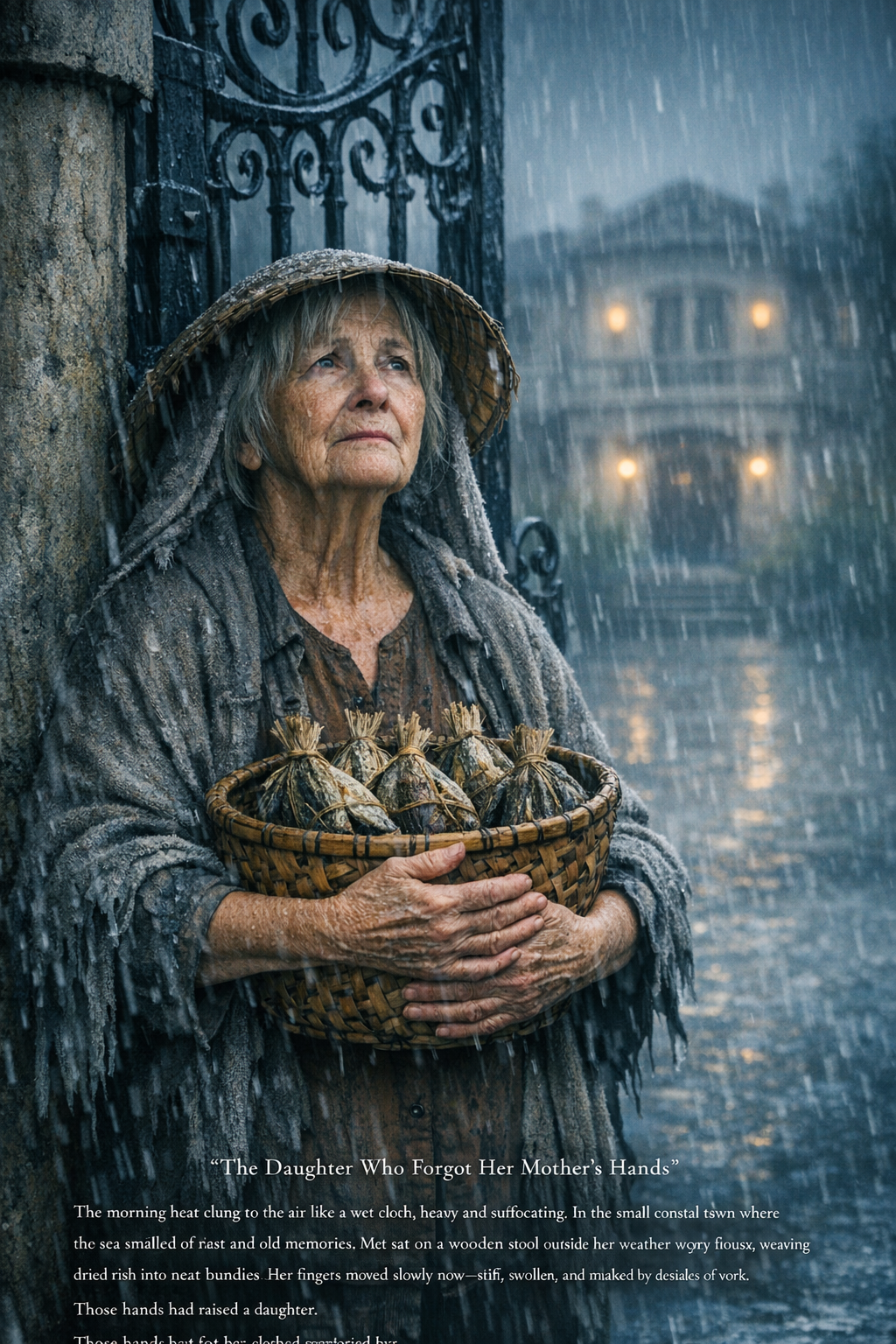
The morning heat clung to the air like a wet cloth, heavy and suffocating. In the small coastal town where the sea smelled of rust and old memories, Mei sat on a wooden stool outside her weather‑worn house, weaving dried fish into neat bundles. Her fingers moved slowly now — stiff, swollen, and marked by decades of work.
Those hands had raised a daughter.
Those hands had fed her, clothed her, protected her.
Those hands had once been her daughter’s whole world.
But now… They were hands her daughter pretended not to know.
Mei’s husband, Huy, stepped out of the house, wiping sweat from his brow. His back was bent from years of hauling fishing nets, but his eyes still carried a softness that hadn’t yet been crushed by disappointment.
“She won’t come,” he said quietly.
Mei didn’t look up. “I know.”
But she still tied the bundles neatly, still arranged them in the basket, still prepared them the way her daughter used to love.
Because hope is a stubborn thing. It clings even when it hurts.
Their daughter, Linh, had married into a wealthy family in the city — a family that lived behind tall gates, marble floors, and chandeliers that cost more than Mei and Huy had earned in a lifetime.
At first, Linh visited. Then she visited less. Then she stopped.
The last time Mei saw her daughter was two years ago, when she stood outside the mansion gate holding a basket of dried fish — the same fish Linh used to beg for as a child.
The guard had looked at her with confusion. “Madam says she doesn’t know you.”
Mei remembered the balcony. She remembered seeing Linh standing there, wearing a silk dress, her hair styled, her face cold.
Their eyes met.
And Linh turned away.
Today, Mei tried again.
She and Huy walked slowly toward the mansion, the sun beating down on their backs. The basket felt heavier with every step, not because of the fish, but because of the memories woven into them.
When they reached the gate, the guard recognized them. His expression tightened.
“Madam isn’t accepting visitors.”
Mei held out the basket with trembling hands. “Please… just give this to her. She used to love—”
“I’m sorry,” the guard interrupted. “She said not to take anything from you.”
The words hit harder than any storm.
Mei lowered the basket. Her hands shook.
Behind the gate, the mansion gleamed — cold, distant, unreachable.
Huy stepped closer, his voice steady but tired. “Can you tell her… her mother is sick?”
The guard hesitated. Then shook his head.
“Madam said she has no parents.”
The world tilted.
Mei felt her knees weaken, but Huy caught her before she fell. The guard looked away, uncomfortable, but he didn’t open the gate.
He didn’t call Linh.
He didn’t even offer a seat.
Mei stared at her hands — the same hands that once braided Linh’s hair, wiped her tears, cooked her meals, held her through fevers and heartbreaks.
Hands that had given everything.
Hands that were now strangers.
A single tear slid down her cheek, disappearing into the wrinkles time had carved.
Huy whispered, “Let’s go home.”
They walked back slowly, the basket still full, the sun still burning, the sea breeze carrying the faint smell of salt and sorrow.
Behind them, the mansion gate remained closed.
And somewhere inside, their daughter lived a life built on forgetting — forgetting the hands that raised her, forgetting the love that shaped her, forgetting the people who would have given her the world.
But Mei remembered. Huy remembered. And the sea remembered too — whispering their grief in every crashing wave.