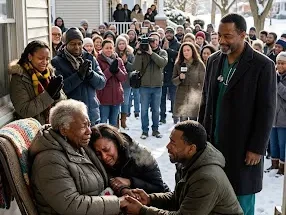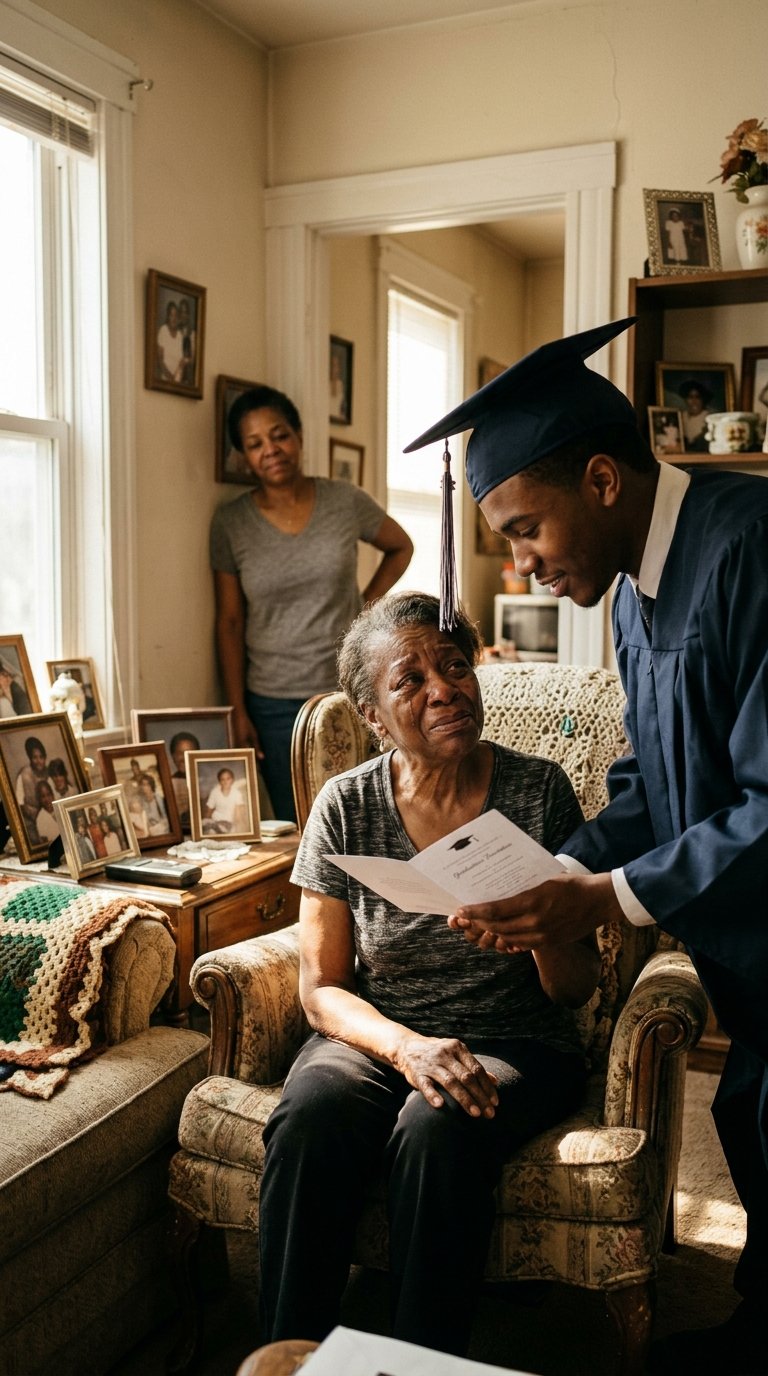
The word was Yes.
Dorothy held the paper to the lamp, as if it might change. Then she folded it carefully and put it in the pocket of her cardigan, close to her heart.
“I’ll keep that one,” she said.
Saturday came with a bright, windy sky. Dorothy had cleaned the apartment twice and rearranged the couch cushions four times. When the knock finally sounded, she was standing in the hallway with her hands clasped.
Renee stood on the landing in a plain blue dress, thinner than Dorothy remembered, with gray threaded through her hair. She held a grocery-store bouquet and a small paper bag.
“Mama,” she said.
Dorothy didn’t speak. She had imagined this moment a hundred ways, some of them angry. But looking at her daughter’s frightened eyes, every prepared sentence dissolved.
“Come in, baby.”
Renee stepped inside. The children, all three, stood in the kitchen doorway. Nobody moved.
“I’m not here to ask for anything,” Renee said, her voice shaking. “I’ve missed so much. I know there’s no way to give it back. But I brought something.”
She opened the paper bag. Inside lay a small, flat box wrapped in newspaper. Dorothy unwrapped it slowly.
It was a ring. A thin gold band, worn but polished.
“It’s yours,” Renee said. “You gave it to me when I was nineteen and told me to hold on to something good. I pawned it two years later.” She wiped her eyes. “I’ve spent six months working double shifts at the diner to buy it back. It was still in the shop, Mama. The owner kept it. He said nobody ever came to claim it, and he had a feeling.”
Dorothy stared at the ring. It was her mother’s wedding band, the only heirloom she had ever owned.
“I can’t undo what I did,” Renee whispered. “But I can start trying to repair it.”
Dorothy closed her hand around the ring. Then she opened her arms, and her daughter fell into them, sobbing like a child.
“You came back,” Dorothy said into her hair. “That’s all I ever wanted.”
Behind them, Marcus quietly took Tasha’s and Joel’s hands, and the three of them stood together, watching their family knit itself back together.
The graduation was held on a warm morning in June at the university’s great hall. Dorothy wore her best navy dress and a corsage that Tasha had pinned on with careful fingers. Renee sat on one side of her, Joel and Tasha on the other. Dorothy had never seen so many people in caps and gowns.
When the dean read, “Marcus Mercer Hayes, Doctor of Medicine,” the whole row rose to its feet. Dorothy stood last, on shaking legs, and she clapped until her palms stung.
Marcus crossed the stage, took his diploma, and then did something not in the program. He stepped to the microphone.
“I’d like to say one thing,” he said. The hall quieted. “When I was eleven years old, I was a very frightened boy. A woman took me in. She worked two jobs and slept on a couch for fourteen years so that I could have a bed. She never once let us feel like a burden.”
Dorothy’s hand flew to her mouth.
“She is seventy-four years old, and she is sitting in the fifth row. Grandma, stand up.”
She didn’t. She couldn’t. Joel stood and pulled her gently to her feet. The hall thundered. People turned, applauding an old woman in a navy dress, a cafeteria cook, a cleaner of churches, a grandmother who had raised children twice.
“Everything I became,” Marcus said, his voice breaking, “started with her.”
Dorothy cried openly. She no longer cared who saw.
That summer, Marcus took a residency at a hospital twenty minutes from home. His first paycheck arrived in July. He handed Dorothy a thick envelope and a small brochure.
“Retire,” he said.
“Marcus, I can’t…”
“You can. Tasha’s working. Joel’s covered by the scholarship. Mom is paying her share. I’m covering the rest.” He pressed the brochure into her hand. “And that’s a trip. Ten days. Branson, Missouri. Gloria’s already booked the seat next to you.”
Dorothy laughed until she had to sit down.
She went. She rode a boat on a lake, watched a show with singing cowboys, and ate pie for breakfast. She sent postcards to all three grandchildren, each one a variation on the same message: Rest is wonderful. I should have tried it sooner.
At home, the bedroom was hers again. Renee, now eighteen months clean, rented a small apartment a few blocks away and visited every evening. They cooked dinner together and didn’t always talk. Sometimes they just stood side by side at the stove, mother and daughter, the old wound healing slowly beneath them.
On the first night back from Branson, Dorothy took the jar down one last time. She emptied the folded papers, the old receipts, and the list of sacrifices. She laid them on the kitchen table, and then she tore each one into small pieces and dropped them in the trash.
“What are you doing, Grandma?” Joel asked from the doorway.
“I’m done counting,” she said.
She kept only the page with the one-word answer. She framed it, and it hangs in the hallway today, between the school photos and the graduation pictures. Visitors sometimes squint at it, puzzled by the shaky handwriting.
Was it worth it?
Yes.
On her seventy-fifth birthday, the whole family gathered around the table. There were four generations now, with Marcus’s fiancée and a baby on the way. Dorothy sat at the head, glowing, a paper crown crooked on her gray hair.
When the cake came, Tasha asked, “Grandma, what do you wish for?”
Dorothy looked around the table at her daughter, her three grandchildren, the small, loud, crowded kitchen she had once feared was too small to hold a family.
“I don’t need to wish,” she said. “I’m already looking at it.”
She blew out the candles. The room erupted in cheers.
And somewhere in that noise, in that warmth, a woman who had spent seventy-four years giving everything away finally understood the truest thing of all.
Love given freely is never lost. It simply travels, from one generation to the next, until it comes home.