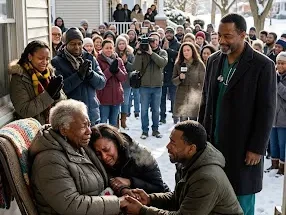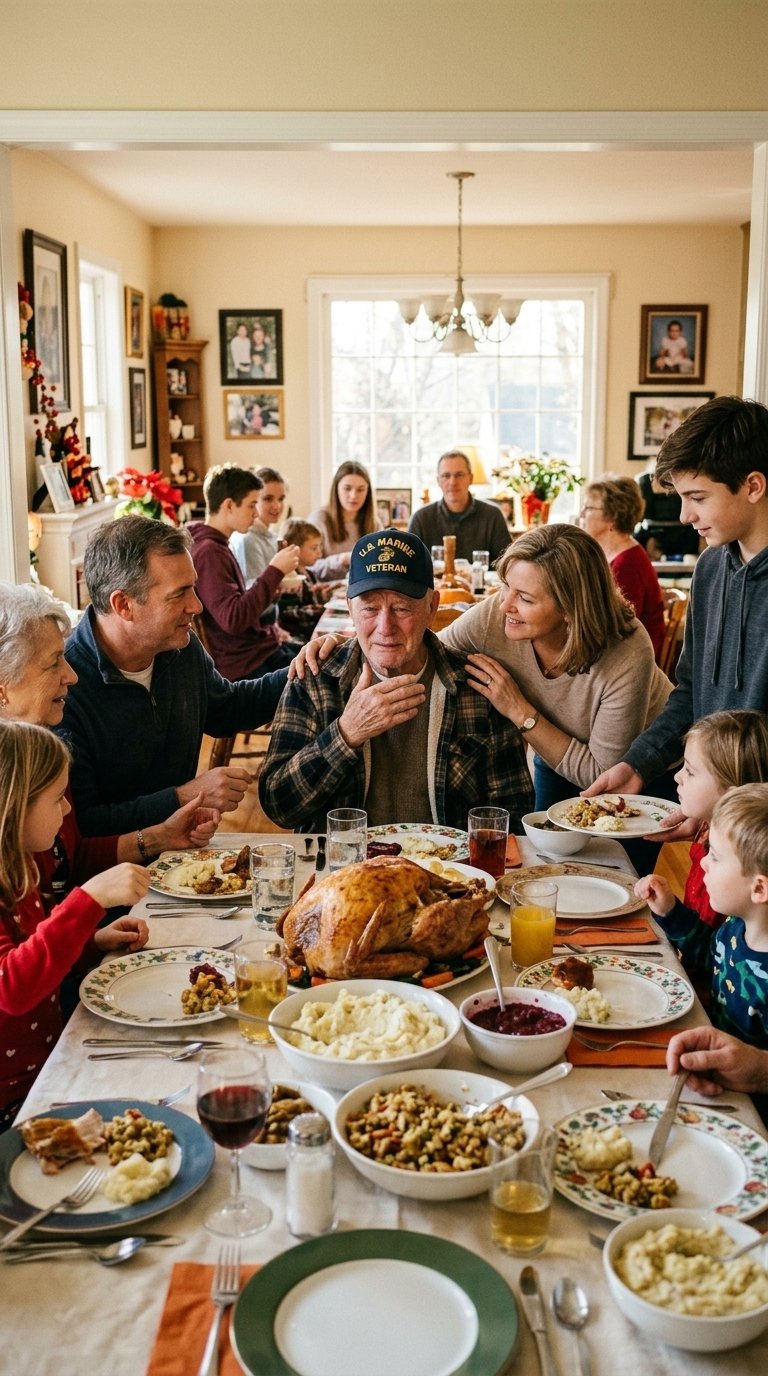
William went home that night a different man than the one who had set two plates that morning. And what happened in the weeks that followed — including the phone call that finally came — completed a story that had been waiting thirty years to be told.
William went home at nine PM.
Rosa had packed food — not discreetly, not as a gesture, but in the direct way she did most things: containers labeled in her handwriting, enough for three days, the sweet potatoes included because she said they deserved to be eaten properly rather than forgotten in a refrigerator.
He carried the containers to his door.
He set them on the kitchen counter.
He sat at the dining room table — the two plates still there, the food long cold, the phone silent — and he sat with what the evening had been for a long time before he cleared the table.
He washed the dishes.
He put the second plate away.
Not permanently — he was not ready for that, and he was honest enough with himself to know it. But away. In the cabinet. In its place.
He went to bed.
He slept better than he had in months.
What followed across the next three weeks was the specific compound effect of Rosa Mendez deciding that Thanksgiving had not been a one-time gesture but the beginning of an arrangement.
She did not announce this. She did not present it as a project or a charity or any framing that would have caused William to decline it because William Carter was a man who did not accept charity from people he had not yet decided to accept it from.
She simply continued.
The following Tuesday she knocked on his door with a container of soup because she had made too much. The Tuesday after that she asked if he knew anything about the tomato plants in her side yard that were not producing the way they should. He spent forty-five minutes diagnosing the drainage issue and told her she needed to amend the soil and came back the next day with the right amendment and fixed it himself because he was there and it needed fixing.
Carlos began stopping by on Saturday mornings with coffee. Not formally — he would knock, say he was walking to the coffee shop, ask if William wanted anything, and return with two cups and sit on the porch for twenty minutes talking about football and the neighborhood and the specific concerns of men who have been paying attention to the world for a long time.
Miguel had decided, with the complete confidence of a seven-year-old who has made a decision, that William was his person. He appeared at the door on weekend afternoons asking if William wanted to see something and William always said yes because the things Miguel wanted to show him were consistently more interesting than whatever William had been doing.
Elena came for Sunday dinner the first week of December and she and William sat at the same end of the table and communicated in the way they had at Thanksgiving and Julia translated the parts that required it and left the rest to them.
William was, he told his tomato plants while amending the Mendez side yard soil, not alone anymore.
He said it quietly, to the tomatoes, and then felt slightly foolish and then decided that the tomatoes deserved to know since they were the reason he was in the yard to begin with.
Michael called on December eighteenth.
Not a scheduled call — an unscheduled one, which immediately told William something was different about it. Michael’s calls arrived on Sundays at two PM with the regularity of an obligation being honored. This one arrived on a Wednesday evening at seven-thirty.
“Dad,” Michael said.
“Michael,” William said.
A pause. The particular pause of someone organizing something they have been carrying for a while and have decided to put down.
“I called to tell you something,” Michael said. “And I want to say it before Christmas because I’ve been— I’ve been meaning to say it for longer than Christmas.”
“All right,” William said.
“I know what I’ve done with Thanksgiving,” Michael said. “I know about the phone. I know you wait. I’ve known for a long time and I’ve told myself it was fine because you never said it wasn’t and I used your silence as permission to keep doing it.”
William sat very still.
“How do you know?” he said.
“Your neighbor,” Michael said. “Rosa. She found my number — I don’t know how, she said a neighbor helped her — and she called me two weeks ago. She didn’t tell me what to do. She just told me about Thanksgiving. About the plates. About the phone.”
William thought about Rosa.
He thought about the soup that had been too much to eat alone and the tomato plants and the Saturday morning coffee and the way she had knocked on his door at noon on Thanksgiving and said come as though it were the most natural thing in the world.
He thought about a woman who had found his son’s phone number and made a call she had not told him about.
“She didn’t tell me she called you,” William said.
“I asked her not to,” Michael said. “I wanted to be the one to tell you.”
William was quiet.
“Dad,” Michael said. “I’m coming for Christmas. Me and Sandra and the kids. All of us. If you’ll have us.”
Three grandchildren William had met four times. A daughter-in-law he had known for twenty years through photographs and brief visits and the voice on the phone when Michael handed her over for birthdays.
“If I’ll have you,” William said.
“I know I don’t have the right to assume—”
“Michael,” William said.
“Yes?”
“I’ve been setting two plates at Thanksgiving for nine years,” William said. “What do you think the answer is?”
A silence.
Then Michael said something William had not heard since Michael was a boy — not the managed adult voice, not the efficient quarterly call voice, but the voice underneath that one, the one that existed before distance and schedules and the accumulation of years had built the layers over it.
He said: “I’m sorry, Dad.”
William put his hand over his eyes.
“I know,” he said. “Come for Christmas.”
Michael arrived on December twenty-third with Sandra and the three grandchildren — ages sixteen, thirteen, and nine.
The nine-year-old was named James. He had William’s jaw and Michael’s eyes and the specific energy of a child who has been in a car for a long time and is ready to be somewhere.
He ran up the porch steps and stopped in front of William and looked at him with the frank assessment of a child who has heard about someone and is now calibrating the reality against the description.
“You’re my grandpa,” he said.
“Yes,” William said.
“Dad said you were a Marine,” James said.
“Twenty-two years,” William said.
“Cool,” James said. And went inside.
William stood on the porch with Michael.
They did not say much. There was too much to say for the porch on December twenty-third and both of them understood that the saying would happen across several days and would be imperfect and would be the beginning of something that needed to be built carefully rather than completed quickly.
Michael put his arms around his father.
William held his son.
On the porch in the December cold, in the specific silence of two people who have waited too long for something and have finally arrived at it.
Rosa came for Christmas dinner.
William had asked. He had knocked on her door on December twentieth and said: “My family is coming. I would like you to be there. And Carlos. And Miguel. And your mother if she’ll come.”
Rosa had looked at him.
“You don’t need to—” she started.
“You called my son,” he said.
She was quiet.
“You found his number and you called him and you told him about the plates,” he said. “And you didn’t tell me because you knew I wouldn’t have let you do it if I’d known.”
“Yes,” she said.
“So,” he said. “Christmas dinner. All of you.”
She came.
Elena sat at the table between William and James, who had decided she was interesting, and Julia translated and everyone ate and the table was full in the specific way of a table that has been claimed by the people sitting at it.
Miguel and James disappeared into the backyard after dinner and could be heard from the kitchen conducting what appeared to be an elaborate game involving William’s tomato plant stakes as props.
William sat on the porch afterward with Carlos, drinking the good whiskey Carlos had brought, watching the December evening come in over the neighborhood.
“Your son seems like a good man,” Carlos said.
“He is,” William said. “He lost his way for a while.”
“We do that,” Carlos said.
“Yes,” William said.
They drank their whiskey.
“Rosa called him,” William said.
“I know,” Carlos said.
“Did you know she was going to?
“No,” Carlos said. “But I knew she would. Eventually. She can’t see something that needs doing and not do it.”
William thought about noon on Thanksgiving. Come. The sweet potatoes. The full table. The small hand on his arm.
“She gave me my son back,” William said.
Carlos looked at him.
“She reminded him you were here,” Carlos said. “He gave himself back.”
William thought about this.
“Both,” he said.
“Both,” Carlos agreed.
William set the table for Christmas the following year.
He did not count the plates before he set them.
He set enough.
There were eleven people at the table — Michael’s family, the Mendez family, Elena who had declared William’s sweet potatoes superior to everything she had eaten in eighty-seven years of Thanksgivings, and a young man from William’s VFW chapter who had nowhere to go and whom William had invited with the specific directness of a man who had learned what an empty seat cost and was not going to let one exist if he could prevent it.
The phone did not ring during dinner.
Because the people who would have called were already there.
The flag on the porch went up in the morning and came in at dusk.
Some things stay the same.
The table doesn’t have to.
— As told by the Marine who set two plates for nine years and, on a Thanksgiving when the phone didn’t ring, found out that the family he needed had been next door the whole time.