At 2:43 a.m., in a dim hotel room near Sea‑Tac Airport, Deputy U.S. Marshal Sarah Mitchell stared at her phone in disbelief. She had just finished escorting a protected witness across Washington state and was preparing to fly back to D.C. at dawn. Exhaustion pressed behind her eyes like broken glass. Rain tapped against the window. The room was silent.
Then her mother texted her as if delivering good news.
We sold your empty house and split the money.
For a moment, Sarah thought she had misread it. Not because the words were unclear, but because some messages are so absurd the mind refuses to accept them. She sat upright, heart pounding, staring at the glowing screen.
Before she could respond, another message arrived.
You’re never even there anyway. The money will help your sister with the wedding.
Sarah’s body reacted before her thoughts did. She nearly knocked over the lamp as she scrambled upright. Her house—the colonial in Alexandria with blue‑gray shutters, the one she bought because it sat fifteen minutes from the courthouse and twenty minutes from headquarters—was not empty. It was an active witness‑protection site. Angela Moretti and her two children were living there under federal protection connected to the Castellano case.
She typed back immediately: What do you mean you sold my house?
Her mother replied instantly, fully awake and disturbingly casual.
Don’t be dramatic. We had your old power of attorney from Afghanistan. We used it. $850,000 cash. Your father and I split it with Rachel for the wedding. You can thank us at the reunion next week.
The word dramatic hit harder than the theft itself. It clarified everything. Her family had no idea what they had done—and no interest in understanding it.
At 2:47 a.m., Sarah called Deputy Chief Crawford. He answered groggily, but the moment she explained, he snapped awake.
“Your house?” “The house the service has been using for Moretti.” “The Castellano witness house?” “Yes, sir.”
Silence. Then a curse.
The Castellano organization was one of the most dangerous criminal networks in the country. Angela Moretti had entered witness protection after watching her husband murdered in a Newark parking lot. She had handled financial records for multiple shell companies and possessed the kind of information that could finally lock the Castellanos into a RICO conviction. The organization had already attempted to locate her through schools, fake utility workers, and shell‑company intermediaries.
If the buyer of Sarah’s house knew what they were purchasing, her family had not sold an empty home—they had sold access to a federal witness.
Crawford’s voice hardened. “This wasn’t a sale. It was a handoff.”
He ordered emergency relocation immediately. Sarah was to board the first flight back to D.C. and report straight to headquarters. No contact with her family. Preserve every message.
By dawn, she was on a plane, sleepless, her phone buzzing nonstop with texts from her mother and sister accusing her of “ruining the wedding” and “making a big deal out of nothing.”
When she landed, she walked straight into a secure conference room where Crawford, Chief Counsel Patricia Williams, Supervisory Inspector Collier, and two tactical deputies were waiting. A digital map of northern Virginia glowed on the wall, her house marked in red.
Sarah explained everything: the old power of attorney from Afghanistan, the texts, the suspiciously low sale price, the family reunion. Patricia typed steadily, then looked up.
“So your parents used an outdated power of attorney to sell a house they did not own, without your consent, while it was being used as a covert witness location?”
“Yes, ma’am.”
Collier added, “That house appraised at 2.8 million six months ago.”
Meaning the $850,000 cash sale was not a bargain—it was a signal.
Patricia traced the buyer: Riverside Holdings LLC. A Delaware shell corporation with no disclosed owner, no financing records, and a fast close.
Crawford didn’t mince words. “Mitchell, your family may have just compromised an active witness location connected to the Castellano organization.”
The danger was immediate. Angela and her children had to be moved.
By late morning, the convoy rolled toward Sarah’s house. She had driven that route countless times—sometimes after long shifts, sometimes carrying takeout for the Moretti kids, sometimes checking windows and locks at midnight. She had insisted the house feel normal for them, even temporarily.
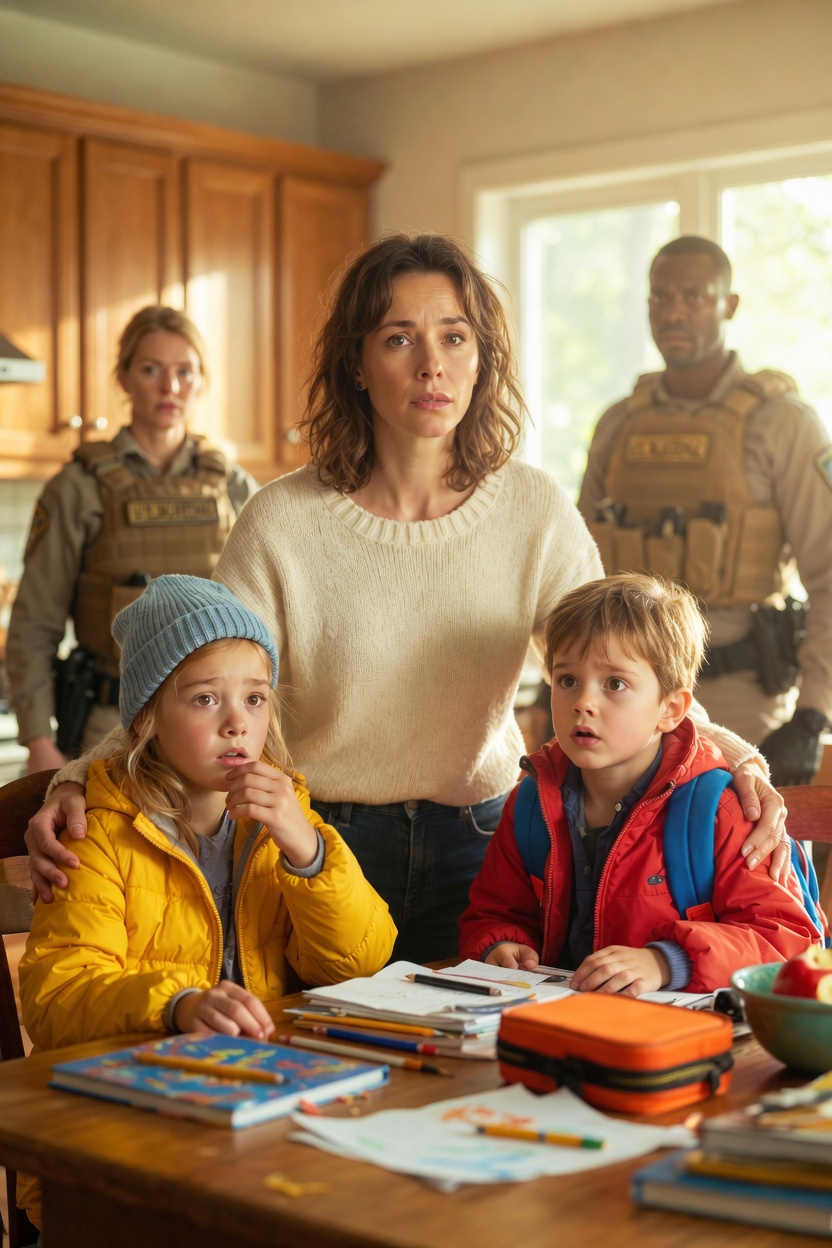
Inside, the Morettis were living a fragile version of safety. Angela sat at the kitchen table helping Luca with subtraction. Sofia colored quietly beside her. When she saw the marshals enter, her face drained of color.
“Did they find us?” she whispered.
“No,” Crawford said. “But we’re relocating you as a precaution.”
Angela’s voice trembled. “You told me we were safe here.”
Sarah stepped forward. “I know. And I’m sorry. But I’m not risking your children’s lives.”
Within minutes, Rodriguez and Chin were packing essentials. Sofia walked to Sarah clutching her drawings.
“Are we in trouble?” she asked.
“No,” Sarah said softly. “We’re just changing houses.”
By noon, the Morettis were en route to a secondary facility so secure even Sarah didn’t know the location until the last moment.
One selfish decision had shattered an entire federal operation.
And her family still had no idea what they had done.
As the convoy turned north toward Pennsylvania—toward the family reunion where her parents and sister were still laughing, celebrating, and spending stolen money—Sarah realized the truth:
They thought they had sold a house.
They had actually triggered a federal investigation.
And U.S. Marshals were about to walk across her uncle’s farm carrying warrants.