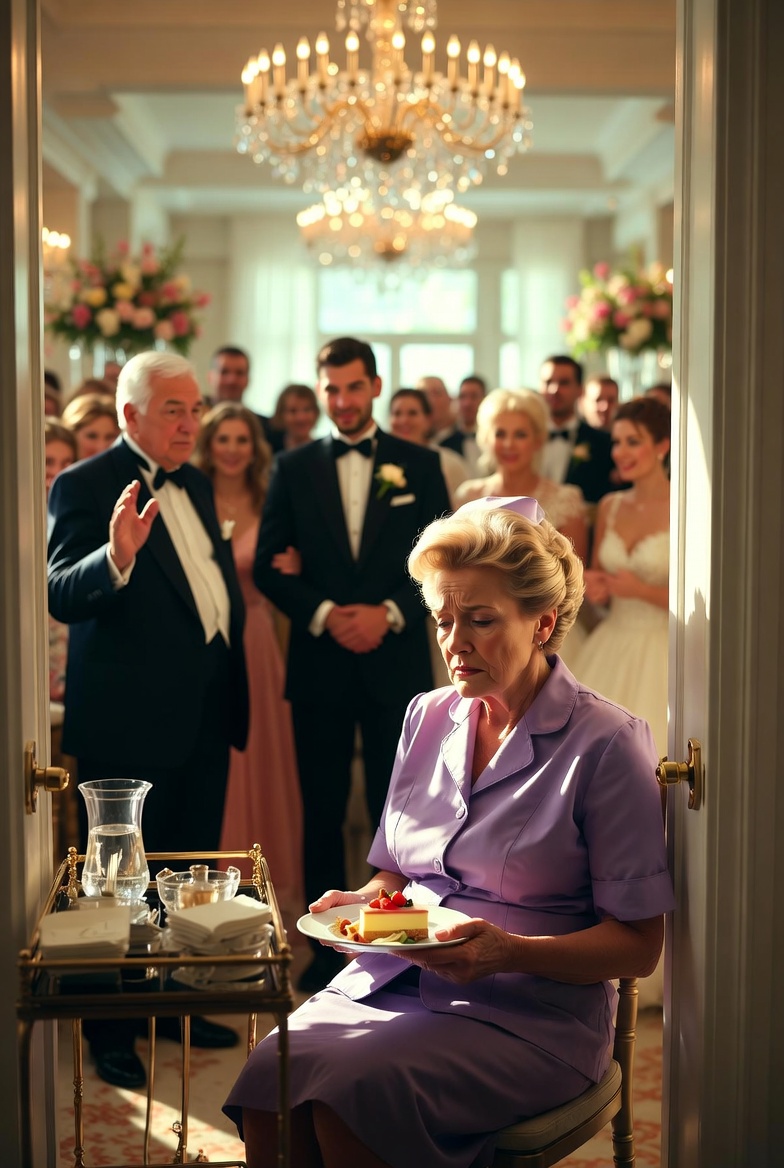
The first sign that something was wrong came the moment my daughter Emma walked toward me across the hotel lobby. The place looked like a magazine spread—marble floors glowing under chandeliers, florists pushing carts of towering white roses, planners whispering into headsets. It should have felt like joy. Instead, Emma wore the tight, careful smile women use when they’re trying to hold a day together with their bare hands.
“Mom,” she said softly, twisting her fingers, “they made a few seating changes.”
That was how the humiliation began—not with shouting, not with insults, but with a single sentence wrapped in politeness. She explained my table had been moved to the back of the ballroom, near the kitchen doors. She said it quickly, as if speed could soften the blow.
Before I could respond, Patricia Whitmore—mother of the groom, queen of the afternoon—approached in heels sharp enough to announce her before she spoke.
“Emma, sweetheart, your hair appointment started ten minutes ago,” she said, then turned to me with a smile that never touched her eyes. “Oh. You’re here.”
I told her the ballroom looked beautiful, because it did. Crystal chandeliers. Ivory roses. Gold accents. A room designed to impress people already accustomed to being impressed.
Emma looked at me again, guilt flickering across her face.
“I’m sorry, Mom.”
“Go on,” I told her. “It’s your day.”
The moment she disappeared, Patricia’s warmth vanished.
“Let’s be honest,” she said quietly. “This wedding has a certain standard. It’s better if you support Emma from the back. The photographer already has a layout planned, and we don’t want anything looking… off.”
Off. The word hung between us like a bruise.
Then she added, “We’ve arranged for the staff meals to be served at your table too. It seemed practical.”
Practical. Some words cut deeper than open insults.
I stood there thinking about everything it took to raise Emma alone—double shifts, cafeteria coffee, studying anatomy terms with her at our tiny kitchen table. I never needed applause. But I never imagined being tucked beside the kitchen doors at my own daughter’s wedding like an inconvenience.
Still, I didn’t argue.
Inside the ballroom, every guest table glowed with candles and flowers. Mine sat half‑hidden behind a pillar beside the swinging kitchen doors. Every few seconds, servers burst through carrying trays, heat and noise spilling into the room.
That was when a young hotel employee approached. Her nametag read Jenny Alvarez.
“Mrs. Mitchell?” she asked softly. When I nodded, she lowered her voice. “My brother knows you.”
I looked at her more closely.
“He was at Cook County after the freeway pileup last winter,” she said. “You stayed long after your shift ended. My mom still says you’re the reason he survived.”
I remembered the night instantly—blood, chaos, too many patients, too few hands. Jenny glanced toward Patricia, who was arranging centerpieces like she was curating a museum exhibit.
“We all see what’s happening,” Jenny whispered. “And none of us think it’s right.”
Her certainty shifted something inside me. Not dramatically—just enough to remind me that dignity doesn’t disappear simply because wealthy people pretend it should.
I thanked her. Then I reached into my purse.
There was a number saved in my phone I had never used. Not because I couldn’t—because I never wanted to. I believed good work should speak quietly for itself.
But sometimes silence becomes permission.
So I made the call.
“Marcus,” I said when he answered. “It’s Sarah Mitchell.”
A pause, then warmth. “Sarah. What do you need?”
I looked across the ballroom—Patricia greeting guests with polished elegance, her husband laughing too loudly near the bar, bridesmaids drifting like satin weather systems.
“I think it’s finally time I ask for that favor.”
The next two hours passed strangely—slow and immediate at once. The ballroom filled with champagne, curated laughter, and the kind of smiles that never reached anyone’s eyes. More than one guest glanced toward my table before looking away too quickly.
I stayed where they placed me. I watched. I waited.
Then I noticed something small.
Jenny returned—but not alone. Two bartenders exchanged a look. A waiter quietly removed his apron. A coordinator closed her tablet and stood still too long. The air shifted, carrying the pressure that arrives right before a storm.
Patricia noticed none of it. She was too busy performing certainty.
I glanced toward the entrance just as the first hotel employee reached for her name badge.
The second untied her apron.
And finally—finally—Patricia turned around.
Because the hotel owner, Marcus Hale, had just walked into the ballroom.
He wasn’t smiling.
He wasn’t impressed.
And he wasn’t there for her.
He walked straight toward my lonely table by the kitchen doors, shook my hand, and said loudly enough for the nearest guests to hear:
“Sarah, I’m so sorry. This is not how we treat the people who save lives in this building.”
Every eye in the room turned.
Patricia’s face drained of color.
Marcus continued, his voice carrying across the ballroom:
“My staff tells me you were placed here. That ends now.”
Servers stepped forward—not to serve Patricia’s guests, but to escort her away from the center of the room. The employees she had treated like furniture stood tall beside me.
And for the first time all day, the people who belonged in the shadows were finally the ones standing in the light.