The afternoon sun spilled across the brick patio of my home in suburban Charlotte, North Carolina, painting everything in gold. I was trimming the rose bushes that lined the fence, the scent of damp earth clinging to my gloves. It was supposed to be an ordinary day — quiet, steady, predictable.
Then I heard my son’s truck pull into the driveway.
I knew that sound instantly. Daniel Harper had always driven too fast, as if speed could prove confidence. But this time, the engine cut sharply, followed by two car doors slamming in quick succession. The kind of sound that announces trouble before anyone speaks.
I stepped out still holding the pruning shears.
Daniel stood near the front walk, wearing a wrinkled gray shirt and the exhausted expression of someone who hadn’t slept properly in days. Beside him stood his wife, Vanessa — perfect makeup, designer handbag, oversized sunglasses, and two expensive suitcases. She didn’t look like a woman arriving for help. She looked like someone annoyed that her hotel suite wasn’t ready yet.
“Mom,” Daniel said quietly, “we need to talk.”
Vanessa didn’t greet me. She walked straight into my house.
Her eyes moved slowly across my living room — the leather recliner, the antique wall clock my late husband had treasured, the framed paintings, the cabinet holding the holiday china I only brought out every Christmas. I had seen that look before. Vanessa always measured things that weren’t hers.
I set down the gardening tools and waited.
Daniel sat in his father’s old chair — the same one where Richard used to watch football every Sunday before cancer took him away. Something inside me tightened unexpectedly. My son looked defeated sitting there, almost like the little boy who used to hide behind me after breaking something.
Vanessa remained standing, phone in hand.
“We sold the house in Providence Hills,” Daniel finally said.
My fingers loosened around the coffee mug I had just lifted.
“The house I helped you buy?”
“Our house,” Vanessa corrected immediately. “We didn’t need anyone’s permission.”
I stayed silent. Because that house had never been just a house to me.
When Daniel and Vanessa got married, I withdrew nearly $45,000 from my retirement savings to help them with the down payment. I painted walls inside that place. I carried moving boxes until my back hurt. I planted flowers near the porch while Daniel promised they would raise children there.
A mother stores promises like sacred things — sometimes longer than she should.
“How much did you sell it for?” I asked.
“Seven hundred and fifty thousand dollars,” Vanessa replied. She almost smiled saying it.
For one hopeful second, I assumed they had a plan. Maybe they were downsizing. Maybe investing. Maybe starting over somewhere smaller.
Hope, I’ve learned, is often another word for denial.
“So where are you living now?”
The silence answered before either of them did.
The ceiling fan turned slowly overhead.
Daniel looked down. “We were hoping to stay here,” he finally admitted. “Just a few months while we figure things out.”
“And the money?”
Vanessa sighed dramatically, as if the question itself offended her.
“There were expenses.”
“What expenses?”
She counted them casually on manicured fingers. “Credit cards. Shopping. A vacation to Maui with my sister. I bought my mom a new SUV. And I invested in a boutique project with a friend.”
“How much?”
“Three hundred and sixty thousand.”
I stared at her. “You invested almost half the money into a business you don’t own?”
“It’s going to succeed,” she answered coldly. “Not everyone thinks small, Margaret.”
There it was — that tone. The one that mistakes recklessness for ambition.
I turned toward my son. “Daniel… tell me this isn’t true.”
He rubbed both hands over his face. “It’s done now, Mom. We just need somewhere to stay.”
Not I’m sorry. Not I tried to stop it. Not I protected some of it.
Just — It’s done.
As though destruction could be buried beneath a sentence.
My husband’s clock read 10:17 AM. On the coffee table sat my property records and tax papers I had planned to organize that morning. This house had been earned. Paid for. Protected. Built through decades of overtime shifts, sleepless nights, and sacrifices nobody saw.
It was not a shelter for irresponsibility. Not even my son’s.
“No,” I said.
Daniel lifted his head. “…No?”
“No,” I repeated. “You made choices. You live with them.”
Vanessa’s lips tightened. “You’d let your own son sleep in his truck?”
“I’d let him learn,” I said quietly.
Her voice rose. “You think you’re better than us because you have this house?”
I didn’t answer.
Because the truth was — I had built this house brick by brick, memory by memory, after losing my husband. It was the only thing that had never betrayed me.
Vanessa stepped closer. “You’re selfish.”
Daniel whispered, “Vanessa, stop.”
But she didn’t.
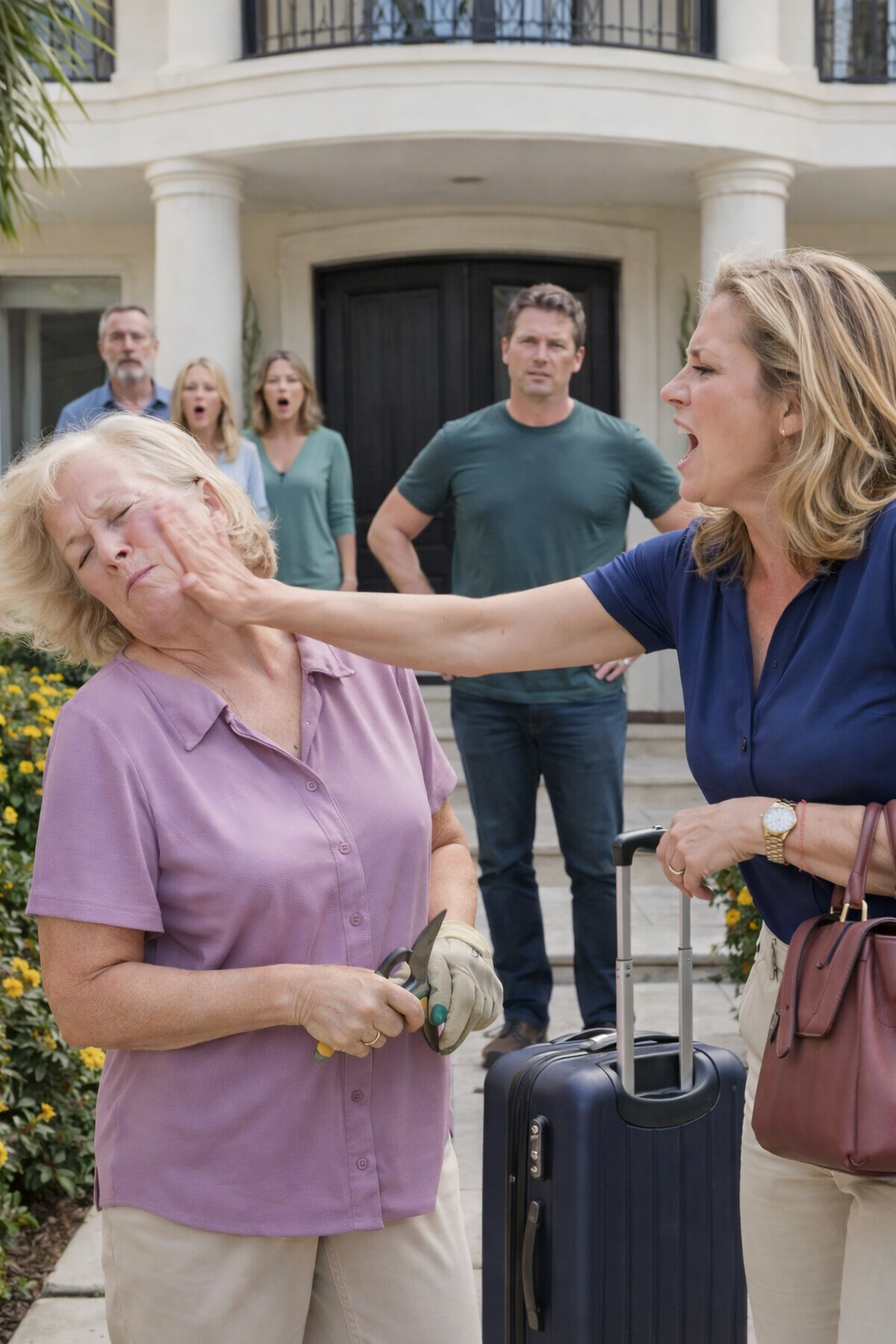
She slapped me.
The sound cracked through the air like a gunshot.
Neighbors turned. Curtains shifted. Somewhere, a dog barked.
I didn’t cry. I didn’t shout. I just stood there, the sting burning across my cheek, the pruning shears still in my hand.
Vanessa’s voice trembled with rage. “You think you can judge us? You think you’re perfect?”
Daniel pulled her back, his face pale. “Enough!”
But it was already too late.
The slap wasn’t just a moment of anger — it was the final punctuation to years of entitlement, manipulation, and silence.
I looked at my son. “You can stay in a motel. I’ll pay for one week. After that, you’re on your own.”
He looked broken. “Mom…”
“I love you,” I said. “But love doesn’t mean surrender.”
Vanessa scoffed. “You’ll regret this.”
I smiled faintly. “I already regret helping you buy that house.”
They left that afternoon. The truck roared down the street, suitcases rattling in the back. The roses swayed in the wind, petals falling like quiet applause.