The heart monitor screamed in frantic, uneven bursts, each alarm slicing through the hospital room like a blade. My cheek throbbed where Diane’s hand had struck me, the sting radiating down my jaw and into my neck. I tasted blood. My vision blurred. My chest tightened, and for a moment, I wondered if this was it—if the trauma of the last twenty‑four hours would finally break me completely.
But then I saw him.
My father.
He had been standing quietly near the door, half‑hidden by the curtain, watching everything. He had arrived early, before visiting hours, slipping in with the nurses who recognized him from the night before. He had stayed silent, giving me space, giving Ryan a chance to be a husband, giving Diane a chance to be human.
But now he had seen enough.
My father was not a loud man. He was not wealthy, not powerful, not influential. He was a retired mechanic with calloused hands and a soft voice. But he had a spine forged from decades of hard work and a heart that had never once failed me.
He stepped forward slowly, deliberately, like a man who had already made peace with whatever consequences would follow.
“Touch my daughter again,” he said, his voice low and steady, “and see what happens.”
The room froze.
Diane’s smirk faltered. Her eyes darted to Ryan, expecting him to intervene, to defend her, to restore her imagined hierarchy. But Ryan didn’t move. He didn’t even turn from the window. He just stood there, hands in his pockets, staring at his own reflection like a man too afraid to face the wreckage he had allowed.
My father walked closer to the bed, placing himself between me and Diane. He didn’t raise his voice. He didn’t raise his hands. He didn’t need to.
“Get away from her,” he said.
Diane scoffed, trying to recover her confidence. “You don’t get to speak to me like that. I am—”
“You are a woman who just assaulted my daughter while she’s hooked up to machines keeping her alive,” my father cut in. “That’s what you are.”
Her mouth opened, but no sound came out.
My mother, who had been standing behind my father, stepped forward too. She was trembling, but her eyes were fierce. “We lost a grandchild yesterday,” she whispered. “And instead of compassion, you brought cruelty into this room.”
Diane rolled her eyes. “Oh, please. She’s exaggerating. Women lose pregnancies all the time. It’s not a tragedy—it’s biology.”
My father’s jaw tightened. “You don’t get to decide what is or isn’t a tragedy for my daughter.”
The heart monitor beeped erratically again, and a nurse rushed in, startled by the tension in the room. She took one look at my face—swollen, red, marked by Diane’s hand—and her expression hardened.
“What happened?” the nurse demanded.
Before Diane could speak, my father answered. “She hit her.”
The nurse’s eyes widened. “You struck a patient? A post‑operative patient?”
Diane sputtered. “It was barely—she was being dramatic—”
The nurse stepped toward the hallway. “I’m calling security.”
That was when Ryan finally turned around.
“Wait,” he said weakly. “Let’s not escalate—”
My father rounded on him. “You stood there and watched your mother hit your wife. You don’t get to talk about escalation.”
Ryan’s face drained of color. “Dad—sir—I didn’t know what to do.”
“You do now,” my father said. “You protect your family. Or you lose them.”
The nurse returned with two security officers. Diane’s face twisted in outrage.
“You can’t remove me!” she shrieked. “My son is the husband! This is his room!”
One of the officers stepped forward. “Ma’am, you need to leave immediately. You are not permitted to assault patients.”
“I didn’t assault anyone!” she snapped. “She’s lying! They’re all lying!”
But the officers didn’t argue. They simply took her by the arms—not roughly, but firmly—and guided her toward the door.
As she was dragged out, she screamed at Ryan, “Are you really going to let them do this to me? I am your mother!”
Ryan didn’t answer.
He didn’t move.
He didn’t even look at her.
When the door finally shut behind her, the room fell into a heavy, suffocating silence.
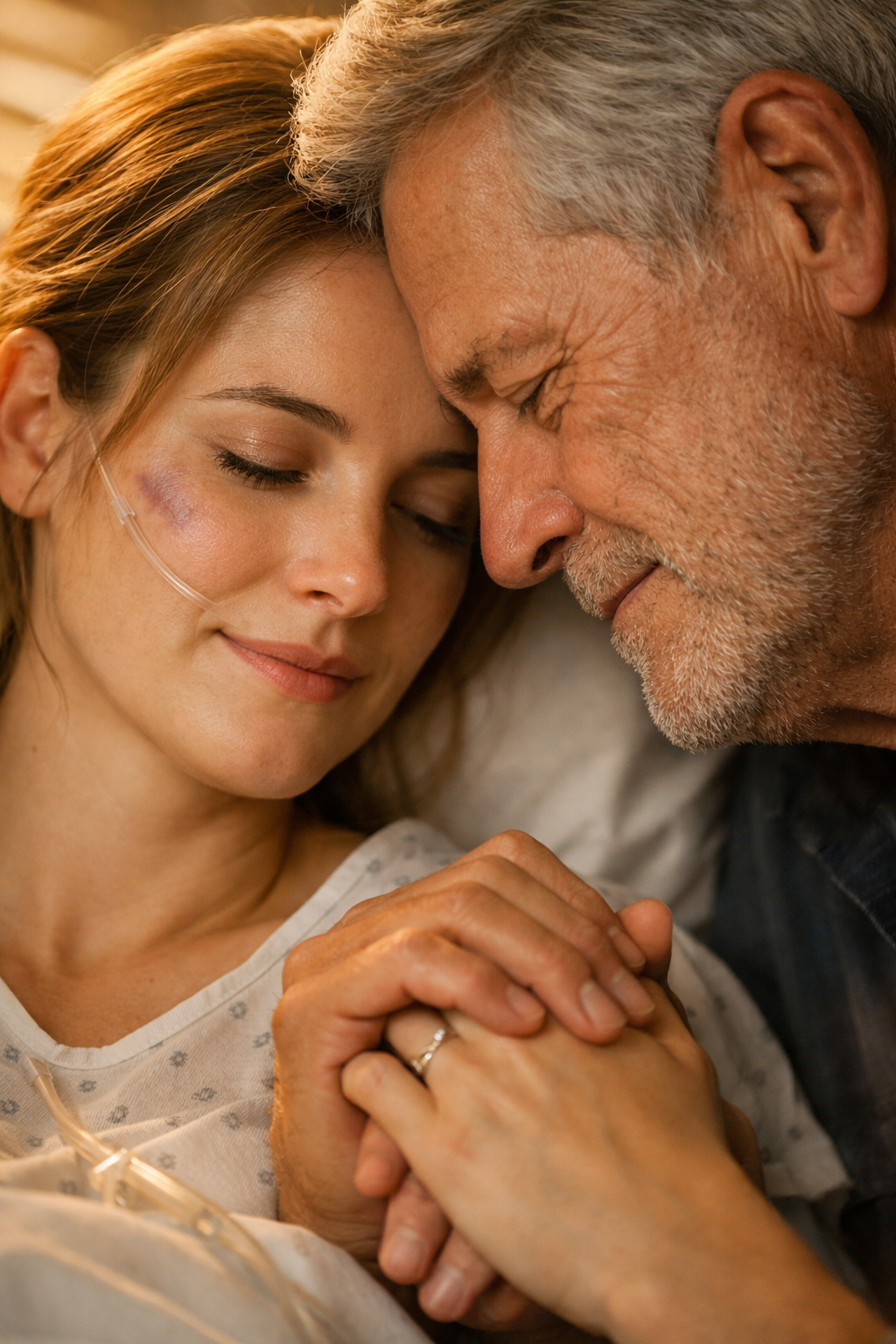
My father turned back to me, his expression softening. He brushed a strand of hair from my forehead, careful not to disturb the IV lines.
“You’re safe now,” he said quietly.
And for the first time since the surgery, I believed him.
When the nurse left and the machines settled into a calmer rhythm, Ryan finally approached the bed. He looked small. Smaller than I had ever seen him.
“I’m sorry,” he whispered.
My father stepped aside but didn’t leave. He stood close enough that Ryan knew he was being watched.
“I didn’t know what to do,” Ryan continued. “She’s always been like that. Controlling. Loud. Overbearing. I didn’t want to make things worse.”
I stared at him, my cheek still burning.
“You didn’t want to make things worse for who?” I asked.
He swallowed hard. “For anyone.”
“No,” my father said. “You mean you didn’t want to make things worse for your mother.”
Ryan didn’t deny it.
I felt something inside me shift—something subtle but irreversible. The kind of shift that happens when you finally see a person clearly, without excuses or illusions.
“I almost died yesterday,” I said softly. “And you let her treat me like an inconvenience.”
Ryan’s eyes filled with tears. “I know. I’m sorry. I’ll fix it. I’ll talk to her. I’ll set boundaries. I’ll—”
“No,” I said. “You won’t.”
He blinked. “What do you mean?”
“I mean I’m done.”
The words came out calm, steady, and shockingly easy.
My father placed a hand on my shoulder—not to influence me, but to support me.
Ryan shook his head. “You don’t mean that. You’re emotional. You’re in pain. We can work through this.”
“You watched your mother hit me,” I said. “And you did nothing. That’s not something we work through. That’s who you are.”
He opened his mouth, but no words came.
“I need peace,” I said. “I need safety. I need people who choose me. You didn’t.”
Ryan’s shoulders slumped. He looked at my father, then at the floor, then back at me.
“I’m sorry,” he whispered again.
But apologies don’t rebuild trust.
They don’t erase betrayal.
They don’t resurrect a child.
He left the room quietly, closing the door behind him. And for the first time since the nightmare began, I felt like I could breathe.
Later that afternoon, a doctor came in to check my vitals. He explained everything gently, respectfully, with the kind of compassion Diane had mocked.
The ruptured ectopic pregnancy had caused massive internal bleeding. I had lost nearly half my blood volume. The surgical team had worked for hours to save me. If I had arrived even twenty minutes later, I wouldn’t have survived.
My father listened with his hands clasped tightly behind his back, his jaw clenched. My mother cried silently beside him.
When the doctor left, my father sat in the chair beside my bed.
“You’re going to be okay,” he said. “We’re going to get you through this.”
I nodded, tears slipping down my cheeks.
“I know.”
Because I finally understood something:
Family is not defined by blood, marriage, or last names.
Family is defined by who stands up for you when the world tries to break you.
And my father—quiet, gentle, unassuming—had stood taller than anyone else in that room
That evening, as the sun dipped behind the hospital skyline, the door opened again. I tensed, expecting Ryan or Diane.
But it was a nurse.
She smiled softly. “Your father asked me to bring you something.”
She handed me a small, folded piece of paper.
Inside, in my father’s handwriting, were five simple words:
“You didn’t lose everything.”
I pressed the note to my chest and closed my eyes.
He was right.
I had lost a child.
I had lost a marriage.
But I had not lost myself.
And I had not lost the people who truly loved me.
Sometimes, the worst moments of your life reveal the truth about everyone around you.
And sometimes, they reveal the strength you never knew you had.