The ambulance lights painted the snow crimson and blue as paramedics lifted Chloe’s limp body onto a stretcher. Her pulse was faint, her breathing shallow, her skin ghost‑white beneath the bruises. I followed close behind, my coat soaked through, my hands trembling — not from fear, but from fury.
At the hospital, doctors rushed her into emergency surgery. I stood outside the trauma room, watching through the glass as they worked to save her. Every beep of the monitor was a reminder of what Marcus and Sylvia had done. Every flash of the scalpel was a promise that they would pay.
When the surgeon finally emerged, his face was grave but steady. “She’s stable,” he said. “Multiple fractures, internal bleeding, but she’s strong. She’ll make it.”
I nodded once. “Thank you.”
He hesitated. “Ma’am, the police are waiting to take your statement.”
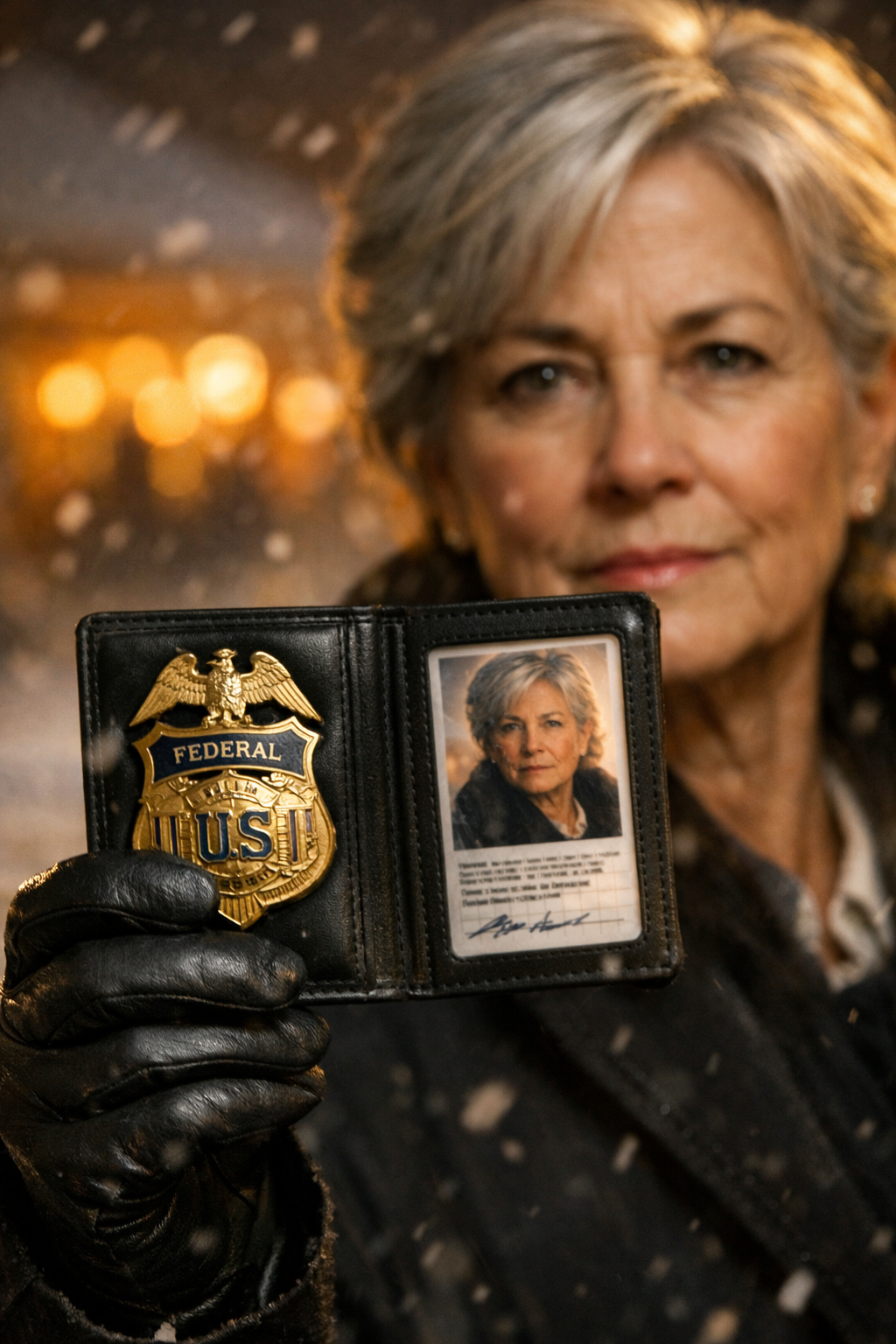
I turned toward the waiting officers — young, polite, professional — and handed them my identification. Their eyes widened when they saw the badge.
“Federal Prosecutor, retired,” one murmured.
“Not retired tonight,” I said.
By noon, Chloe was in intensive care. I sat beside her bed, watching the slow rise and fall of her chest. Her face was bandaged, her lips cracked, her hands bruised. But she was alive.
I opened my old leather briefcase — the one I hadn’t touched in years — and pulled out my badge, my credentials, and a single manila folder labeled “Emergency Authority.”
The officers who had taken my statement returned. “Ma’am, we’ve confirmed the assault. We’ll need to bring Marcus and his mother in for questioning.”
“Not questioning,” I said. “Arrest.”
They exchanged glances. “We’ll need a warrant.”
I slid the folder across the table. “You have one.”
Inside was a pre‑signed federal authorization — a relic from my final year in office, allowing immediate action in cases of domestic violence with probable cause and imminent danger. It was rare, but it was legal.
“Gather your team,” I said. “We’re going in.”
By 4 p.m., the snow had stopped. The city was quiet, blanketed in white. I rode in the lead vehicle, the SWAT van rumbling through the frozen streets. My badge hung around my neck, my expression unreadable.
The officers were tense. “Ma’am, are you sure you want to be present?”
“I’m not here as a spectator,” I said. “I’m here as a mother.”
We turned onto Marcus’s street — a row of immaculate mansions glowing with holiday lights. Through the frosted windows, I could see guests laughing, glasses clinking, silverware gleaming under chandeliers.
They were carving their turkey.
They were celebrating.
They thought they had gotten away with it.
At exactly 5:00 p.m., I gave the signal.
The SWAT team moved like shadows — silent, precise, unstoppable. The front door burst open, splintering under the battering ram. Screams erupted from inside. Crystal shattered. Silverware clattered to the floor.
I stepped through the doorway, my badge catching the light.
“Federal agents!” one officer shouted. “Hands where we can see them!”
Marcus froze mid‑carve, the knife still in his hand. Sylvia stood beside him, her pearls glinting, her face twisted in disbelief.
“What is the meaning of this?” she shrieked. “This is private property!”
I walked forward slowly, my heels clicking against the marble floor. “You called me this morning,” I said. “Remember? You told me to pick up my trash.”
Marcus’s face drained of color. “Eleanor… I—”
“Save it,” I said. “You’re under arrest for aggravated assault, attempted murder, and conspiracy.”
Sylvia’s voice rose to a hysterical pitch. “You can’t do this! We’re respected people! My son works for—”
I held up my badge. “And I worked for the United States Department of Justice.”
The room fell silent.
Marcus tried to speak, but his words stumbled over themselves. “It was an accident—she fell—”
I stepped closer, my voice calm, surgical. “You hit her with a golf club. You left her bleeding in the snow. You called me to clean up your mess.”
He swallowed hard. “You can’t prove—”
I tossed a small flash drive onto the table. “Security footage from your own home. You forgot the cameras in the foyer.”
Sylvia’s face went white.
Marcus lunged for the drive, but an officer pinned him to the wall. “You’re done,” I said. “You’ll spend Thanksgiving in custody.”
As they cuffed him, I turned to Sylvia. “You wanted your mistress at the table? You’ll have plenty of company where you’re going.”
By midnight, the mansion was sealed off as a crime scene. The guests had been escorted out, their designer coats dusted with snow and disbelief. Marcus and Sylvia were booked, processed, and photographed. Their mugshots would circulate by morning.
I returned to the hospital.
Chloe was awake.
Her voice was weak, but her eyes were clear. “Mom… did you…?”
“Yes,” I said softly. “They’re in custody.”
She closed her eyes, tears slipping down her cheeks. “I thought I was going to die.”
I took her hand. “You didn’t. You fought. And now they’ll never hurt you again.”
She smiled faintly. “You wore your badge?”
“I did.”
Her fingers tightened around mine. “You’re still my hero.”
The next day, the news broke. “Thanksgiving Raid: Retired Federal Prosecutor Leads Arrest of Daughter’s Abusers.”
Reporters camped outside the hospital. Commentators debated ethics, procedure, motive. But none of that mattered. The truth was simple.
Marcus and Sylvia had underestimated the wrong woman.
They had mistaken silence for weakness, kindness for fragility, and motherhood for submission. They had forgotten that justice doesn’t retire — it waits.
When Chloe was discharged weeks later, she moved into my home. Her recovery was slow but steady. The bruises faded. The nightmares softened. The strength returned.
On Christmas morning, she handed me a small box. Inside was a silver badge — engraved with the words “For the woman who never stopped fighting.”
I looked at her, tears in my eyes. “You didn’t have to—”
“I did,” she said. “Because you reminded me that justice isn’t just a word. It’s a promise.”
Months later, I stood in court as Marcus and Sylvia faced sentencing. The judge read the verdict: guilty on all counts. The courtroom was silent except for the sound of my daughter’s steady breathing beside me.
When the gavel fell, I felt no triumph — only peace.
Outside, the spring sun was warm on my face. Chloe slipped her arm through mine. “You know,” she said, “I used to think Thanksgiving was about gratitude.”
“It still is,” I replied. “Just not for turkey.”
She smiled. “For justice?”
“For survival,” I said. “And for second chances.”
We walked out together, the courthouse doors closing behind us — two women who had been broken, but never defeated.